Improving international student success: Examining college policies and strategies for recruitment and employment support in Ontario and British Columbia (IREC)

Team Members
Funders
Mitacs Accelerate Grant.
This work is part of the BMO Newcomer Workforce Integration Lab made possible by a gift from BMO.
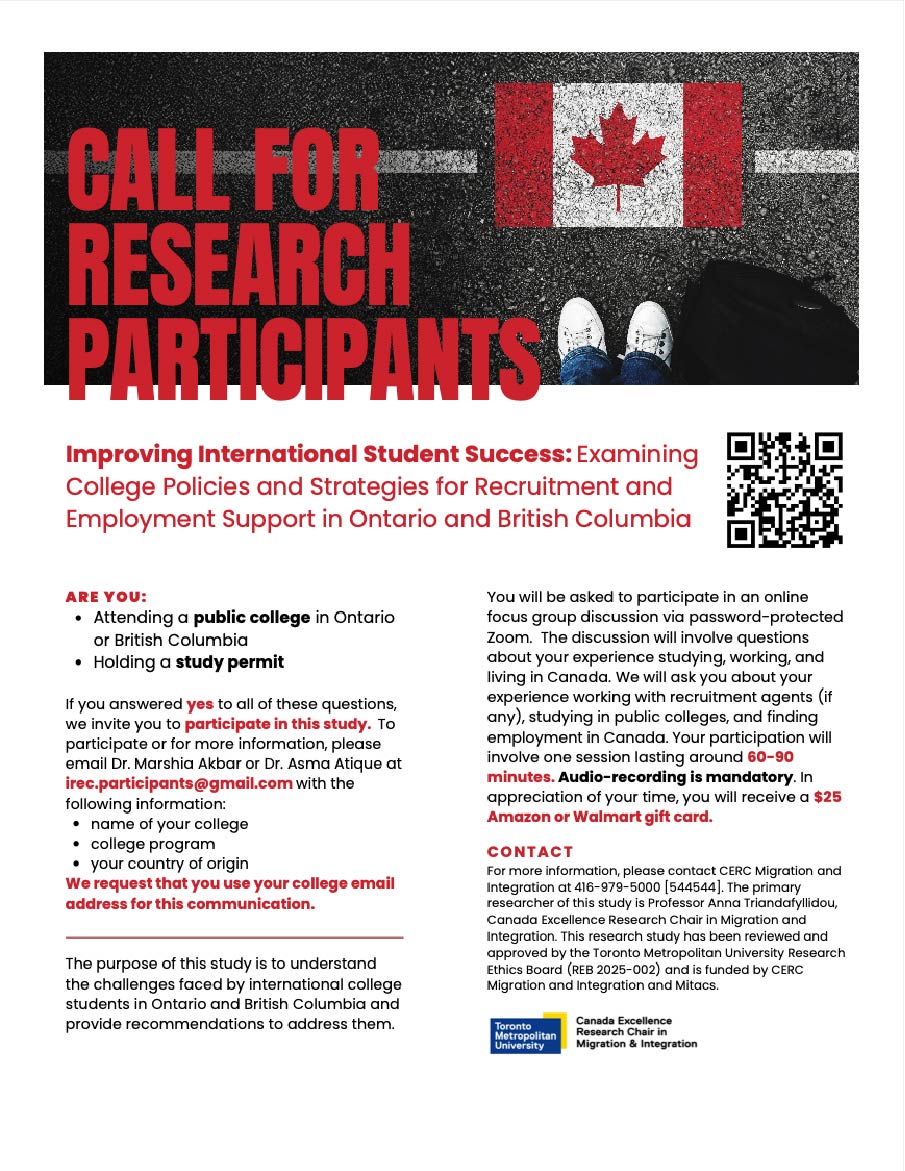
Description
Since the mid-2000s, international student enrollment in Canadian post-secondary institutions has grown significantly, with colleges experiencing a particularly sharp rise. Between 2010/2011 and 2021/2022, international student numbers in colleges increased more than fourfold, from 34,653 to 155,178 (Statistics Canada 2022). Ontario and British Columbia saw notable growth, with Ontario’s colleges surpassing universities in international student enrollment by 2018/2019 and accounting for 53% of the province’s international students by 2021/2022. In British Columbia, colleges hosted 30% of international students in the same year.
Relying heavily on international students' tuition to offset provincial funding cuts, colleges adopted a business model emphasizing immigration pathways to attract students, often using recruitment agents. In Ontario, international students contributed 68% of tuition revenue in 2020/21, totaling $1.7 billion. However, minimal regulation of recruitment agents has led to fraudulent practices, including false admission letters and exaggerated employment prospects. Reports reveal significant commissions paid to recruiters, such as Ontario’s public colleges disbursing over $114 million in 2020-21, raising concerns about misleading marketing and inadequate oversight.
International students often face employment barriers due to mismatched programs, lack of relevant work experience, and temporary status, leading to underemployment and difficulty qualifying for permanent residency. Short-term work permits and limited career support exacerbate these challenges, especially for college graduates compared to university peers. Recent federal policy changes, including study permit caps, higher financial requirements, and restrictions on post-graduate work permits for public-private partnerships, underscore the need for colleges to reform policies and strengthen support systems to improve employment and integration outcomes for international students.
There have been at least 30 policy reforms made between 2023 and 2025 introduced by the IRCC and provincial governments that are framed as measures to protect students from “bad actors.” However, many proposed changes such as the cap on international students have contributed to a sharp decline in the number of international students and may risk exacerbating the challenges faced by international students and public colleges.
Against this backdrop, the study on Ontario and British Columbia colleges will focus on three main themes:
- Impact of unethical practices by recruitment agents,
- A) To understand the impact of unethical recruitment practices and misinformation by agents on international students.
- B) To identify the impact of unethical recruitment practices by agents on the reputation of public colleges in Ontario and British Columbia.
- Ethical recruitment practices strategies adopted by the colleges and
- A) To explore strategies and policies adopted (or planned) by colleges to engage with licensed immigration consultants to protect students from deception and scam.
- B) To provide evidence-based recommendations for colleges to establish ethical recruitment and information dissemination model, fostering collaborations with regulatory bodies that license immigration and citizenship consultants or lawyers.
- Academic programs and employment support services.
- A) Investigate the availability of employment and career development support on college campuses and identify necessary services to enhance students' employment opportunities.
- B) Understand colleges' plans to align course curricula with labour market needs and establish career support systems to facilitate the integration of international students into the workforce.
- C) Offer recommendations on how colleges can collaborate with employers, and non-profit and settlement organizations to provide employment training and opportunities for international students.
The study is a collaborative effort between the Canada Excellence Research Chair (CERC) and the College of Immigration and Citizenship Consultants (CICC) to examine colleges’ strategies for collaborating with licensed immigration consultants, aligning curricula with labor market demands, and improving career support systems to facilitate student workforce integration. This research will provide evidence-based policy directions for Ontario and British Columbia, with insights applicable to other provinces and internationally. It aims to shape employment and integration strategies, addressing key challenges faced by international students.

Methodologies
The study will employ a qualitative case study approach to examine the diverse contexts, factors, processes, regulations, policies, and programs that shape recruitment processes, engagement with education agents, regulated immigration consultants, course quality, and career support services in the college sector of Ontario and British Columbia. By conducting interviews and focus groups, the research seeks to illuminate the lived experiences of college students and graduates while gathering perspectives from multiple stakeholders. This methodology aims to facilitate the generation of comprehensive, comparative and multisectoral approach and evidence-based recommendations.
Project Outcomes
Literature Review completed. Primary data collection underway.
Book Chapters
Akbar, M. (2024). Challenges Facing International College Students in Canada (external link) . In S. Irudaya Rajan (Ed.), India Migration Report 2023: Student Migration (pp. 138-160). Routledge.
Blogs
Atique, A. (2025) International Student Mobility through Racial Capitalism: Are International Student-workers Canada’s “New” Exploitable Cheap Labour? (external link) Research with International Students.
Conference Presentations
Improving international student success: Examining college policies and strategies for recruitment and employment support in ON and BC (IREC), Canadian Bureau for International Education Conference 2025, Quebec City
International Student Mobility through Racial Capitalism: Are International Student-workers Canada’s “New” Exploitable Cheap Labour? August 25, 2025