Bringing accessibility back down to Earth
In space, the rules of human mobility change. In low gravity, for example, walking is no longer a necessity in the same way it is on Earth. Our relationship with our bodies and the environment around us is fundamentally different.
For Dr. Farhan Asrar, this raises an intriguing question: what if the next breakthrough in disability inclusion came not from a hospital or rehabilitation clinic, but from space?
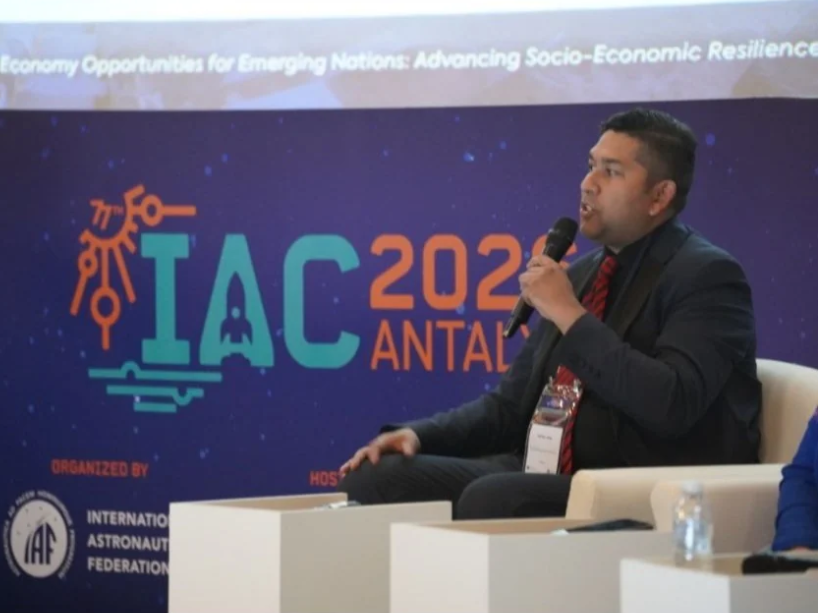
As a space medicine expert and associate dean of clinical faculty affairs at TMU, Dr. Asrar recently spoke at an international UN-affiliated space conference, where he explored how research and innovations developed for the extreme conditions of space could have practical applications on Earth.
A giant leap for accessibility
Addressing delegates from around the world, Dr. Asrar highlighted the many barriers persons with disabilities face in education, employment and health care. These barriers can make everyday activities and full participation in society more difficult, but they are not inevitable.
“Space can serve as a lab for disability research,” said Dr. Asrar. “Its extreme environment reveals and amplifies key challenges in mobility, strength, balance, sensory function, and independence, driving innovations that directly benefit people on Earth.”
Telemedicine is one example of how space technology has influenced health care. Though virtual care became more common during the COVID-19 pandemic, astronauts have been receiving care remotely since the early days of space-travel in the 1960s.
Dr. Asrar discussed innovative solutions utilizing space technology, and encouraged delegates to consider how their space-related research could better meet the needs of persons with disabilities on Earth.
From deep space to everyday care
That same perspective is finding its way into Dr. Asrar’s own work at the TMU School of Medicine. Earlier this year, he began a research project as part of the Summer SRCI Project pilot. Working with TMU medical student Harmil Kalia, he explored whether gloves worn by astronauts during space walks could have practical applications for stroke patients.
Astronaut’s gloves are designed to help crews perform demanding tasks while looking to manage fatigue on space walks. The project explores whether adapted versions of this technology could also support people recovering from a stroke as they work to regain movement and strength.
Introducing space medicine into medical school does more than expose students to new areas within health research, Dr. Asrar argues. It also encourages them to think outside the box when it comes to confronting systemic bias and improving care.
Breaking through barriers
The severe conditions of space can be disabling for anyone, regardless of their abilities on Earth. When familiar ways of moving and interacting no longer apply, assumptions about what people can and cannot do begin to change.
“Space can be an equalizer,” said Dr. Asrar. “On Earth, we’re putting barriers where there shouldn’t be barriers, creating ableism.”
The challenge is not simply to help people adapt to the world as it exists, but to rethink the barriers built into it. For Dr. Asrar, space medicine offers an unexpected starting point for that conversation.