A day in the life of a family medicine resident
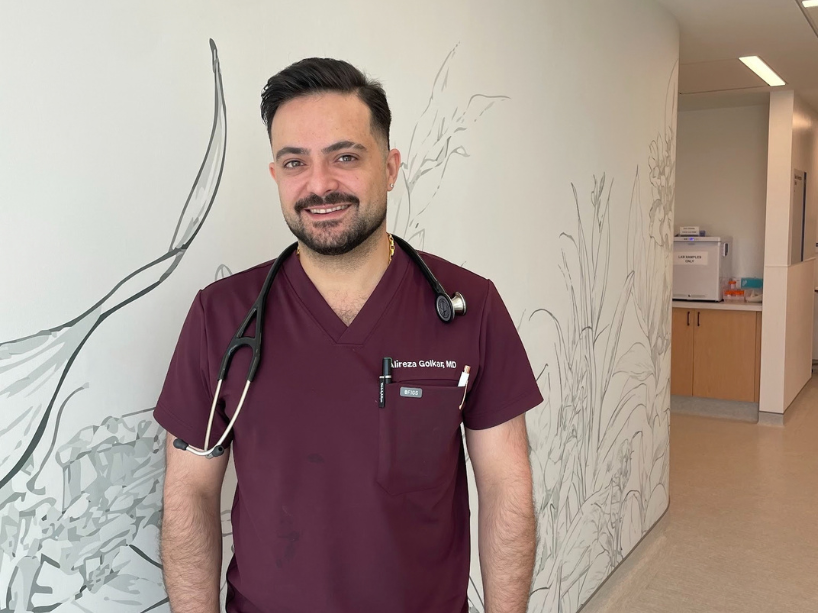
Six years into his medical journey in Canada, TMU family medicine resident Dr. Alireza Aliakbargolkar is finally getting where he wants to be: in a clinic room, sitting across from patients, listening to their concerns and helping to improve their daily lives.
Every Thursday, Dr. Aliakbargolkar spends his clinic day at the TMU Integrated Health Centre (IHC), supported by 407 ETR. The flagship IHC, located within the School of Medicine, serves as a primary care teaching clinic where residents work alongside an interprofessional care team, while expanding access to team-based primary care in one of Ontario’s fastest-growing regions.
There, family medicine residents learn what it means to practice in a holistic, collaborative setting, alongside physicians, nurses and nurse practitioners, social workers, registered dietitians, midwives and other health-care professionals.
“It feels real, I’m becoming a family doctor,” said Dr. Aliakbargolkar. “The patients see me directly, and I’m the practitioner who's following up with them, supporting them longitudinally.”
For residents, the clinic is also a chance to get to know the people they serve and better understand the health needs of communities across Peel Region.
9:30 a.m. | The work of earning trust
From 9:30 a.m. to 5 p.m., Dr. Aliakbargolkar sees up to eight patients a day. In a system often strained by high volume, seeing eight patients a day offers time to talk, hear nuances, and co-design treatment plans.
For Dr. Aliakbargolkar, those hours mark an important step in his career as he builds lasting relationships with his patients.
“For me, growing trust between my patients and myself has been the most rewarding,” said Dr. Aliakbargolkar. “They can rely on me to have their best interests at heart, which is important for the success of their treatment.”
That trust, he admits, doesn’t happen in a single appointment. It builds over time, through conversations, follow-ups and the experience of knowing that someone will be there to help.
1:00 p.m. | Navigating the uncertainty
The work, however, isn't without friction. Shared decision-making requires balancing clinical advice with a patient's personal expectations and real-world constraints. As a physician in training, Dr. Aliakbargolkar is also learning the complex web of local community resources and referral pipelines.
When clinical cases present gray areas, he turns to his preceptor—an experienced physician assigned to supervise his practice.
The relationship acts as a crucial bridge between textbook theory and practical care, refining clinical decision-making through supervision and mentorship. Despite the challenges, Dr. Aliakbargolkar knows some aspects of becoming an independent family physician can only come with time and experience, along with the guidance of those who have been there before.
5:00 p.m. | Beyond the clock
By the time 5 p.m. rolls around, Dr. Aliakbargolkar has finished his shift and is wrapping up his administrative work, reflecting on the day.
But the relationships don't necessarily end when the clinic day does. He says that when a patient needs an urgent call or follow-up, he sometimes chooses to make the extra time.
“Many patients appreciate you when you do your best for them, and that gives me satisfaction,” said Dr. Aliakbargolkar. “I know I’ve chosen a career that can make a difference.”
In an era of rapid health system transformation, the core of primary care remains unchanged: a doctor, a patient, and a room where someone takes the time to listen.
The IHC is actively enrolling patients for primary care. Those looking for a family physician in Brampton and surrounding communities can register here.
Does TMU’s Family Medicine Residency Program sound like a good fit to you? Start your journey today.