Caring through complexity: a day in geriatric medicine
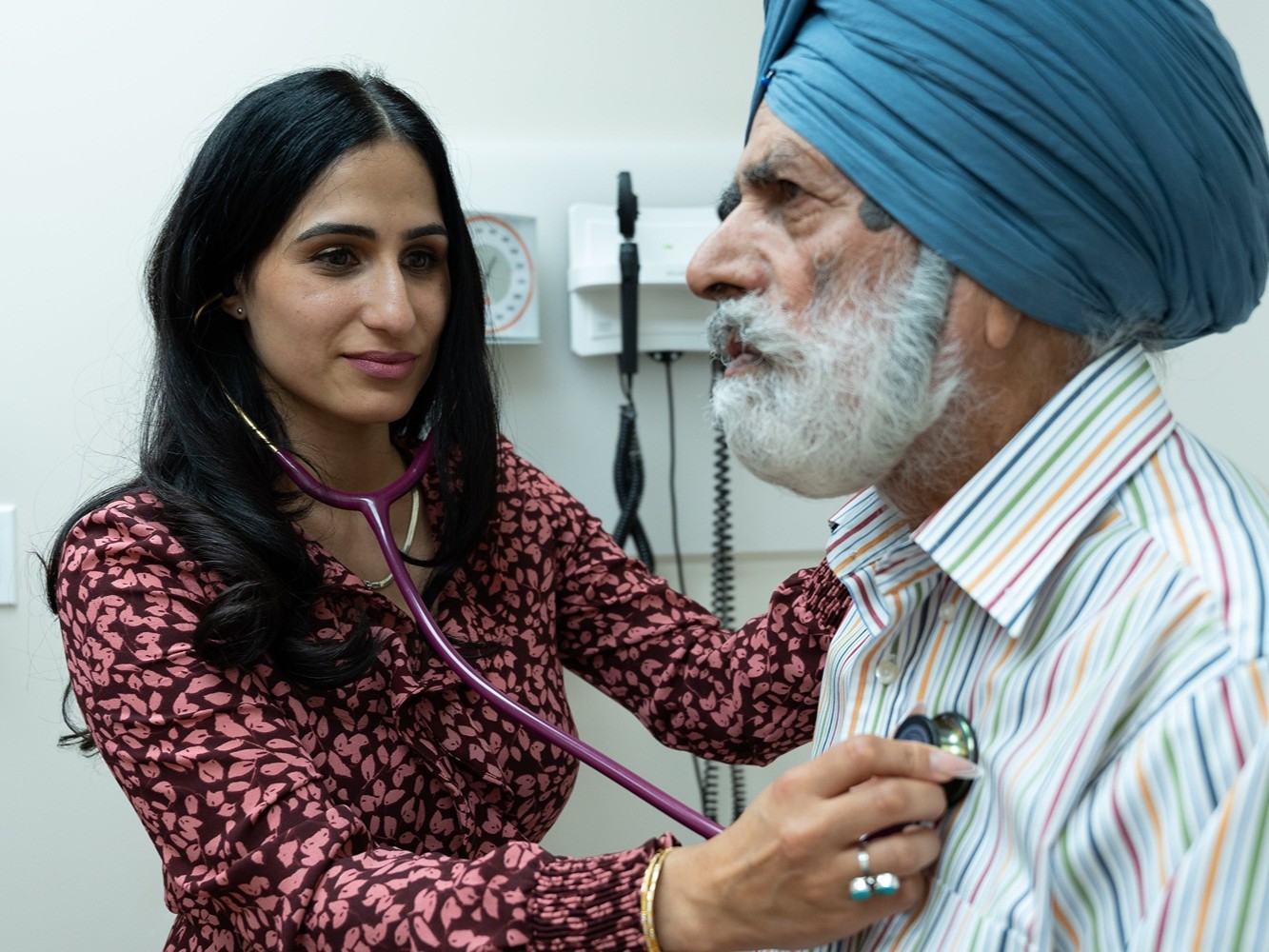
Aging is often called a gift. For geriatrician Dr. Rachel Johnston, the real reward is walking alongside her patients through their lives—supporting them as their needs, priorities and stories evolve.
As TMU’s Geriatric Medicine Residency Program Competence Committee Chair and staff geriatrician at William Osler Health System (Osler), the primary clinical partner for TMU’s School of Medicine, Dr. Johnston says she finds joy in each unique story a patient brings to her practice, each with its own set of challenges and priorities.
“Most patients that we see value their independence, their autonomy and their quality of life,” she said. “The general approach I take in geriatrics is that we might make a few, or sometimes many, small tweaks to hopefully change a patient’s trajectory.”
Much of Dr. Johnston’s work centres on patients living with dementia, Parkinson’s disease and various other forms of complex care, both in a hospital and in outpatient settings. Far from the misconception that geriatric medicine is passive or limited in scope, Dr. Johnston says the specialty is deeply hands-on, requiring careful attention to medical complexity, family dynamics and quality of life.
What matters most
Geriatrics, Dr. Johnston says, is grounded in the “five M’s” framework: mind, mood, mobility, medicine and what matters most.
“It’s really the whole crux of why we’re showing up in the first place,” she said. “Everything else follows from that.”
For Dr. Johnston, that can mean recognizing when a patient’s distress is not simply a symptom to be managed, but a sign that something deeper needs attention. She recalls caring for a woman in her 90s who had fallen, fractured her spine and became delirious in the hospital.
“The patient was in lots of pain, and sometimes even providing comfort measures helps,” Dr. Johnston said. “We followed up with her later on and found her more comfortable and relaxed. I didn’t cure her of anything, but there’s a huge satisfaction in relieving someone of their discomfort.”
That same sense of meaning extends beyond the patient to their families and caregivers, who often arrive overwhelmed, exhausted and searching for answers.
“In the clinic setting, we’re able to put things into context, name what families are going through, normalize and validate their experiences and then provide wraparound support,” she said.
A day in the life
A typical day for Dr. Johnston involves reviewing complex patient histories, meeting with patients and their families and conducting in-depth assessments that focus on both medical needs and quality of life.
At Osler, Johnston works within a strong interdisciplinary model that includes nurses, social workers, pharmacists, physiotherapists, occupational therapists and dietitians. She says this structure is essential in a specialty where the clinical and emotional burden can be heavy.
“It really, truly is a team-based approach," she said. “We’re able to share the heavy lifting required so that we can all meaningfully contribute to the patient's care journey without being overloaded.”
For future residents considering training in TMU’s Geriatric Medicine program, Johnston says the field is best for those who are curious, patient and comfortable with complexity.
“Geriatrics is fantastic for a trainee who thrives on complexity, is comfortable working at a slower pace, and is generally curious about their patient and their lives,” she said.
For Johnston, geriatrics remains her dream career, one that asks physicians to look beyond charts and lab results and see the full story of the person in front of them. Every day, that means asking not just what is the matter, but what matters most.