Smart Blue Roofs and Canadian Policy: Are Regulations Keeping Pace?
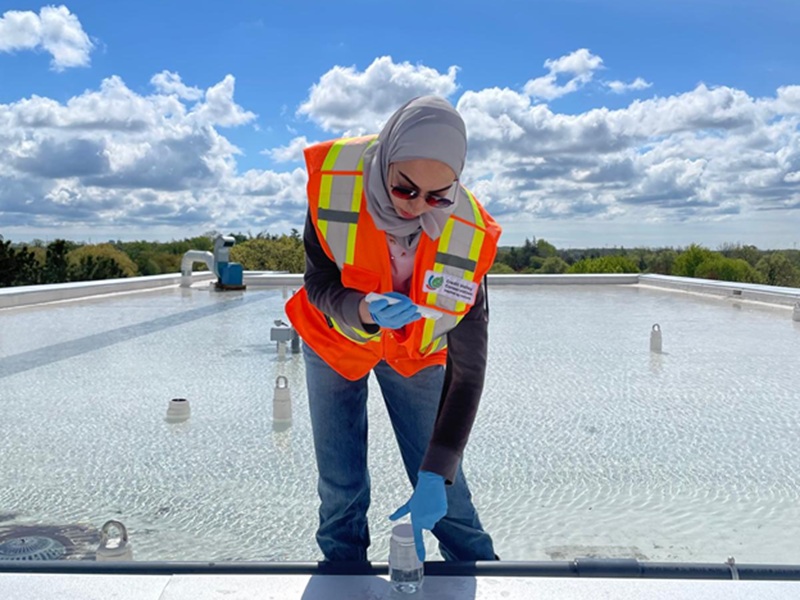
Environmental Applied Science and Management PhD candidate Dima Balaa collects samples from the rooftop.
Climate change is reshaping precipitation patterns globally and across Canada. Rainfall is increasingly characterized by short, intense storms rather than steady events, significantly elevating flood risks in urban areas. As cities search for ways to adapt, green infrastructure has emerged as a promising solution. Tools such as bioswales, green roofs, and blue roofs are gradually being incorporated into planning strategies and policy frameworks.
For years, the inclusion of green roofs in Toronto’s Green Roof Bylaw under Bill 60 signaled meaningful progress. Adopted in 2009, the bylaw required new industrial, commercial, institutional, and residential developments larger than 2,000 m² to incorporate green roofs. While blue roofs were not explicitly mandated, the policy helped normalize rooftop stormwater management. However, the repeal of this bylaw by the Ontario government in October 2025 marked a step backward for many researchers and practitioners who had hoped similar policy momentum would extend to blue roofs. Despite this setback, developers still have the option to install blue roofs and may benefit from doing so in the long run.
Blue roofs are engineered systems designed to temporarily store rainwater on rooftops, either through controlled drainage technologies or simple ballast-filled trays. By slowing runoff, they help reduce pressure on sewer systems and mitigate flooding risks. Over time, they can also contribute to building cooling, energy savings, and reductions in the urban heat island effect. Importantly, these benefits are optimized when water can be stored for longer periods and released strategically, either ahead of potential future storms or for potential reuse.
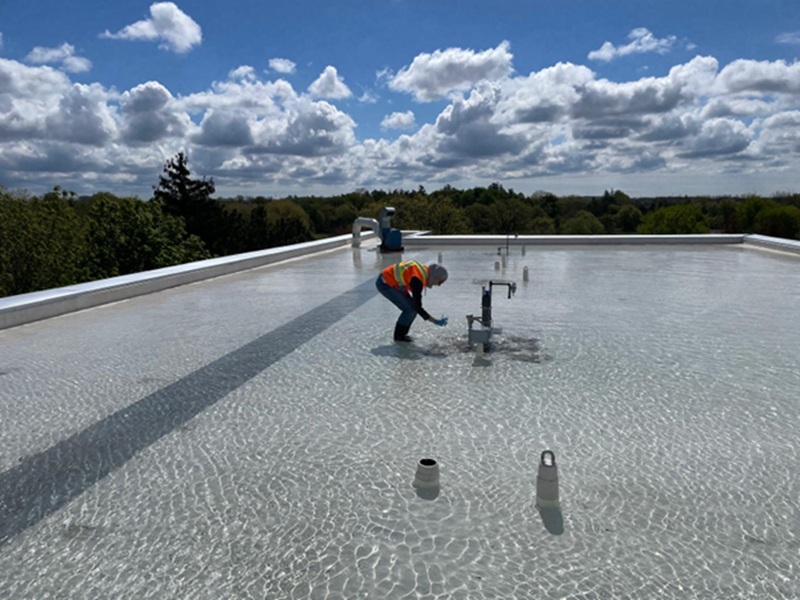
Yet Canadian building and plumbing codes impose a significant constraint. Water detained on rooftops must typically be drained within 24 hours, a provision known as the drawdown time requirement. At first glance, this rule aligns with public health priorities, and as a public health researcher, I appreciate the precautionary intent. However, a closer look suggests that the requirement may be overly conservative for modern smart blue roof systems.
Both the National Plumbing Code (NPC 2.4.10.4) and the Ontario Building Code (OBC 7.4.10.4) connect this requirement to Health Objective 2, which aims to limit illness risks associated with unsanitary conditions. However, the NPC’s intent statement primarily warns that inadequate drainage could result in stagnant water, leading to mould or mildew growth and potential harm to occupants.
Here lies the tension. Many advanced blue roof systems are designed to prevent stagnation. Many incorporate recirculation alongside treatment processes such as filtration, ultraviolet disinfection, and chlorination. For example, the Credit Valley Conservation (CVC) smart blue roof in Mississauga includes all three treatment steps, ensuring that water remains treated and monitored while stored on the roof.
Notably, the codes provide little detail beyond mould and mildew. Few water quality parameters are explicitly addressed, leaving developers and public health professionals to navigate unclear and vague guidance. When examining the broader regulatory logic behind the 24-hour rule, it becomes clear that the requirement is heavily rooted in structural concerns. Stored water adds weight, and timely drainage reduces the risk of roof failure, material degradation, and flooding. However, this logic was largely developed with traditional roofs in mind, systems that lacked monitoring, treatment, and operational control.
Emerging research suggests that well-designed blue roofs can safely retain water beyond 24 hours. The assumption that delayed drainage inevitably creates microbial risk does not always hold true. Evidence from the CVC case study, currently unpublished, indicates that water quality is influenced more by effective disinfection, such as maintaining adequate chlorine residuals, than by storage duration alone. In fact, good water quality was maintained even when water remained on the roof longer than the prescribed timeframe.
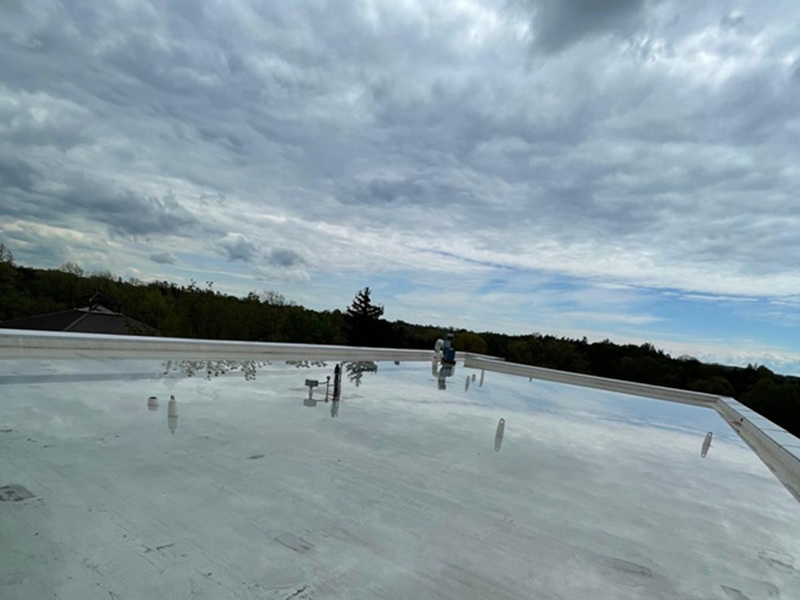
This shifts the conversation. Many risks appear to stem not from how long water is stored, but from poor design, maintenance, or operational oversight. In this light, the 24-hour drawdown requirement begins to look less like a strict safety threshold and more like a cautious default rooted in older infrastructure assumptions.
Another policy gap further complicates adoption: the absence of clear water quality standards for stormwater stored on rooftops when reuse is not the primary objective. Existing codes focus heavily on end-use applications, often referencing the Canadian Standards Association (CSA B805) guidelines for rainwater harvesting intended for flushing, irrigation, or washing.
But what about blue roofs installed primarily for flood mitigation, thermal performance, or sewer load reduction?
Without defined treatment targets, developers face uncertainty. Overdesigning treatment systems can drive up costs, while minimal treatment raises questions about safety and permitting. This ambiguity may discourage investment in advanced blue roof systems altogether.
Insights from the Credit Valley Conservation (CVC) blue roof, examined as part of ongoing research, highlight this broader dilemma. While the installed system aligns with CSA guidance, it invites a critical question: is near-potable treatment necessary for all blue roofs, or could a more tailored approach ensure safety without unnecessary expense? Current codes offer few answers.
Ultimately, this is where research plays a critical role. In many ways, today’s blue roof installations are functioning as living laboratories, generating the evidence needed to inform future policy. The gap between technological capability and regulatory frameworks highlights an urgent need for updated guidance.
Despite recent policy setbacks, there is reason for optimism. Findings from policy analysis and ongoing case studies suggest that blue roofs can be both safe and scalable. What is needed now is a shift toward more flexible, performance-based regulations, ones that account for modern treatment technologies while continuing to safeguard public health and structural integrity.
As climate pressures intensify, the question is no longer whether cities should adopt innovative stormwater solutions, but whether our policies are evolving quickly enough to support them. Smart blue roofs are ready. The real question is: are our regulations ready too?

Dima Balaa is a PhD candidate and a Geoffrey F. Bruce Fellow in the Environmental Applied Science and Management program at Toronto Metropolitan University (TMU). Her research focuses on the intersection of water quality, treatment systems, and public health and policy. She holds a master’s degree from TMU, where she explored public risk perceptions of microplastics and nanoplastics in drinking water using Reddit discourse analysis and expert interviews.
Currently, Dima is leading public health research within the interdisciplinary Credit Valley Conservation (CVC) Smart Blue Roof project, investigating microbial levels in standing water to ensure compliance with Ontario’s recreational water standards. Her work involves evaluating health risks across progressive time intervals, from 24 hours to one week, and identifying treatment needs using microbial and water quality indicators. By integrating public health perspectives into engineering and architectural design, Dima aims to inform potential refinements to the Ontario Building Code’s 24-hour drawdown limit and contribute to advancing sustainable water reuse strategies and resilient urban design.
Questions about the article? Contact Dima Balaa directly at: dima.balaa@torontomu.ca