Sustainable Food Containers on Campus: Why Systems Matter More Than Materials
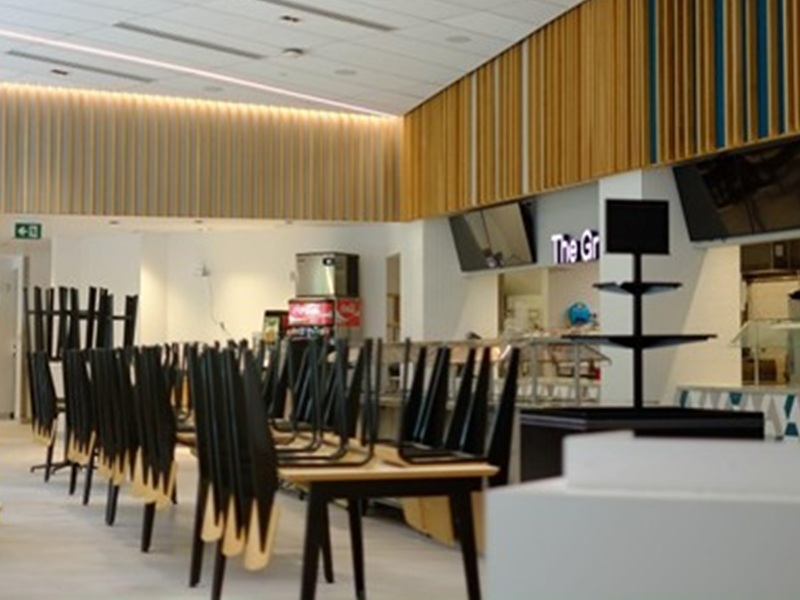
Pittman Hall Residence at TMU.
Across university campuses, sustainable food packaging is often framed as a material problem. Compostable containers replace plastic. Recyclable options replace disposables. These changes are visible and well intentioned, but they do not always deliver the environmental benefits they promise.
Recent research examining food container systems used in a Canadian campus cafeteria shows why. The findings point to a simple but often overlooked reality: sustainable food packaging is not defined by materials alone, but by how entire systems function in practice, including user participation, return rates, and the operational workflows maintained by food service staff.
Looking Beyond the Container
The analysis compared three food container systems commonly used in campus dining:
● Single-use plastic containers
● Compostable bagasse clamshells
● Reusable plastic containers cleaned and reused on site

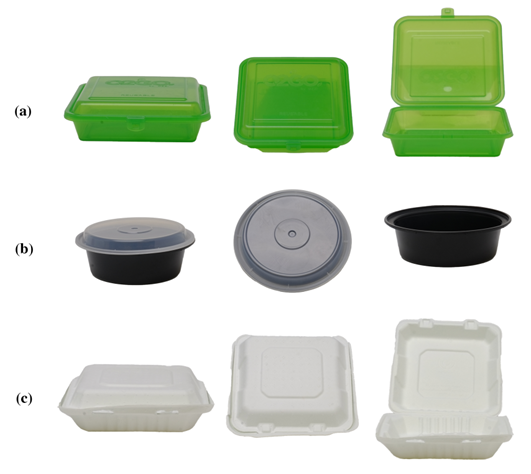
(a) Reusable polypropylene clamshell, shown closed, top view, and open configuration;
(b) single-use polypropylene container (black), shown assembled, lid, and base;
(c) compostable bagasse clamshell, shown closed, top view, and open configuration.
Rather than focusing only on what the containers were made of, the study evaluated the full system required to serve meals at scale. This included material production, transportation, use and cleaning, and end-of-life disposal.
This matters because a container’s environmental impact depends on how often it is used, how it is collected, how it is cleaned, and how it is ultimately disposed of. A material that appears sustainable in theory can perform poorly in practice if the surrounding system is not designed to support it.
What the Results Show
Single-use plastic performed the worst: Single-use plastic containers had the highest environmental impacts across all categories evaluated. Most of these impacts were driven by raw material extraction, manufacturing, and disposal.
Compostable does not automatically mean sustainable: Compostable bagasse containers performed better than single-use plastic, but worse than reusable containers in most cases. In practice, compostable containers were often landfilled due to contamination and waste system limitations, reducing their environmental advantage.
Reuse only works when reuse actually happens: Reusable containers had the lowest environmental impact across most categories, but only after they were reused enough times. Environmentally, reusable containers outperformed single-use plastic after approximately 17 uses, and outperformed compostable containers after approximately 37 uses in most impact categories. Financially, the system reached break-even much sooner, becoming cheaper than single-use plastic after about 7 uses, and cheaper than compostable containers after about 9 uses.
In other words, reuse is not inherently sustainable. It becomes sustainable only when systems are designed to support high return rates and long container lifespans.
Why This Matters for Students
For students studying Environmental Applied Science and sustainability, this research highlights a key lesson:
Sustainability is a systems problem, not a material problem.
Effective solutions depend on infrastructure, behavior, return rates, and realistic break-even thresholds. Without these elements, even well-intentioned packaging choices can fail to deliver real environmental benefits.
Campus food services operate in controlled environments, making them ideal testing grounds for reuse systems. But success depends on system design, not labels or assumptions.
The future of sustainable food packaging will be shaped less by what containers are made of and more by how well the systems around them actually work.
Read the full study: Snyder, W. R., & Park, J. (2024). Environmental and economic analysis of reusable and single-use food packaging formats in university campus food services. Packaging Technology and Science. (external link) https://doi.org/10.1002/pts.2826 (external link)

Will Snyder is a PhD student in the Environmental Applied Science and Management (EnSciMan) program at Toronto Metropolitan University. Will is under the supervision of Dr. Jay Park and a member of the Sustainable Packaging Research Lab (SuPaR Lab).
Questions about the article? Contact Will Snyder directly at: wrsnyder@torontomu.ca