Traditions
Convocation is an exciting and momentous occasion. From the "pomp and circumstance" to the gowns and hoods worn by the graduating class, convocation is full of old and new traditions. Learn more about the traditions you may see when you attend a convocation ceremony!
Family and friends are requested to rise when the graduand and academic processions enter the Arena, and remain standing until the conclusion of the invocation, where they will be instructed to be seated. Following the convocation address, the graduands will rise for the general presentation of candidates and then they will be called and presented for the awarding of certificates, and undergraduate and graduate degrees.
The ceremony will conclude with the singing of the national anthem. The audience is asked to remain standing until the conclusion of the academic recession, where the Chancellor's Party, Stage Party and the graduates have filed out of their seats to join the celebrations.
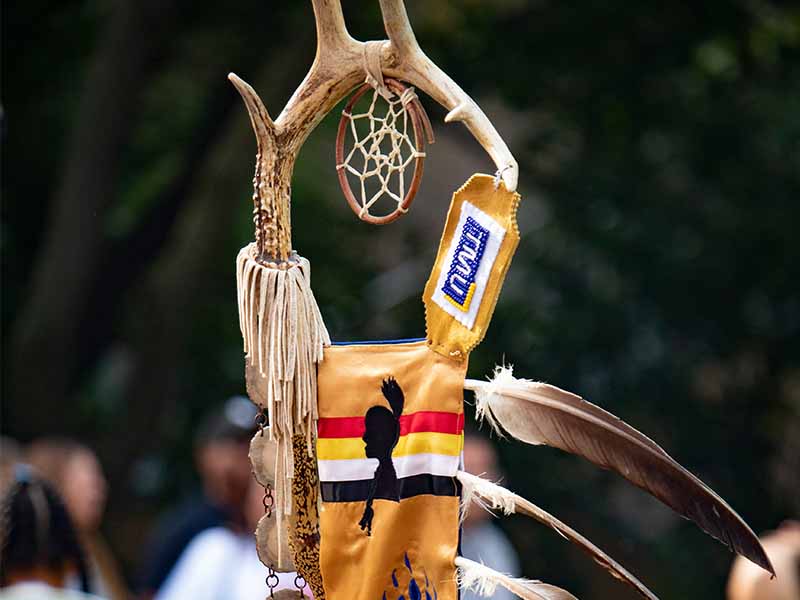
In 2012, Toronto Metropolitan University and Gdoo-maawnjidimi Mompii Indigenous Student Services (GMISS) were presented with an Eagle Staff, the traditional flag of Indigenous peoples, which is present at significant events, including convocation. The Eagle Staff offers courage for the teaching and learning of Indigenous students. It also recognizes TMU and GMISS’ leadership in creating a strong holistic support system for Indigenous students.
Especially designed for TMU and GMISS, and featuring the university’s colours, the Eagle Staff contains carved pieces that depict the Seven Grandfather Teachings of wisdom, love, respect, bravery, honesty, humility and truth. Footprints sewn into the cloth represent the learning journey of Indigenous students at TMU while the silhouette of a learner beneath a dream catcher symbolizes students’ attainment of their goal. Finally, 12 feathers, from an eagle caught in a trap and perished in Fort Albany, James Bay, represent the services and programs offered by GMISS, the Indigenous Education Council (IEC), TMU and Indigenous students.
A 13th feather was added to represent the work of GMISS and the IEC for Missing and Murdered Indigenous Women, Girls and Two-Spirit People (MMIWG2S), including men, boys, and all Indigenous People.
The mace plays a major role in all university ceremonies and convocations, and symbolizes the chancellor’s authority to award degrees. The Howard Kerr Memorial Mace is named in honour of Toronto Metropolitan University’s founder and first principal, who led the institution from its inception in 1948 until 1966. Kerr had the foresight that ultimately enabled TMU to evolve from an experimental institute of technology into Canada’s leading university for high-quality, career-related education.
The mace, a gift from Kerr’s hometown of Seaforth, Ontario, features symbols that reflect the institution's development and customs and was designed by Professor Emeritus Eugen Bannerman and handcrafted as a commission by Nova Scotia artist and sculptor Douglass Morse.
In 2024 the mace went through a transformation. Several changes to the mace were recommended by a working group consisting of the Office of the President, the Office of the Vice-President, Equity and Community Inclusion, including the Indigenous Initiatives unit, and University Relations.
The new design included updating the university’s name and the addition of beadwork representing the Star Blanket that the Indigenous Education Council gifted to the university in 2013.
Douglass Morse was commissioned to make the changes. With blue and yellow beadwork and coloured gemstones, TMU’s refreshed mace is a true representation of the university’s past, present and future.
The mace is carried into the ceremony by the bedel - a faculty member designated by the faculty or dean.
Governor General’s Academic Medals
Created and awarded in 1873 by Lord Dufferin, Canada’s third Governor General, the Governor General’s Academic Medal recognized scholastic achievements and has since become one of the most prestigious awards for students at Canadian educational institutions.
The Governor General’s Academic Medal is awarded to the student who graduates with the highest standing at their institution. Today, the medal is awarded at four levels: bronze at the secondary school level, collegiate bronze at the post-secondary diploma level, silver at the undergraduate level and gold at the graduate level. Visit gg.ca (external link) for detailed descriptions of each medal.
Toronto Metropolitan University Gold Medal
One of the university’s highest awards, the TMU Gold Medal is given to students who demonstrate outstanding academic achievement and school involvement.
First awarded in 1951, the medal has since been bestowed upon more than 200 undergraduate, graduate and certificate students from the Faculties of Arts; The Creative School; Community Services; Engineering and Architectural Science; Science; The G. Raymond Chang School of Continuing Education; the Ted Rogers School of Management; and the Yeates School of Graduate and Postdoctoral Studies.
One student from each faculty and school receives the medal: undergraduate and certificate students during the spring convocation ceremonies, and graduate students during the fall ceremonies.
Board of Governors Leadership Medal
First presented in 2013, the Board of Governors Leadership Award and Medal is the university’s highest award. The award criteria include a student’s final cumulative grade point average, as well as outstanding academic achievement and leadership qualities. Those characteristics are evidenced by a student’s membership in committees or extracurricular activities, or involvement in student and/or university affairs.
Each academic year, all TMU Gold medalists are eligible to receive the Board of Governors Leadership Award and Medal.
The honour is awarded to a continuing education or undergraduate student during the spring convocation ceremonies and a graduate student during the fall ceremonies.
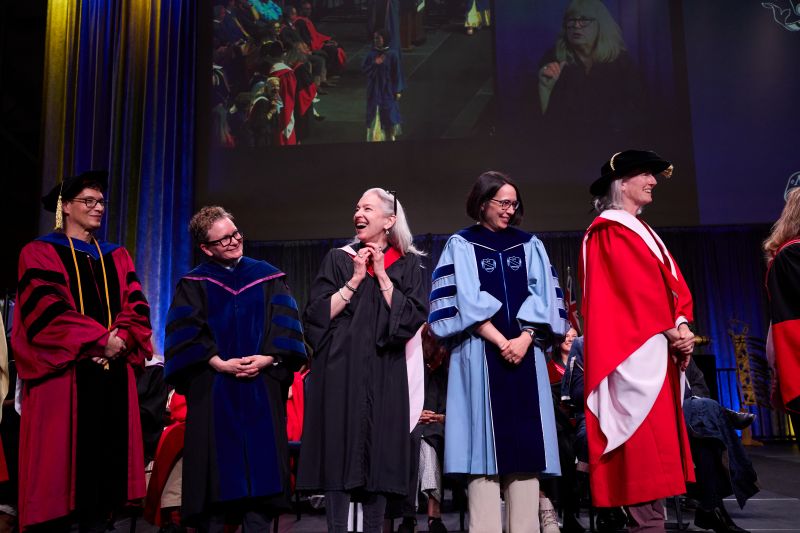
During the academic procession, gowns, hoods and caps are worn by Toronto Metropolitan University faculty, administration, members of the board of governors, graduating students and honorary doctorate recipients.
Academic costume dates from the 14th century, when long robes and hoods were worn by students and faculty to keep warm. Today, academic regalia have come to symbolize various scholarly honours and distinctions. The highest academic awards, for example, are represented by fuller gowns.
Additionally, specific colours on the hood represent different degree-granting fields. The gown worn by certificate and baccalaureate-degree recipients features a common “undergraduate” style but in a distinctive blue colour. At convocation ceremonies, you will see caps as part of the regalia of PhD graduates only, and notice that the president and chancellor have distinct caps and gowns representative of their offices.
Faculty members participating in the Stage Party wear the caps, gowns and hoods of the institution in which they earned their highest degree.
Students have graduated to the sound of ringing bells on campus since 1964. But it’s actually an electronic carillon, rather than bells, that produces the sounds.
Donated by the Alumni Association in 1964, the original carillon sat upon a vintage school desk in Kerr Hall West. The keyboard made felt-covered hammers strike musical rods, and the vibrations were amplified and sent to three horn speakers in the clock tower, atop Howard Kerr Hall.
Wayne Detcher, Electrical Technology ’64, has played the carillon during nearly every convocation ceremony for more than 60 years. In fact, during the spring 2014 convocation ceremonies, he played the new carillon for the first time.
The instrument, which resembles an electronic organ in a wood console, was purchased with help from a fundraising campaign that collected more than $100,000 in donations.
In 2024, Wayne Detcher retired from playing the carillon after 61 years. Today, the carillon continues to play throughout the TMU campus and the sounds of the carillon are broadcast to the graduates in the Mattamy Athletic Centre after their convocation ceremony.