Building Culturally Safe Pathways to Recovery through SOUDA
The reality of Canada’s drug epidemic became personal for Gurkirat Nijjar during a late night shift at a gas station in Surrey, British Columbia, when a customer overdosed in the bathroom. What once felt like a distant national crisis, suddenly became all too clear.
“At that time, I knew about the overdose epidemic only from the news—something happening ‘out there’ before I came to Canada as an international student in 2015—but that night, it became painfully real,” said Nijjar.
A 2019 report from (PDF file) Fraser Health (external link) later confirmed what Nijjar experienced first hand: drug toxicity deaths among South Asian residents had risen by 255 per cent between 2015 and 2018, compared to a 138 per cent increase in the rest of the population. Most of those affected were young men under 40—many employed, living with family, and facing significant barriers to care due to stigma, language gaps and a lack of culturally appropriate services.
“That data reflected exactly what we were seeing in the community,” Nijjar said. “It reinforced why culturally informed, language-specific harm reduction work is essential.”
Over the next four years, as overdose cases continued to climb, Nijjar grew increasingly concerned by the absence of community-based supports tailored to South Asian families. There were few grassroots organizations offering education, prevention resources, or safe spaces for conversations about addiction.
So he decided to build one.
Taking the first step and beyond
In 2019, equipped with overdose response and prevention training through the South Asian Mental Health Alliance, he founded the Students Overcoming Substance Use Disorder and Addictions Society of Canada (SOUDA). The organization set out to address addiction through a culturally-grounded approach—offering education and support in English, Hindi, and Punjabi, while working to dismantle stigma and strengthen community capacity.
“Overcoming addictions and substance use is incredibly difficult, and even harder without a strong support system,” he said.
Since its founding, SOUDA has delivered harm reduction education, contributed policy recommendations to British Columbia’s Standing Committee on Health, and expanded its reach across communities in need. Most recently, the organization was selected as one of 10 community groups to receive a microgrant from the Region of Peel (external link) as part of its ongoing Substance Strategy.
Empowering the community
Now as a first-year medical student at the TMU School of Medicine, Nijjar is turning his attention to young people.
SOUDA’s latest initiative, Breaking Barriers: South Asian Youth Conversation Circles, brings youth together to talk openly about substance use, recovery, housing insecurity, and access to care—topics that are often avoided in families and communities shaped by cultural silence around addiction.
“My work with SOUDA showed me that addiction care must address culture, housing and immigration status alongside medicine,” Nijjar said. “That’s what inspires me to pursue a career as an addiction physician.”
Looking ahead, SOUDA aims to expand access to mental health and housing supports, advocate for policy change, and train youth with lived experience to become peer leaders—efforts designed to prevent overdoses while advancing more equitable health outcomes.
Behind Nijjar’s work is a quieter influence: his grandmother.
“She always nudges me to be a better version of myself,” Nijjar said. “Whenever things are going well or feeling tricky, I check in with her for a little advice—her words always stick with me.”
When asked what he would say to others navigating substance use or recovery, Nijjar doesn’t hesitate.
“Remember that you’re not alone, and that you deserve support,” he said. “Reach out to someone you trust. Stay connected. Talk to your loved ones. If faith or spirituality brings comfort, lean into that. Return to activities that ground you. And seek professional help early. Recovery is possible—and you are worthy of care.”
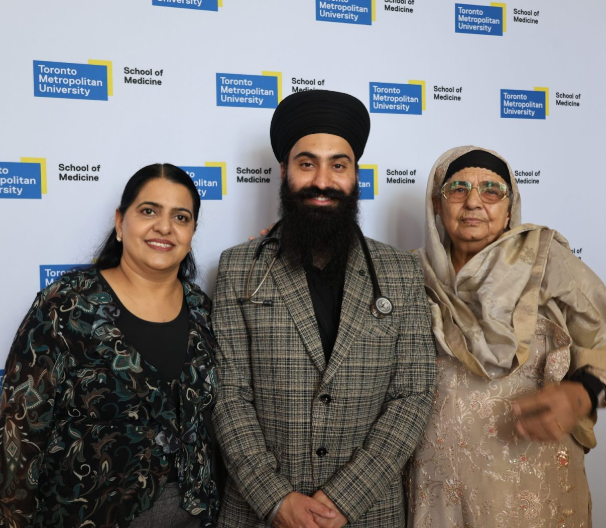
Gagandeep Kaur (left), Gurkirat Nijjar (middle) and S. Manjit Kaur Nijjar (right)
“My work with SOUDA showed me that addiction care must address culture, housing and immigration status alongside medicine, that’s what inspires me to pursue a career as an addiction physician.”