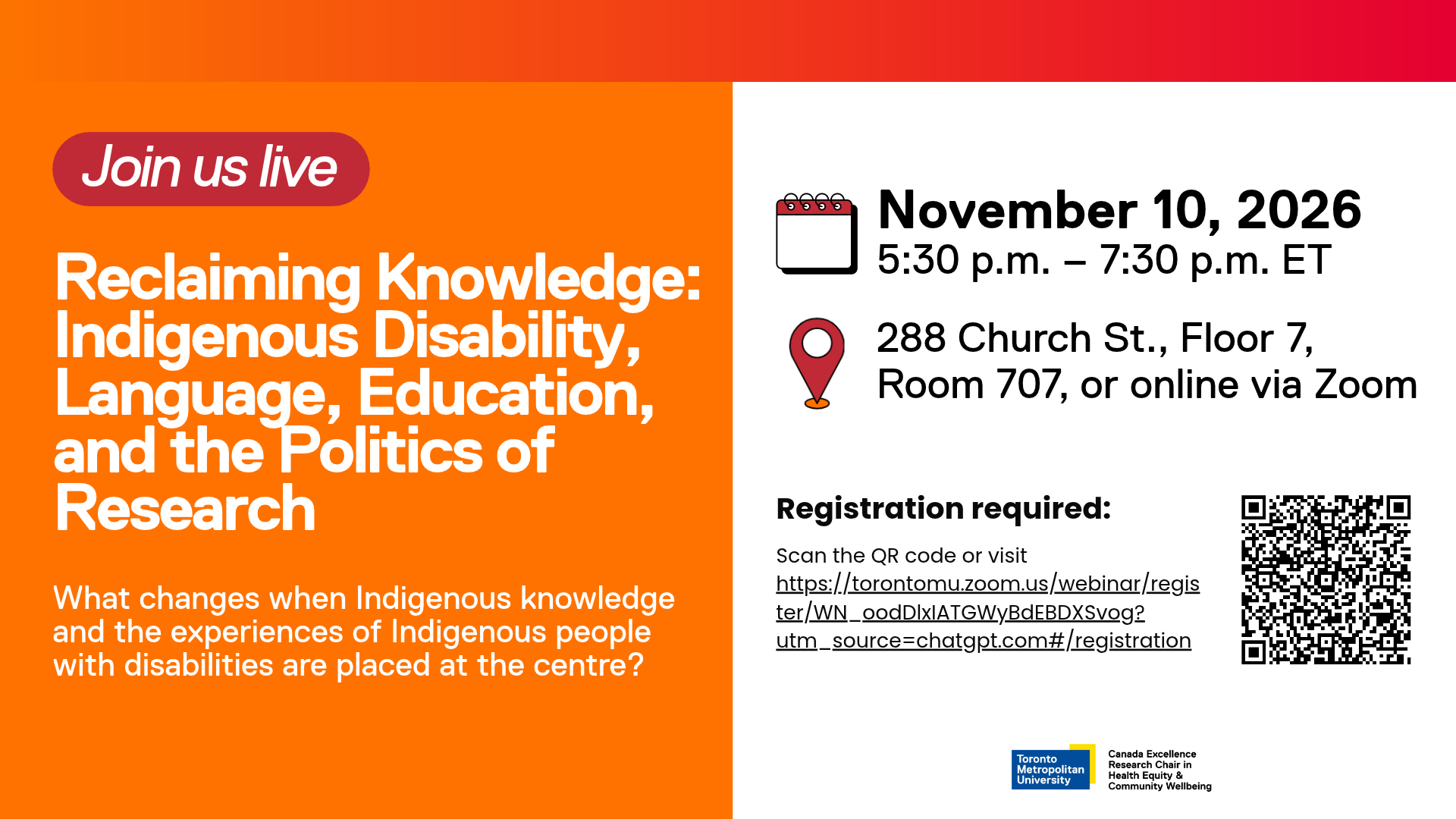
Reclaiming Knowledge: Indigenous Disability, Language, Education, and the Politics of Research
- Date
- November 10, 2026
- Time
- 5:30 p.m. - 7:30 p.m. ET
- Location
- 288 Church St, DCC 707-709 & Zoom
- Open To
- Open to the Public
- Accessibility
- To ensure full participation, please email any specific accessibility needs—such as sign language interpretation, or captioning, among others. While we are committed to meeting all accessibility needs to the best of our ability, there may be circumstances where certain requests cannot be fully accommodated; in such cases, we will work with you to find appropriate alternatives.
- Contact
- cerc.healthwellbeing@torontomu.ca
- Tags
Reclaiming Knowledge: Indigenous Disability, Language, Education, and the Politics of Research
Please join us for “Reclaiming Knowledge: Indigenous Disability, Language, Education, and the Politics of Research,” a two-hour hybrid public lecture bringing together three scholarly perspectives from John Gilroy, John Ward, and Rodney Adams, whose work spans Australia and Canada.
Presented by the CERC in Health Equity and Community Wellbeing, the lecture will explore Indigenous disability, language, education, and the politics of research, offering critical perspectives on how knowledge is produced, understood, and reclaimed.
Abstract: How might our understandings of disability, language, education, and knowledge change when Indigenous knowledge systems and the experiences of Indigenous people with disabilities are placed at the centre?
This public lecture brings together three scholarly perspectives from Australia and Canada to examine how colonial systems have shaped understandings of disability and difference, whose knowledge is recognized, and how research, education, and language can either reproduce or challenge these structures.
Drawing on Indigenous Disability Research in Canada, one presentation considers Education-as-Reconciliation and the ways Indigenous understandings of learning and human being can challenge deficit-based approaches to disability. Using the Medicine Wheel as a framework, it explores the interconnected spiritual, mental, physical, and emotional dimensions of human experience and considers disAbilities as differences in learning, processing, communication, perception, and ways of knowing. The presentation examines how colonial education systems, including the legacy of Indian Residential Schools, disrupted traditional approaches to learning and contributed to physical, mental, emotional, and spiritual disconnection. Indigenous methodologies and knowledge systems, including Two-Eyed Seeing, the Métissage Research Paradigm, Wìsakedjàk, the Indigenization of Critical Disability Theory, and Elders’ oral knowledge, offer alternative approaches that recognize orality, hand talk, sign, visual-spatial abilities, mind mapping, multisensory learning, and community participation as legitimate forms of knowledge and communication.
A second presentation examines the relationship between Indigenous disability research, evidence-informed policy, and colonial knowledge production. Drawing on Indigenous disability standpoint theory and a case study from New South Wales, the presentation considers why evidence-informed disability policy has not necessarily addressed the experiences and inequities faced by Indigenous people with disabilities. It asks how the history of disability studies has shaped what is recognized as evidence and whose knowledge informs policy, while examining how research can reproduce colonial power structures and privilege established systems of knowledge and authority.
The lecture also turns to the histories and revitalization of Indigenous sign languages in Australia and Canada. Indigenous sign languages have been impacted by colonial ideologies of normalcy and European imperialism, including what Indigenous scholar Aileen Moreton-Robinson describes as “white possessiveness.” While the revitalization of First Nations sign languages has become an important part of global Indigenous language reclamation movements, these efforts can overlook the historical and contemporary roles of Deaf First Nations people. Historically, Deaf Aboriginal and Torres Strait Islander people were valued members of their communities, contributing to traditions of translanguaging, linguistic fluidity, and multimodal communication. Recognizing these histories challenges dominant understandings of disability and language while highlighting Deaf Indigenous people as knowledge holders and active contributors to language revitalization and community life.
Together, the three perspectives invite us to reconsider whose knowledge is recognized, how knowledge is gathered and communicated, and how colonial understandings of disability and difference continue to shape education, research, policy, and language revitalization. By centering Indigenous knowledge systems and the experiences of Indigenous people with disabilities, the session explores possibilities for more inclusive, relational, and culturally grounded approaches to learning, research, policy, and community life.
Event Details
Date: November 10th
Time: 5:30 p.m. – 7:30 p.m. ET
Venue: 288 Church St., 5th Floor, Room 707 & Zoom
Registration:
https://forms.gle/nZFGFS66TJzHE3kf6 (external link)
If you require any accessibility accommodations, please contact: cerc.healthwellbeing@torontomu.ca