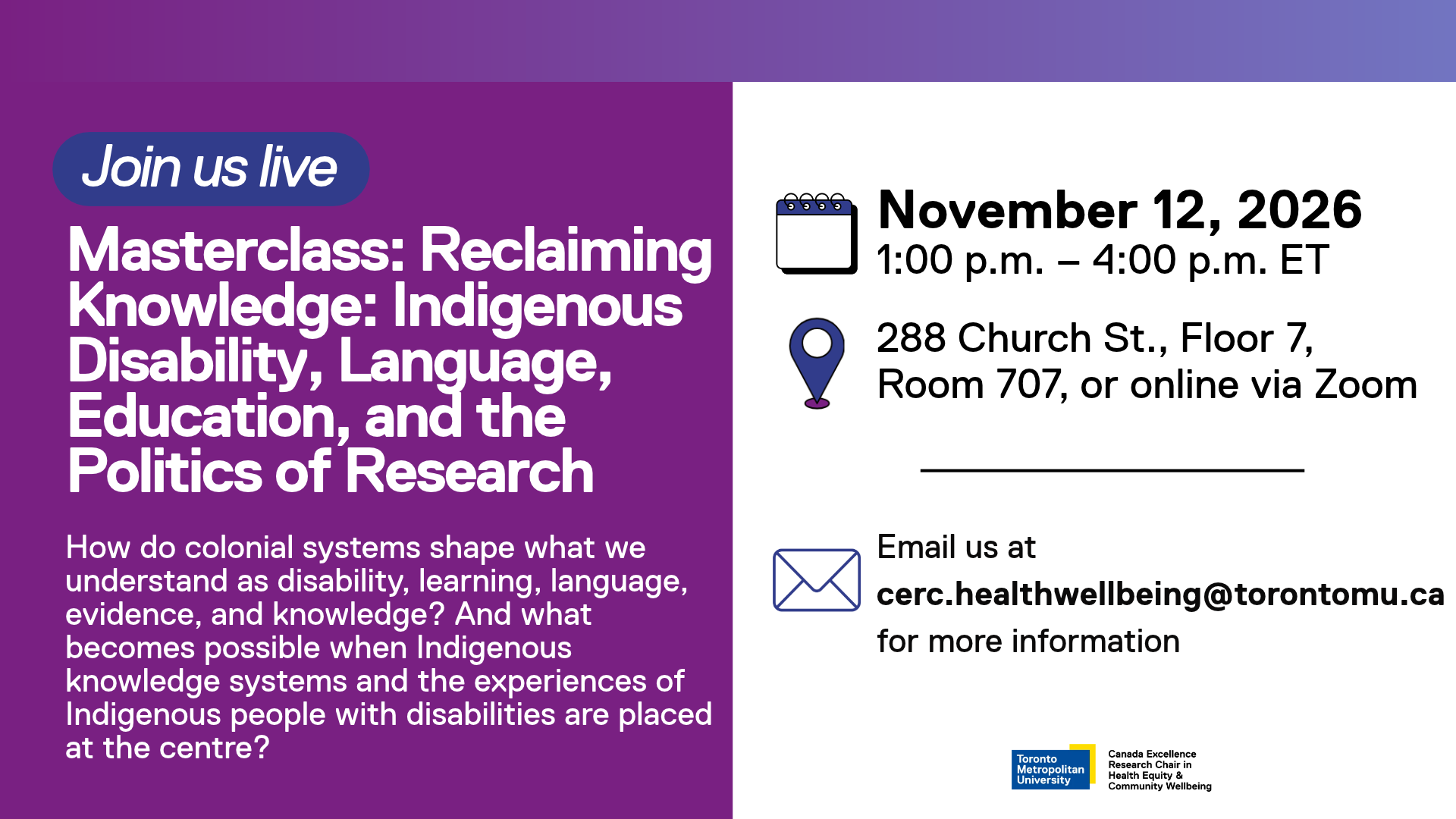
MASTER CLASS: Reclaiming Knowledge: Indigenous Disability, Language, Education, and the Politics of Research
- Date
- November 12, 2026
- Time
- 1:00 p.m. - 4:00 p.m. ET
- Location
- 288 Church St, DCC 519
- Open To
- Master's and PhD Students
- Accessibility
- To ensure full participation, please email any specific accessibility needs—such as sign language interpretation, or captioning, among others. While we are committed to meeting all accessibility needs to the best of our ability, there may be circumstances where certain requests cannot be fully accommodated; in such cases, we will work with you to find appropriate alternatives.
- Contact
- cerc.healthwellbeing@torontomu.ca
Call for Abstracts
Reclaiming Knowledge: Indigenous Disability, Language, Education, and the Politics of Research
How do colonial systems shape what we understand as disability, learning, language, evidence, and knowledge? Whose knowledge is recognized, and whose experiences inform research, education, policy, and practice?
We invite Master’s and PhD students to submit a short abstract for an interactive masterclass exploring Indigenous disability, Indigenous knowledge systems, language, education, research, and policy.
The masterclass will take place November 12, 2026, from 1:00–4:00 p.m. ET, in person at Toronto Metropolitan University (TMU).
Bringing together perspectives from Australia and Canada, the masterclass will examine how colonial systems have shaped understandings of disability and difference, while exploring Indigenous approaches that offer alternative ways of understanding, producing, and communicating knowledge. Topics will include Indigenous Disability Research, Indigenous sign languages, Deaf Indigenous experiences, Education-as-Reconciliation, Indigenous research methodologies, disability policy, and the relationship between research and colonial systems of knowledge.
Who should submit?
We welcome submissions from MA and PhD students whose research, scholarship, or creative practice engages with themes including:
- Indigenous disability and disability justice
- Deaf Indigenous people and Indigenous sign languages
- Indigenous education and Education-as-Reconciliation
- Indigenous knowledge systems and methodologies
- Disability studies and Indigenous Disability Research
- Colonialism and knowledge production
- Research and evidence-informed policy
- Indigenous languages, communication, and linguistic diversity
- Accessibility, inclusion, and different ways of knowing
- Community-engaged and relational research
- Decolonizing research, education, or professional practice
You do not need to be working directly on disability to participate. We welcome interdisciplinary research that connects with the broader questions of knowledge, difference, colonialism, education, language, and inclusion.
Abstract Submission
Students are invited to submit a short abstract of 150–250 words describing their research, emerging ideas, or area of inquiry and its connection to the masterclass themes.
Your abstract may describe:
- Research that is underway or recently completed
- An emerging research question or area of inquiry
- A methodological or theoretical approach
- Community-based or applied work
- A critical reflection arising from your research or practice
You do not need to have completed your research to submit. We particularly welcome emerging and exploratory work.
Selected students will have an opportunity to briefly introduce their work during the masterclass and engage in facilitated discussion with speakers, researchers, students, and community partners.
Submission Details
Abstract length: 150–250 words
Eligibility: MA and PhD students
Submission: cerc.healthwellbeing@torontomu.ca
Deadline: Oct 31, 2026