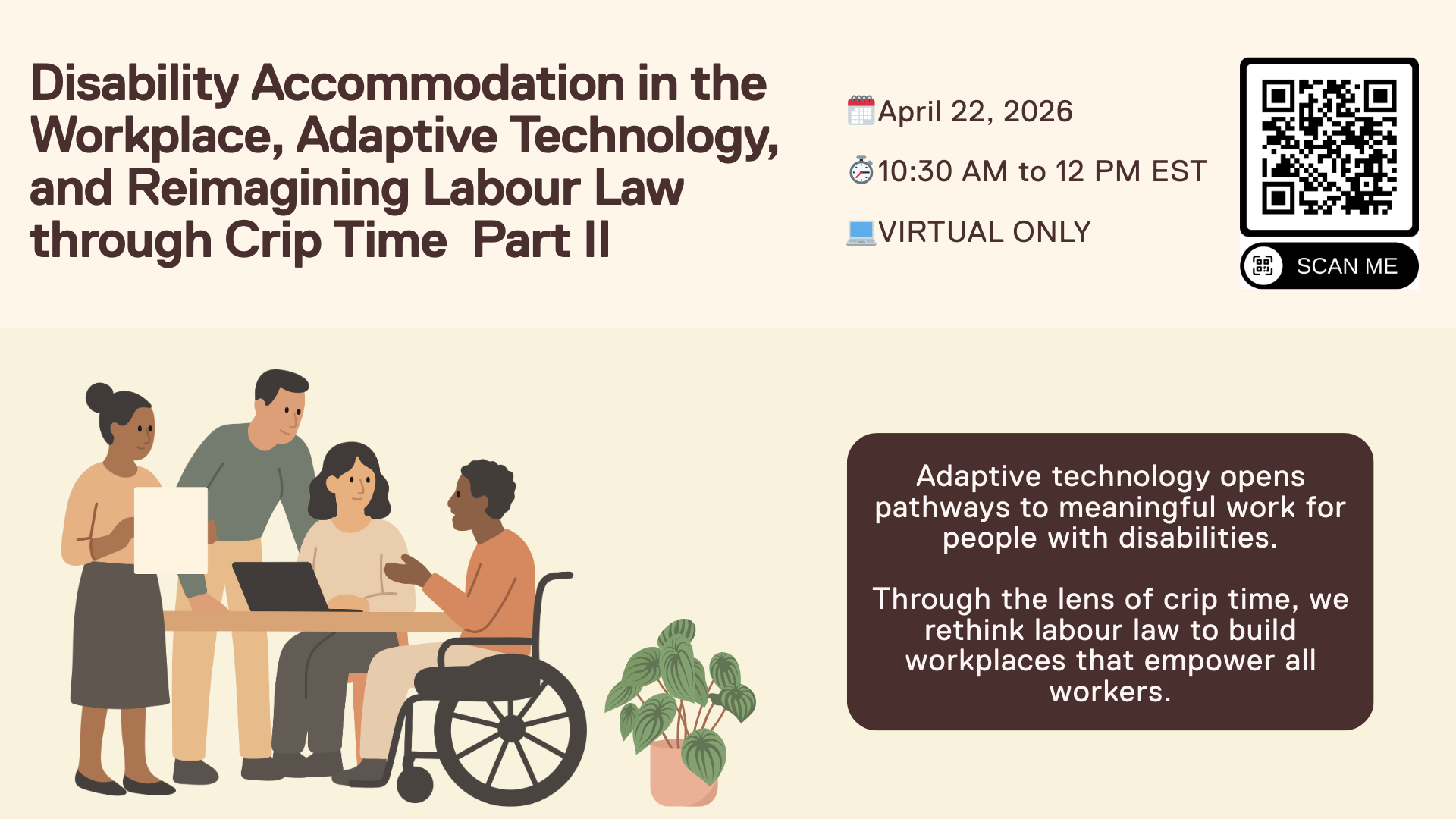
Disability Accommodation in the Workplace Adaptive Technology, and Reimagining Labour Law through Crip Time - Part II
- Date
- April 22, 2026
- Time
- 10:30 a.m. - 12:00 p.m. ET
- Location
- Zoom
- Open To
- Open to the Public
- Contact
- Tarndeep Pannu, tarndeep.pannu@torontomu.ca
CERC Health Equity and Community Wellbeing Speaker Series: Disability Accommodation in the Workplace Adaptive Technology, and Reimagining Labour Law through Crip Time - Part II
Public Lecture hosted by the Canada Excellence Research Chair in Health Equity and Community Wellbeing.
Please join us for the virtual public lecture “Disability Accommodation in the Workplace - Part II” by Dr. Ravi Malhotra and Dr. Mark Thomas moderated by Vayshali Patel, Senior Research Associate at the CERC in Health Equity and Community Wellbeing. This event is free and open to the public.
Disability Accommodation in the Workplace, Adaptive Technology, and Reimagining Labour Law through Crip Time - Part II
Abstract: People with disabilities often rely on assistive technology for activities of daily living, including work and leisure. This can range from screen readers that render text accessible to blind and learning-disabled individuals to ergonomic tools that enable people with physical disabilities to flourish. In this paper, based on SSHRC-funded qualitative research interviews with a sample of Ontario residents with a variety of disabilities, we explore how technology may or may not assist people with disabilities in achieving their goals. The concept of "crip time", originally developed by Ellen Samuels and Alison Kafer, is used to analyse how disabled people experience time differently and the implications this holds for the workplace. We suggest that adaptive technology has the potential to harness the talents of people with disabilities and level the playing field. Relying on the work of the philosopher Cornelius Castoriadis, we suggest that crip time allows disabled people to articulate their own understanding of time that empowers them. However, as Roulstone and others have suggested, we argue that adaptive technology, in both its creation and implementation phases, must be co-created with disabled people. Such a project requires the construction, per Castoriadis, of new social imaginary significations that envision new ways of working, living, and flourishing. Crip Time anticipates the future of a labour law liberating for all workers. As the late Marta Russell remarked, disabled people are the canary in the coal mine. Crip time facilitates the creation of a new social imaginary signification that will enable rethinking a dynamic and effective labour law jurisprudence for the 21st century.
Date: Wednesday, April 22, 2026
Time: 10:30 to 12 PM. EDT
Format: Virtual
Location: Zoom
Register: Please register here: https://torontomu.zoom.us/webinar/register/WN_K0PulIxrQiSamZD6jBx_Cg#/registration (external link)
Accessibility: Captioning will be provided on Zoom.
For questions and access inquiries please contact Tarndeep Pannu, tarndeep.pannu@torontomu.ca by March 25, 2026.