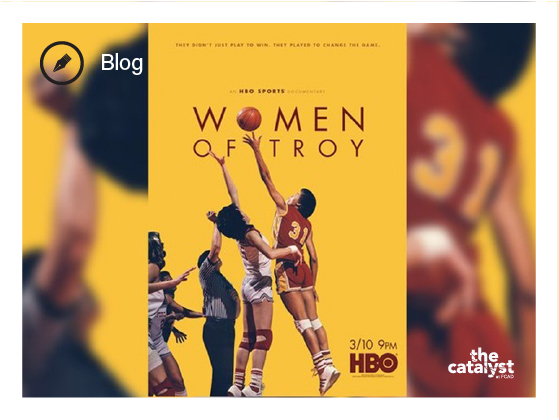
WOMEN OF TROY:
Check out what Chelsea is up to!
Film Synopsis
Women’s basketball takes the spotlight in an HBO sports documentary as we are introduced to superstar, Cheryl Miller who is arguably the greatest female basketball player of all time. The documentary follows the University of Southern California (USC) 1980s women’s basketball team and how Miller’s talent and leadership paved the way for the women’s game and gender equality. The film explores basketball history from stories by Cheryl Miller (external link) herself and game-changers, including Doris Burke (external link) , Cynthia Cooper (external link) , Juliette Robinson (external link) , Linda Sharp (external link) , Pam McGee (external link) , Paula McGee (external link) , Rhonda Windham (external link) . All of whom have outstanding accolades of their own. The USC Trojans offered women a stage to showcase their talents, leading them to consecutive national championships. However, the team’s success also played a significant role in influencing the National Basketball Association (NBA (external link) ) to establish a league for women to play on a professional level called the Women’s National Basketball Association (WNBA (external link) ). A massive step towards equality in sports.
Key Takeaways and Further Discussion Points
This film was a fantastic watch whether you are a seasoned vet or completely new to the game of basketball. Women’s sports are rarely given the spotlight it deserves, and through enriched storytelling, viewers are immersed in the historical journey of women’s basketball. Not only does the documentary expose the incredible athletic skills these women possess, but the additional value is placed on their ability to change stubborn minds and encourage the world to embrace women’s sports within all levels of the industry.
“With men, they started to evolve on their own. Women, it was up to everybody else how they could play the game. Not them.” – Jackie MacMullan (external link)
Women’s sports began the same way that men’s sports did. The difference is that men are allowed to write their own stories and develop the sport in any way they want. Fans didn’t and still don’t question the game as the men’s professional leagues continue to make it up as they go along. However, women are forced to follow the blueprint that men leave behind, and the power is given to society to determine their worth, credibility, and ultimately their future. Women’s sports are compared against the men’s game, representing the fundamental normative that women need to ‘strive’ toward to find their place. It is as if when our higher power placed the game of basketball on earth, it was only intended to be designed by men and for men. It is perceived to be THE standard for any human being who wishes to play it.
“As the game evolved, what changed? It was television coverage.” – Kim Mulkey (external link)
“The biggest thing that came out of that [her career in sports] was the younger generation, the younger crop of young girls, watching this, being inspired to play at this level. ‘Do I think I can do that? Do I really think I can do that?’” – Cheryl Miller (external link)
So, if visibility is essential to growing a fanbase, why is there intense resistance toward developing professional women’s sports leagues and then broadcasting their games so fans can form opinions of their own? Instead, we allow fans to fall into the classic narrative that the male experience shapes us to believe.
And don’t tell me it’s because women’s sports aren’t entertaining enough for anyone to watch. I’ll get to that pathetic argument in a moment.
Each sports league began as an unknown business. Like any startup, one cannot truly anticipate a product’s attractiveness to the market, and only through time, preparation, and promotion will you know how viable you are for success. For example, someone, or rather a party of people, had to take the leap when establishing professional men’s basketball. Investors were sought out, and broadcasting companies were persuaded to believe that enough audiences would tune into the games for them to turn a profit. There were numbers, testimonials, research, and stats that projected a viable future for men’s professional sports, as there are with any new business venture. Still, no one could genuinely guarantee the product would be a success. However, based on the data, investors took the risk and have been generously rewarded ever since.

So, explain something to me. If all it takes is public interest and savvy businesspeople to manipulate optimistic projections, why is it so hard for investors to take the same risk on women’s sports? Moreover, what is up with the argument that there simply isn’t a demand for women’s sports live in the arena or on television?! Uhhhh…there is a demand if you just ask consumers. Also, how is it possible for a sport to gain a fanbase for a demand to occur IF CONSUMERS CANNOT SEE THE PRODUCT?

Don’t believe me? This list of articles may help clear some things up:
- More women are playing sports. Why is no one watching? (external link)
- Women’s sports popularity is growing, according to Nielsen study (external link)
- US viewership of the 2019 Women’s World Cup final was 22% higher than the 2018 men’s final (external link)
- I thought the main issue in women’s sports was equal pay. I was wrong (external link)
Think of it in another way. The demand for smartphones was utterly unknown when they first came to the market. We hadn’t experienced this type of technology before, nor did we understand our eventual desire or obsessive need to have one. Until one day, a guy in a black turtleneck broadcasted to the world his newest invention. Magazine ads, billboards, videos on the internet, and news platforms broadcasted this turtleneck-wearing man’s genius, and now the entire population practically requires smartphones to function. However, had we not been EXPOSED to it, we may have never known.
AND ANOTHER THING…
After the XFL (external link) fiasco, no investor or broadcast company can convince me that taking risks on a new sports product isn’t worth it. Even good old American football couldn’t make it work the first time around, and YET, companies took a second and third chance on them after it was already proven to be a colossal failure.

Billionaire businessman, Vince McMahon (external link) , is known as a major staple within the corporate sports landscape. He is a promoter and executive within WWE, and over the past 20 years, he has sought to expand his wallet into the football business. After NBC lost their broadcast rights of NFL games, McMahon, and his newly established entertainment company, Alpha Entertainment, formed a deal with NBC to bring fans a new American Football age. In 2001, the XFL was developed for a single season to compete for NFL audiences. The structure of the game varied from its traditional form to allow for digital innovations and intensified play. The introduction of Skycams and mic’ing up players in-game enabled the league to test out new forms of entertainment that would bring a level of intimacy and personality that fans are not privy to in the NFL. After benefiting from strong viewership in their first few games, the interest died off, and the ratings plummeted. The league and its partners lost more than $35 million (external link) and were forced to fold only after one season.

XFL, DC Defenders fan
Still not satisfied with the outcome, McMahon dumped more money into the league’s revival, making a comeback in 2020. Alpha Entertainment, the XFL parent company, has since filed for Chapter 11 bankruptcy (external link) due to the COVID-19 pandemic. Given that this is an unexpected turn of events out of the league’s control, one could not suspect the longevity of the XFL’s rebirth for its second time around. This does, however, show that there are plenty of deep-pocket business people willing to risk it all for a product that may not survive. Oh, wait, and they did, again. In August 2020, Hollywood and sports mogul Dwayne “The Rock” Johnson (external link) , business partner Dany Garcia (external link) , and Gerry Cardinale (through Cardinale’s fund RedBird Capital Partners) purchased the XFL out of bankruptcy for a whopping $15 million. So, if investors can justify spending millions on an unstable strategy for a men’s league, what makes standing up for women’s equality in sports any different?
Think hard now because the argument of there being a lack of interest and low viewership is pretty mute at this point.
In Allies We Trust
“Michael Jordan, Shaquille O’Neal, name a star and to watch those men treat a woman with that level of respect, it can’t help but have an impact moving forward on an entire gender. Here those men were, embracing a basketball person, but a basketball person who happened to be a woman, and treating her as an equal, that is where society changes.” – Doris Burke (external link)
In the film, Doris Burke notes that as Cheryl Miller entered into the world of sports broadcast, what played a significant role in the shift of societal perceptions, was the VISIBLE support and respect that prominent male athletes afforded her.
… So, you’re saying that if I can see human decency in-person or on television, it encourages the social normalcy of equal treatment?! Damn.

I believe it takes a persistent group of allies both within the industry and throughout the public to raise awareness of gender bias in sports. The industry and the public need to take an active role in changing their discriminatory attitudes. As leaders with a prominent voice, athletes, coaches, executives, and sports media companies must set the example to audiences by taking more significant leaps to create gender equality. How can they do that? Well, first, pull out your wallet, connect with some of your wealthy friends, and pull some funding together for women’s sports programs.

Or better yet, buy a whole professional women’s team in the National Women’s Soccer League (NWSL) like this star-studded investor group (external link) . Or even something as simple as pro athletes in the National Hockey League (NHL) wearing the Professional Women’s Hockey Players Association (PWHPA) merch to games/practices and teams posting it on their social media platforms.

Any type of exposure helps grow the game, and then it is in our hands as fans to shut down our resistance to change and eliminate our negative behaviours within social society.
That’s it. That’s the tweet. Thank you for coming to my TED Talk.
Find Women of Troy on Crave.ca (external link) and on HBO.com (external link) !