MD Program Curriculum
Curriculum Phases
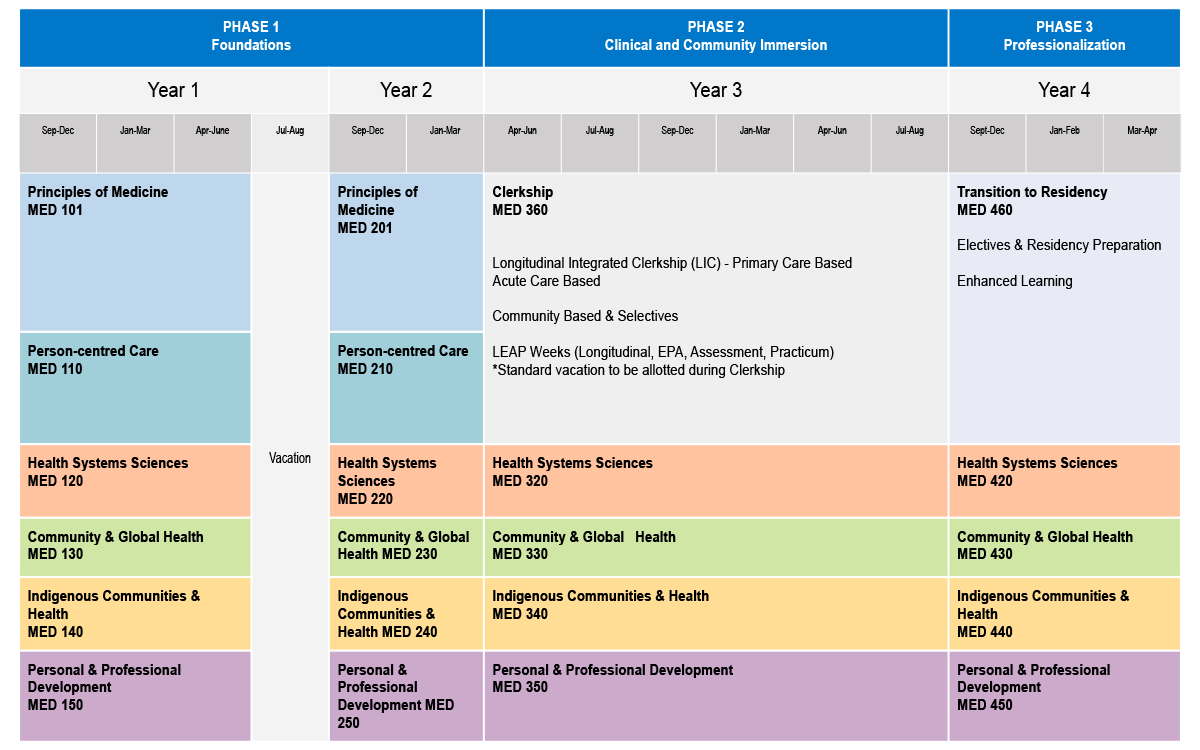
The four-year curriculum is arranged in three phases across four years and integrated throughout. The curriculum has been intentionally structured so that topics and cases spiral vertically through courses within each year of study and grow in complexity in each successive year (i.e., horizontal spiral) of the Program.
Within each of the three phases, students undertake a series of courses, four of which run longitudinally across the years to enhance knowledge and application. For each course in a given year, all learning must be complete for students to progress to the next year level in that course.
The years of study in the MD program are of varying lengths in order to accommodate our 17-month Clerkship in Phase 2. This unique experience gives medical students exposure to the full scope of care, incorporating a Longitudinal Integrated Clerkship in primary care clinics, acute care hospital rotations, and community rotations including rural medicine, long-term care, selectives and more. Phase 2 also includes six weeks of vacation distributed throughout; this structure enhances the continuous clinical exposure while providing regular intervals of rest, mirroring the scheduling of residency programs.
Explore MD Program

Phase 1
Phase 1 (Foundations Phase) provides the foundations and grounding for clinical learning through acquisition and application of knowledge, skills and abilities, from the basic sciences and clinical, social and health systems science. Within this phase will be foundational knowledge on anti-racism, equity, bias and inequities within the healthcare system. Required courses in this phase focus on Indigenous people and practice, professional and self-development, and experiential learning in community and clinics.

Phase 2
Phase 2 (Clinical and Community Immersion Phase) provides full immersion in clinical experiential learning through a Longitudinal Integrated Clerkship that is primarily (3 days a week) based in Family Medicine, with required clinical learning in defined specialty areas of medicine in hospital sites, community and health affiliate clinics (i.e., Psychiatry, Emergency Care, Medicine, Surgery, Women’s Health, Paediatrics). Students will be required to continue study in courses focused on Indigenous people and practice, global health, professional and self-development, and health systems.
Phase 3
Phase 3 (Professionalization Phase) is an opportunity for career-focused experiential learning to strengthen our graduates’ skills in the program goals via electives, preparation for post-graduate studies and completion of a self-directed learning block. Students will be required to complete study in courses focused on Indigenous people and practice, professional and self-development, and health systems.