Rebooting Responsibility: Tackling E-Waste Together
Keywords: E-waste; ICT and sustainability; sustainable development; circular economy; urban mining; policy and planning; natural language processing; machine learning
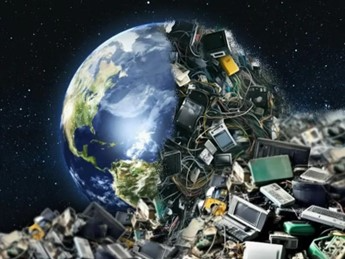
We have quickly moved into an era of digitalization through revolutionary technological transformations, shifting sectors towards automation while creating endless possibilities of living in online words. These changes have occurred due to our increased consumption and production of electronic and electrical equipment, making them a boon as well as a curse. Our gadgets have brought upon a concealed price tag: large quantities of waste, specifically electronic waste (or commonly known as e-waste). These include the usual laptops and cellphones, but also a growing list of objects such as small and large appliances, temperature exchange equipment, and even medical devices.
The question of how do we start managing our growing pile of e-waste is something that countries are just starting to tackle. As legislation in countries is not uniform, it has become difficult to track management on both local and global levels. Even countries with formal e-waste management systems are challenged with disposal and recycling rates.
Canada is one of the wealthier countries confronted with the challenge of effectively managing its increasing stock of e-waste. Shockingly, Canada’s e-waste flow tripled (external link) between the years 2000 and 2019 and is expected to reach 1.2 billion kilograms by 2030. Today, the major concerns for Canada are that it does not have a single, uniform national definition for e-waste as well as the lack of consistency across policies related to its management. In fact, many of these policies have underperformed as there is no federal regulation that has been implemented. While a few policies have been enforced at provincial levels, these have not been completely leveraged and what has emerged are systems which, while widespread, suffer from a lack of harmonization and data transparency.

Canada’s e-waste flow tripled between the years 2000 and 2019 and is expected to reach 1.2 billion kilograms by 2030.
As a passionate environmental scientist, I come from a multi-disciplinary background with interests in environmental policy and planning, sustainability, e-waste management, and the circular economy. My interests in these areas have largely stemmed from my personal experiences and upbringing. I strongly believe that sustainability is an important function of our lives and so it is our responsibility as researchers to lead and translate the sustainability jargon into a simple language that everyone can understand and replicate in order to maximize its benefits.
Because my parents are originally from India and immigrated to Canada many years ago, they have always inculcated a culture of minimalism. Their motive of less is more is something that has significantly shaped my consumption and purchasing habits. This is why I have never felt the need to purchase items I did not need. If anything in our household was disposed of, I was absolutely sure that it could not be reused anymore.
My family and I are also very tech-savvy, but we are very particular that once any of our equipment is obsolete the same rules have applied. We ensure that we take all of our e-waste and donate it to the nearest Value Village location. Although my parents are not environmentalists, they instilled the principles of reduce, reuse, and recycle from my childhood which have now become a significant part of my lifestyle.
There have been instances when I have visited my relatives and witnessed unwanted chargers and appliances stacked inside a cupboard or garage and forgotten. When explaining to them that these items can be donated to nearby locations, they are taken aback. Their reactions have always left me astonished. My daily interactions with family and friends have always made me reflect on one thought: if people in my own family do not know how to properly dispose of their e-waste, then I would imagine and expect people in the rest of the country to be in similar situations.
Consumer electronics have become such an essential part of our lives that we tend to ignore their environmental impacts especially when the benefits are so blindingly bright. Having said that, I quickly came to the realization that there needs to be a deeper understanding and discussion of sustainable e-waste management so that we can create comprehensive and practical solutions in our country.
Over the years, I've heard individuals in schools, governments, and the media repeat the same message: one needs to implement reduce, reuse, recycle in their daily lives. However, this does not appear to be the case in Canada, particularly when it comes to e-waste. During the COVID-19 pandemic, I witnessed policymakers disagree about what actions need to be taken, and that there is a disconnect in how that message is being interpreted and understood by Canadians. This is a result of regulations not being communicated effectively. This is what motivated me to continue my research at the PhD level.
Under the supervision of Dr. Shirazi, my research involves using different machine learning tools for investigating the most effective policies related to the circular economy, with an emphasis on e-waste management. The aim of my research is to fill in the knowledge gap in understanding the state of existing policies through comparative case studies as well as being able to develop resources to support more proactive and thoughtful policymaking that will help propel adoption of the circular economy directed towards the Canadian e-waste sector.
As the amount of e-waste continues to increase, there is a moral responsibility to rethink our relationship with digital technologies. Through my work, my objective is to drive meaningful conversations about circular and sustainable e-waste management methods that will lean towards a centralized focus on how we as stakeholders envision and perceive the risks of buying new electronic and electrical equipment for short periods of time.
My message is to convey that genuine sustainability necessitates a comprehensive consideration of social, economic, and environmental factors. The circular economy should not be pursued in isolation but as part of an integrated strategy for sustainable development that places justice and equity on equal footing with our environmental goals. I hope that communication with respect to how to correctly dispose of e-waste becomes more convenient and accessible for individuals so that the choices and procedures for e-waste management become less complicated in Canada.
Looking ahead, I am considering careers inside and beyond academia because there are so many opportunities to weave together teaching, research, and working with local communities. While I see myself as an avid observer, researcher, and commentator, my PhD journey is really helping in opening up pathways that are allowing me to converse with individuals that are tied closer to policy and contributing to a growing body of knowledge that seeks to address the urgent challenges posed by e-waste in a rapidly digitizing world.

As a second-year PhD candidate in the EnSciMan porgram, I come with a strong background in public education and a passion for advocating for sustainable e-waste management practices. Under the supervision of Dr. Shirazi, my PhD research focuses on using qualitative and quantitative approaches in advancing our understanding of the role of sustainablee-waste management in Canada being a crucial part of the circular economy. Through my work, I hope to foster a more equitable approach to e-waste management that prioritizes environmental, economic, and social sustainability as well being able to guide governmental policies and propel Canada's adoption of circular economy.
Questions about the article? Contact Saidia Ali directly at: s20ali@torontomu.ca