My Top 5 Favourite Courses
If you take a look at the undergraduate course calendar, you will see that our university offers a lot of courses. Over the course of my degree, I have actually taken 52 different courses (yes, I did in fact count)!
From these 52 courses, I have narrowed down five of my favourites. A couple of these courses are open to all undergraduate students, but some of them are unique to my program. Make sure you confirm what courses are part of your program’s course calendar before enrolling in any of them.
1. MEC 830 - Mechatronics Systems Design
MEC 830 is my favourite core curriculum course. Open only to Mechanical Engineering students in the Mechatronics Option, this course truly made me feel like a mechatronics engineer. There is no final exam (a rarity in engineering) and the course is very project oriented. The projects are designed so that you really have to apply and combine your knowledge of mechanical systems, electronics and programming. Noteworthy projects include building a solar tracker and an autonomous robotic car.
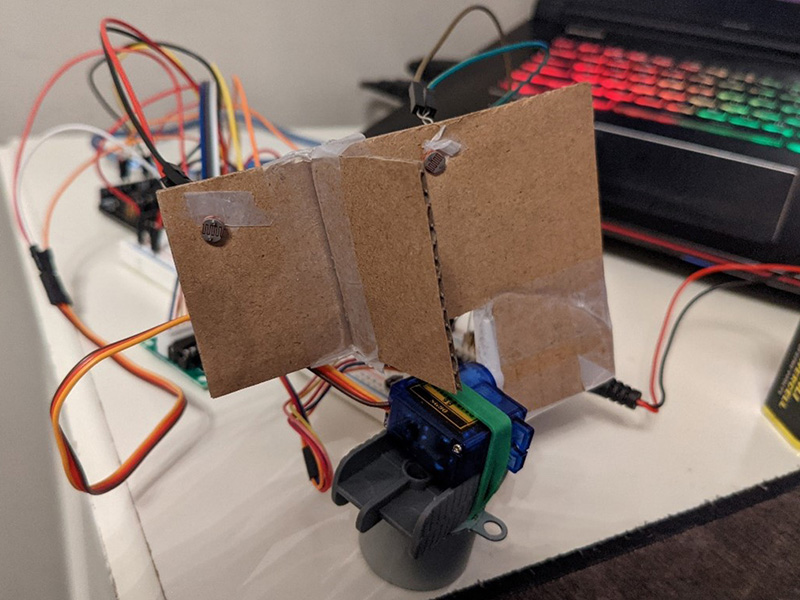
I built a dual-axis solar tracker capable of repositioning itself when it detects a light source.
2. POL 208 - Globalization and World Politics
If you like world politics and are not afraid to debate controversial matters, then POL 208 is for you. My professor, Dr. Evgeny Efremkin, managed to keep our three-hour evening spring lecture engaged. You will examine international relations in the post-9/11 world and the effects of globalization.
POL 208 is a lower-level liberal studies course and may be available for you to take as part of your studies depending on your program.
3. SSH 505 - Making the Future
Administered by the Leadership Lab, SSH 505 is an upper-level liberal studies course that challenges your understanding of being a leader and changemaker. You have the entire semester to develop a project (either with a group or individually) that will facilitate social change in a community of your choice. Each lecture featured notable guest speakers from politicians to industry leaders.
My group and I created a transit advocacy campaign (external link, opens in new window) to address overcrowding and delays in Toronto’s subway system. We were actually selected out of eight changemaking projects to receive the Making the Future Fund to help further our campaign after the course’s completion.
4. CEN 810 - Interdisciplinary Engineering for Sustainability and Innovation
CEN 810 is by far the most unique course I’ve ever taken. This course counts towards the eighth semester core elective required of all engineering students. But it’s not just open to all engineering students at our university, it’s also the first multi-university engineering course! My project group actually consisted of students from four different Canadian institutions!
Delivered entirely virtually, CEN 810 is part of the How to Change the World (external link, opens in new window) education program. You and your group will develop a solution to address any of the United Nations Sustainable Development Goals (external link, opens in new window) in a given community. Throughout the course, you will meet with experts and stakeholders in the affected community, and receive guidance on your solution portfolio.
5. EMS 201 - Entrepreneurship and Innovation Management
Business Management students, I now understand your struggles. While EMS 201 is specifically only for engineering students enrolled in the Optional Specialization in Management Sciences, it’s actually just a condensed spring semester version of the Business Management capstone course, BUS 800.
Each week, you will examine a case study of a real company. As a non-business major, this course had a steep learning curve, especially since it integrates material from so many other business courses. However, I still found it to be super interesting because of how different it is from other courses that I have taken. Since I had a relatively small class, my professor, Steve Tissenbaum, actually took us on a field trip to a pub for a creative assignment.
I hope some of these choices resonate with you! For other course recommendations, check out my blog post on five recommended lower-level liberal studies courses.
- Jeremy