2026 Site Map
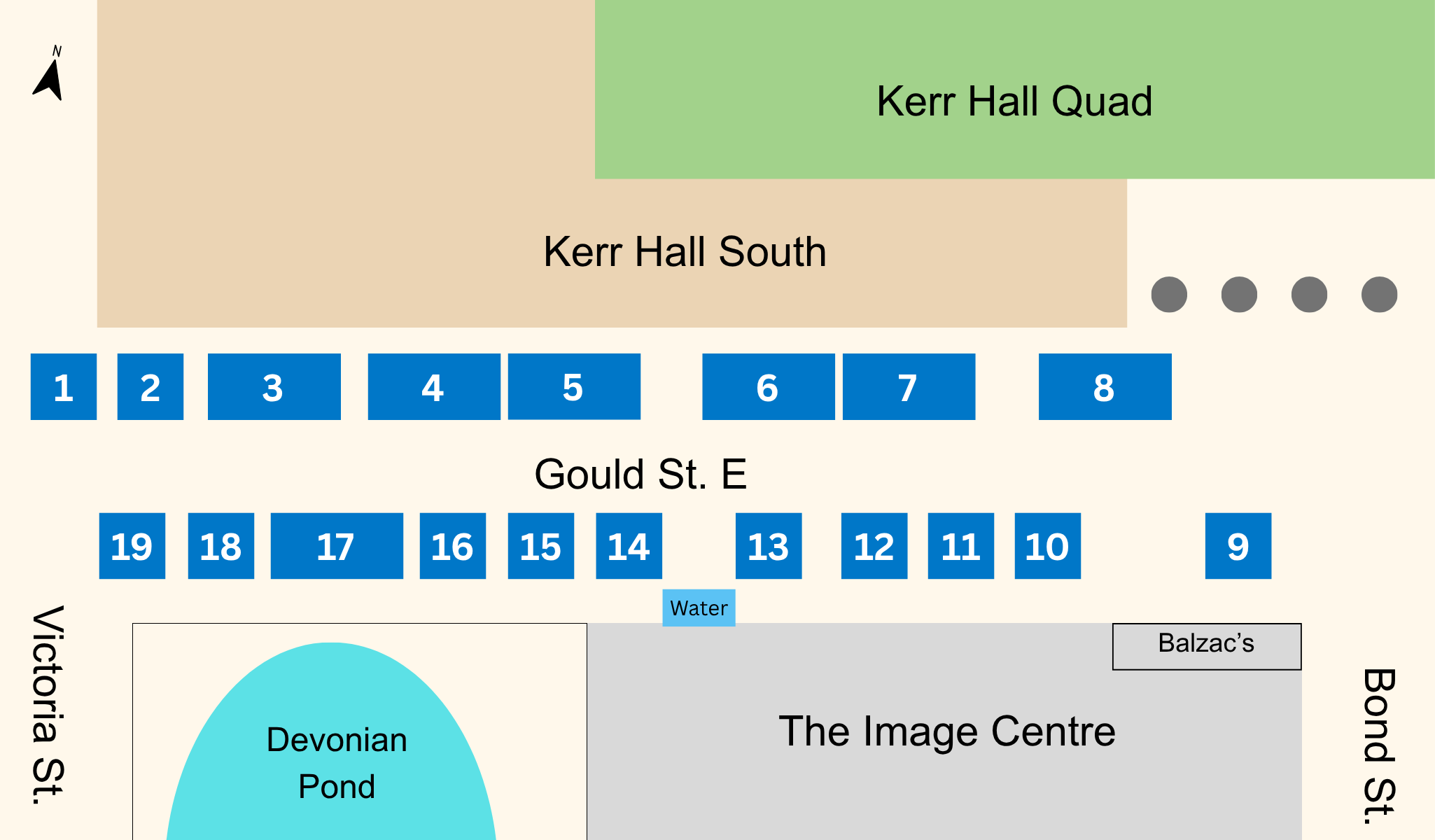
Booth Details
Visit our Information booth for general information and guidance on various activities available to all participants.
Our booth will feature an interactive activity using Ozobots, which are small programmable robots that introduce visitors to basic coding and robotics concepts. Participants will draw coloured lines that the robots can detect and follow, learning how colour combinations can be used to control movement and behaviour. This hands-on activity encourages problem-solving, creativity, and exploration of foundational coding concepts in a fun and accessible way.
Presented by Let's Talk Science (external link, opens in new window) and SciXchange (opens in new window)
We will be demonstrating various aspects of psychological science, spanning brain, perception, and cognition.
Presented by the Department of Psychology at TMU
Visit our booth to discover whirligigs, a versatile toy that has inspired an innovative and cost-effective method for centrifuging blood. Build a magnetic battery train with magnets through a copper coil.
Presented by the Department of Physics at TMU
Sound to hear:
Immerse yourself in our booth's engaging listening activity, where you'll explore a spectrum of frequencies from low to high until you reach your personal frequency maximum.
Sound to see:
Go above 20 kHz (ultrasound), and use an ultrasound scanner to generate sound waves in order to view objects (e.g., rubber duck) in a water bath. These interactive demonstrations will enlighten you about how ultrasound serves as a method to visualize our inner body using sound waves.
X-ray zone:
Two X-ray activities, and an infinity mirror
Presented by the Department of Physics (opens in new window) at TMU
Use a VR headset to immerse yourself in virtual reality projects
Presented by students in the Department of Computer Science at TMU
Use a VR headset to immerse yourself in virtual reality projects
Presented by students in the Department of Computer Science at TMU
The team will bring one of there robots that has competed in the FIRST Robotics competitions. They will explain the workings of it - how it was designed, built, programmed and driven. They will have hands on activities for kids including Lego, screwdriver boards, EV3 robots and more!
This booth is restricted to Science Rendezvous event volunteers.
We explore the mysterious and magical black boxes of deep learning to predict the future! Using pictures from lung imaging, we can use deep learning to make a disease diagnosis.
Presented by Quantitative Image Analysis in Medicine (external link) by Dr. Miranda Kirby
Build your own working lung model to take home!
Presented by Quantitative Image Analysis in Medicine (external link) by Dr. Miranda Kirby
Use X-ray vision to take pictures inside the body to study the lungs. Using these pictures, you can see healthy and diseased parts of the lungs.
Presented by Quantitative Image Analysis in Medicine (external link) by Dr. Miranda Kirby
Family-friendly interactive activities
Canadian Association for Girls in Science (CAGIS) (external link)
DIY cold lava lamp and spontaneous supersaturation
Presented by the Chemical Institute of Canada (CIC) (external link) - Toronto section
ArtSci presents a hands-on origami activity where you can make your own jumping paper frog! As you fold and press the paper, you’re actually storing potential energy in the frog. When you let go, that energy is released and turns into kinetic energy, making the frog jump. It’s a simple, fun way to see a core physics concept in action while getting a bit creative. Great for all ages, come fold, test, and see how far your frog can leap!
Presented by ArtSci student group (external link)
Join us for canoe making and other demos informed by Indigenous ways of knowing.
Presented by the Scixchange at TMU
Participants will explore the fascinating world of plant signalling and communication. Visitors will explore how plants respond to their environment through measurable electrical signals using a simple biosignal setup. By gently interacting with a live plant (for example, touching it, shining light on it, or creating airflow), participants will be able to observe real-time changes in the plant’s electrical activity.
To enhance engagement, multiple plants may be connected to the tool to allow participants to compare responses and explore the idea of plants “talking” or reacting in parallel. This hands-on activity is designed to spark curiosity and demonstrate that plants are dynamic, responsive organisms! The activity will remain flexible and may include additional visual elements, such as images or diagrams, to help the public connect with the concept of plant-environment interactions.
Presented by the Department of Chemistry and Biology at TMU
Learn about our projects concerning road salts and microplastics in water.
Presented by the Urban Water TMU
Water Station
There will be a water station available, near booths 13 and 14. Please help us to reduce plastic water bottle consumption at this event.