Solar plane takes flight thanks to support
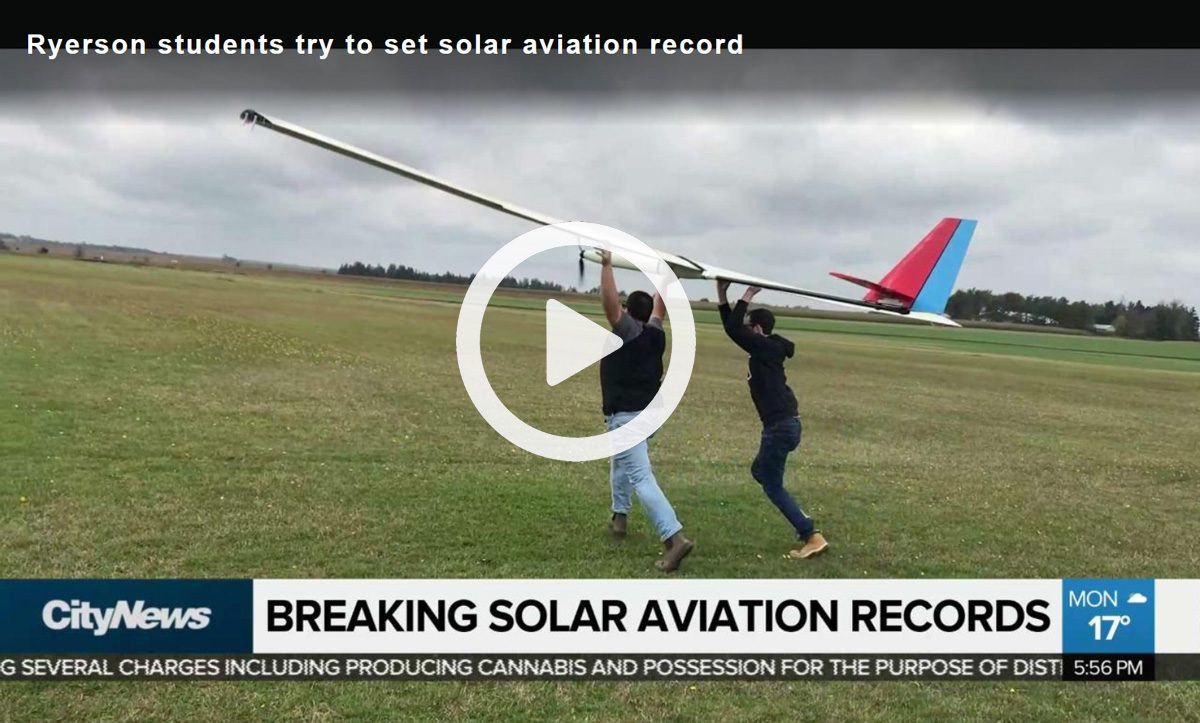
For some, the idea of flying in a plane without an engine is terrifying. But for Dr. Goetz Bramesfeld, an associate professor in the Department of Aerospace Engineering at Ryerson University, sitting in the pilot seat of a glider is pure bliss.
“It’s the most amazing thing you can fly without a motor,” says Dr. Bramesfeld. “You’re up their soaring through the air with hawks and eagles — it’s incredibly aesthetic.”
With the Kenneth M Molson Foundation supporting him since 2015, Dr. Bramesfeld has been able to share his fascination for sailplanes with students, and provide them with opportunities to test the theories they learn in the classroom through the Ryerson Applied Aerodynamics Laboratory of Flight (RAALF).
“I can’t stress enough how instrumental the Kenneth M Molson Foundation has been to the research and direction of the lab,” says Dr. Bramesfeld.
The Kenneth M Molson Foundation was established more than 50 years ago to support charitable and educational organizations in Canada, with a major emphasis on projects of aeronautical engineering education and research. Dr. Bramesfeld uses support from the foundation to fund applied aerodynamics and aircraft design projects with a primary focus on small unmanned aerial vehicles. The research goal is to improve the understanding of the aerodynamics and flight dynamics of small aerial vehicles (drones, gliders, etc.) in order to advance their effectiveness. This includes simulations, analysis, wind-tunnel tests, and flight experiments.
Teams of graduate and undergraduate students in the lab will work separately on rotors or propulsion systems, aerodynamics, materials, aircraft structure and design, and energy or power sources. Then bring all the pieces together to build a craft that can fly. Much of the testing takes place at the Ryerson Aerospace Engineering Centre (RAEC) located at Downsview Park, a 7000 square-foot research facility.
“Ultimately students learn that that aerospace engineering is the design of a system. You have to combine all the other disciplines to build a successful airplane — a series of details to put together the big picture,” notes Dr. Bramesfeld, adding that through this process he endeavors “to prepare students for engineering as opposed to teach them engineering.”
Some applications for ultra lightweight robotic aerial vehicles include long range observation (think mines or pipelines), the ability to follow animal herds without disturbing them (due to low volume), or use by the military to achieve better situational awareness.
Thanks to the Kenneth M Molson Foundation, a variety of aviation projects within the lab have taken flight including, the current project, an ultra-long endurance solar powered aircraft. The clean renewable energy aerial test vehicle has been cleverly named the CREATeV.
Next summer, CREATeV will attempt to fly continuously for 60 days and break the record for longest unmanned flight. The current record is 26 days.
Dr. Bramesfeld believes we are only just starting to get a sense of the possible applications of these types of aircraft. “Electric flight is becoming a reality,” he notes. “Solar cells are ready. Propulsion systems are ready. Batteries are ready. Everything is at a stage where we can put them together and that’s where the challenge resides and the innovation takes place.”
The work at RAALF is also made possible through support from Aventech Research, the Natural Sciences and Engineering Research Council, Record Technology and Development, Advanced Mobility Products, MI Concept + Design, the York Soaring Association, and the Toronto Electric Model Aviation Club.