Ryerson student produces NASA invented material at fraction of cost
Gram-for-gram, aerogel costs three times more than gold.
Aerogel is a low density and high heat resistant silica-based substance, originally developed in the jet propulsion lab at NASA. It is currently used to insulate rockets, space suits and collect comet dust, and is too expensive for experimentation and innovation by the public. Until now. At work in Ryerson’s Science Discovery Zone, second-year Biology student Mark Zaidi, Leslie Capobianco, and chemistry professor, Dr. Bryan Koivisto, have created an alternative means of production to synthesize aerogel.
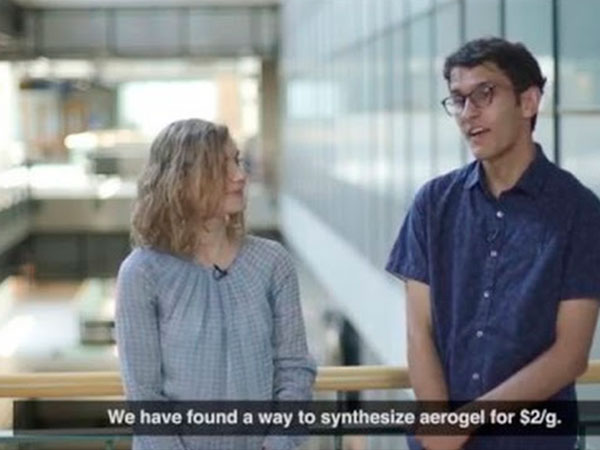
“The cheaper synthesis pathway that we’ve discovered has no carbon footprint, uses minimal energy and has reduced the cost of aerogel from $134 to $2 per gram,” said Zaidi. “After every iteration in the lab, our aerogel is getting more and more transparent – which is evidence of its quality and purity.”
Their project made Zaidi the 2017 winner of The G. Raymond Chang – Sheldon Levy Partnership Award. The award, created by a gift from the late chancellor's son and daughter, Andrew Chang and Brigette Chang-Addorisio, rewards innovative students at work in one of 10 Ryerson zones, and encourages them to further their entrepreneurship endeavours. Zone projects submitted for consideration must challenge the status quo and create something better.
As the third lightest material ever made, and the best insulator in the world, aerogel can have multiple applications with far-reaching impact. Zaidi and Capobianco, co-founders of Entropy Labs, are currently working in the Zone to research and develop more uses for the – now cost-effective – substance. This includes a project with Dr. Umberto Berardi to make windows from the material in order to reduce heat loss in buildings and lower energy costs.