Facilities

SCITHub connects multiple all-electric HVAC systems, lighting, security, information technology, communications, the building envelope and other systems through a shared digital backbone. Across three remotely accessible testbeds, researchers can compare technologies and control strategies side by side, observe how people interact with smart environments and study performance using real-time data.
Key Capabilities:

Three all-electric HVAC configurations: Air-source and water-source variable refrigerant flow (VRF) systems, and water-source heat pumps can be compared side by side on a geo-exchange loop. supporting research into energy optimization and fault detection.

Full-scale home and office environments: Purpose-built residential and workplace settings support human-building interaction research and the development of technologies for homes, workplaces, campuses and cities.

Integrated data and remote research: A shared digital backbone and cognitive digital twin give authorized researchers access to real-time building data and support remote monitoring, analysis and experimentation.

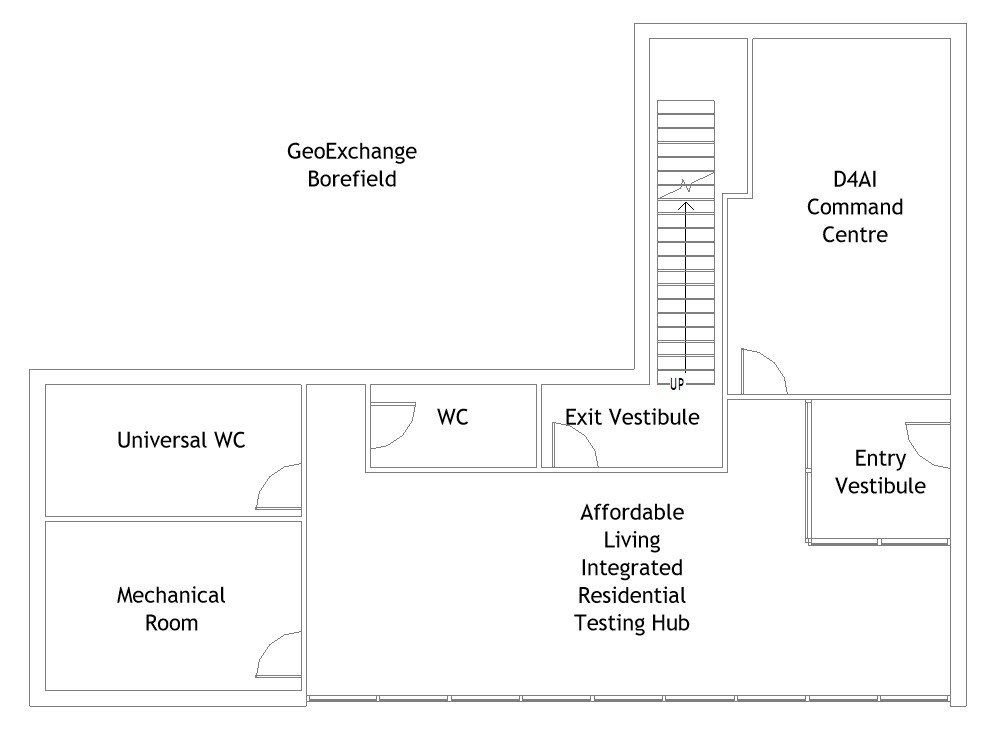
Ground Floor
The ALIRT and the D4AI Command Centre are located on the ground floor. A digital backbone ties together all of the digital equipment and sensors. These are connected to a smart command and control centre, which allows us to integrate a magnitude of building-systems information. The data from the integrated systems and from the broader campus is collected into a brain of sorts, a Cognitive Digital Twin.
The facility’s mechanical systems support side-by-side testing of three all-electric HVAC configurations, including systems connected to a Geo-Exchange loop.
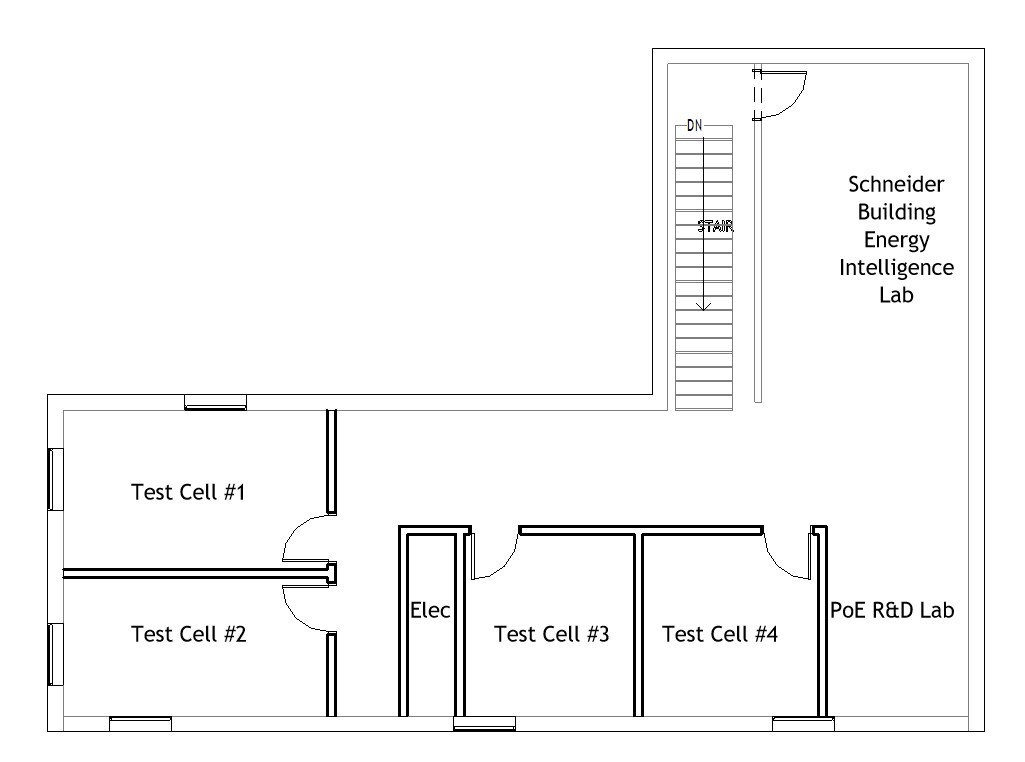
Second Floor
With an open floor plan and partition office spaces, the second floor will also be home to the Schneider Electric Building Energy Intelligence Lab, comprising a visualization suite, a workshop to develop test and validate Power of Ethernet (PoE) Technologies, and four test cells to compare these different technologies and controls in equivalent conditions.
Testbeds
Researchers can develop, test and validate smart-building solutions across three distinct, remotely accessible testbeds.
Smart Home Testbed
Affordable Living Integrated Residential Testbed
Located on the ground floor, the full-scale smart-home testbed supports research related to everyday residential activities including cooking, eating, sleeping, and recreation. Sensors and two HVAC configurations allow researchers to compare system performance and study how smart-home technologies operate under controlled conditions.
Smart Office
Schneider Electric Building Energy Intelligence Lab (BEIL)
The Schneider Electric Building Energy Intelligence Lab is a research space that connects state-of-the-art low-carbon HVAC technologies with power management, lighting, security, and IT/communication systems.
This space is equipped with advanced metering, monitoring, and three individually controllable HVAC systems (water-source VRF, air-source VRF, and water-source heat pumps) to evaluate building performance throughout the operation of these integrated systems. This means researchers can acquire more accurate data to develop better strategies and improved smart technology applications for residential and commercial settings.
D4AI Command Centre (CC)
The D4AI Command Centre (CC) functions like a brain where the BEIC Test Cells and ALIRT connect with a cloud-housed data ingestion, management, and analytics platform.
It will process data (i.e. building automation, campus pedestrian and traffic flow sensors, campus infrastructure monitors, weather stations data, and facility management systems like maintenance, occupant complaints, space planning, etc.) from TMU’s Cognitive Digital Twin. This centre consists of a specialty "data centre in a box" along with a full visualization suite to engage with streamed data from the BEIC, ALIRT, and TMU Campus Digital Twin, as well as remote facilities at the University of Victoria and University of New Brunswick.