Research & Labs
Research & Labs
Research that moves people, machines, and systems forward.

Our faculty and graduate students are tackling the fast-changing needs of society. Working together, and in partnership with industry, they are advancing robotics, mechanics, and systems operation, and how all three connect with people. From biotechnologies that benefit human health to artificial intelligence for 3D printing, this is research with real-world impact.

Research in our department spans mechanical, industrial, and mechatronics engineering, from materials and thermofluids to robotics, human factors, and data analytics. Explore our faculty and the themes driving their work, or find a graduate research supervisor whose interests match yours.
“Industry partnerships allow us to develop knowledge, tools and methods for creating healthy work environments. Collaborating with real workplaces gives students valuable experience and allows us to identify and solve problems before they happen.”
Dr. Patrick Neumann, Professor, Industrial Engineering, and Director, Human Factors Engineering Lab
Students: Get involved in research
Third-year undergraduate students with a CGPA of 3.0 or higher can spend 12 weeks in the spring or summer doing research with a FEAS professor through the Dean’s Research Fund Undergraduate Research Experience (DRF-URE). Professors apply on your behalf, so reach out to faculty whose work interests you.
Our labs and facilities give students and researchers hands-on access to equipment for robotics, materials testing, metal casting, thermofluids, sustainable energy, and more.
Two of our faculty hold Tier 2 Canada Research Chairs, advancing research that makes energy use cleaner and more efficient.
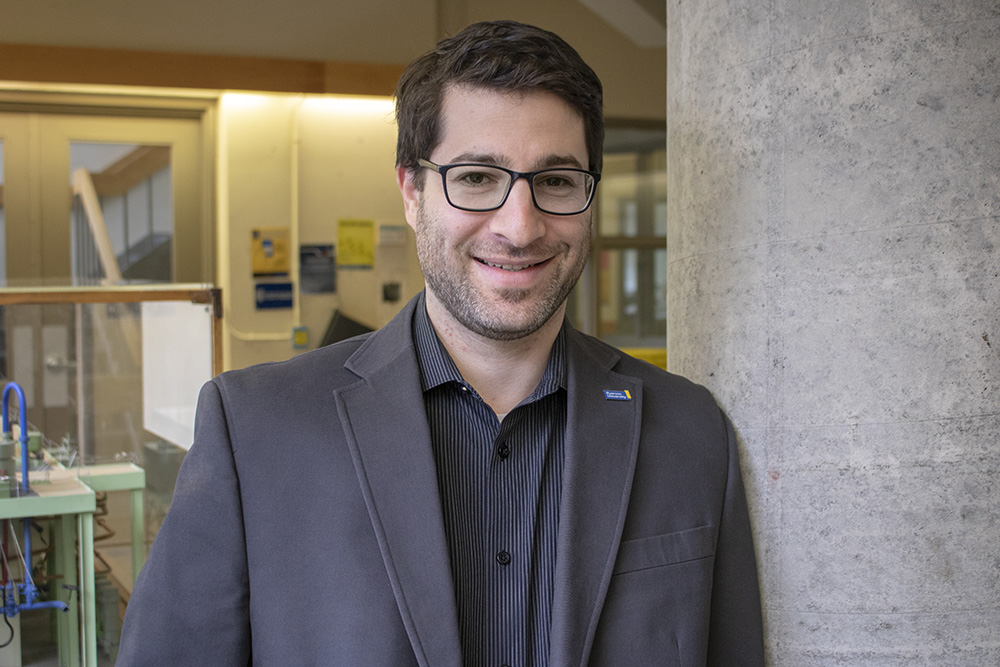
Dr. Seth Dworkin
Canada Research Chair (Tier 2) in Sustainable Energy Modelling and Simulation, 2017 to 2027
Dr. Dworkin works to reduce emissions from aircraft engines and from geothermal heating and cooling systems. Using computer models, he finds ways to improve how these systems perform and builds models that industry can adapt and use.

Dr. Sharareh Taghipour
Canada Research Chair (Tier 2) in Physical Asset Management, 2018 to 2029
Dr. Taghipour is working to reduce greenhouse gas emissions in industries such as transportation, commercial buildings, and heavy manufacturing. She develops new methods to improve energy efficiency by optimizing physical assets like turbines, transformers, and dams. Her work also helps carbon-intensive industries, such as mining, iron, and steel, operate more sustainably.