Research Group of Eric De Giuli

Eric De Giuli
Associate Professor
edegiuli@torontomu.ca
Office: KHS 331B
The De Giuli group studies the statistical physics of complex systems. Current interest focuses on two topics: (i) emergent behaviour in chemical reaction networks, with applications to biology, and (ii) ensemble models of language, with applications to first language acquisition in humans and machine learning.
Complex systems involve huge numbers of interacting parts, and what we aim to understand is their emergent behaviour: what 'phases' are possible, what controls transitions between them, and so on. Since complex systems are out of thermal equilibrium and typically involve many non-dynamical degrees of freedom, new analytical methods are needed. We take advantage of analogies between various areas of physics and beyond to transfer knowledge from one domain to another. For example, EDG proposed a model of random languages, combining ideas from linguistics with those of statistical physics; to understand this model theoretically, a mapping was created to field theories studied in high energy physics. In other recent work, we exploit a mapping between stochastic systems and control theory.
Students are expected to have strong analytical skills and to be able to work independently. We can currently only recruit domestic (Canadian citizen / permanent resident ) students.
Watch a recent colloquium by Dr. De Giuli (external link) :
Complexity, noise, and control (May 2026)
Recent Publications from Group
Google Scholar for Eric De Giuli (external link)
- Eric De Giuli, “Noise equals control”, Phys. Rev. E 112.2 (2025): 024142. Journal link. (external link)
- David Wolpert, Jan Korbel, Christopher W. Lynn, Farita Tasnim, Joshua Grochow, Gülce Kardeş, James B Aimone, Vijay Balasubramanian, Eric De Giuli, David Doty, Nahuel Freitas, Matteo Marsili, Thomas E Ouldridge, Andrea W. Richa, Paul Riechers, Edgar Roldán, Brenda M. Rubenstein, Zoltán Toroczkai, Joseph Paradiso, “Is stochastic thermodynamics the key to understanding the energy costs of computation?”, Proc. Nat’l. Acad. Sci. 121 (45), e2321112121. Journal link. (external link)
- Fatemeh Lalegani and Eric De Giuli, “Robustness of the random language model” Phys. Rev. E 109, 054313. Journal link. (external link)
- Masanari Shimada, Pegah Behrad, and Eric De Giuli, “Universal slow dynamics of chemical reaction networks” Phys. Rev. E 109, 044105. Journal link. (external link)
- Camille Scalliet and Eric De Giuli, “Dynamical mean-field theory: from ecosystems to reaction networks” J. Phys A 55 474002. Journal link. (external link)
- Eric De Giuli, “Corrigendum: Emergence of Order in Random Languages” J. Phys A 55 (48), 489501. Journal link. (external link)
- Masanari Shimada and Eric De Giuli, “Random quench predicts universal properties of amorphous solids,” SciPost Phys. 12, 090. Journal link. (external link)
- Faheem Mosam, Diego Vidaurre, and Eric De Giuli, “Breakdown of random matrix universality in Markov models,” Phys. Rev. E 104, 024305. Journal link. (external link)
- Eric De Giuli and A. Zee, “Glassy Gravity,” Europhys. Lett 133, 20008. Journal link. (external link)
- Eric DeGiuli, “Renormalization of Elastic Quadrupoles in Amorphous Solids,” Phys. Rev. E 101, 043002. Journal link. (external link)
- Eric DeGiuli, “Emergence of Order in Random Languages,” J. Phys. A. special issue celebrating Giorgio Parisi 52 (50), 504001. Journal link. (external link)
- Eric DeGiuli, “Random Language model”, Phys. Rev. Lett. 122, 128301. Journal link. (external link)
- Eric DeGiuli, “Field theory for amorphous solids”, Phys. Rev. Lett. 121, 118001. Journal link. (external link)
Graduate students in Group
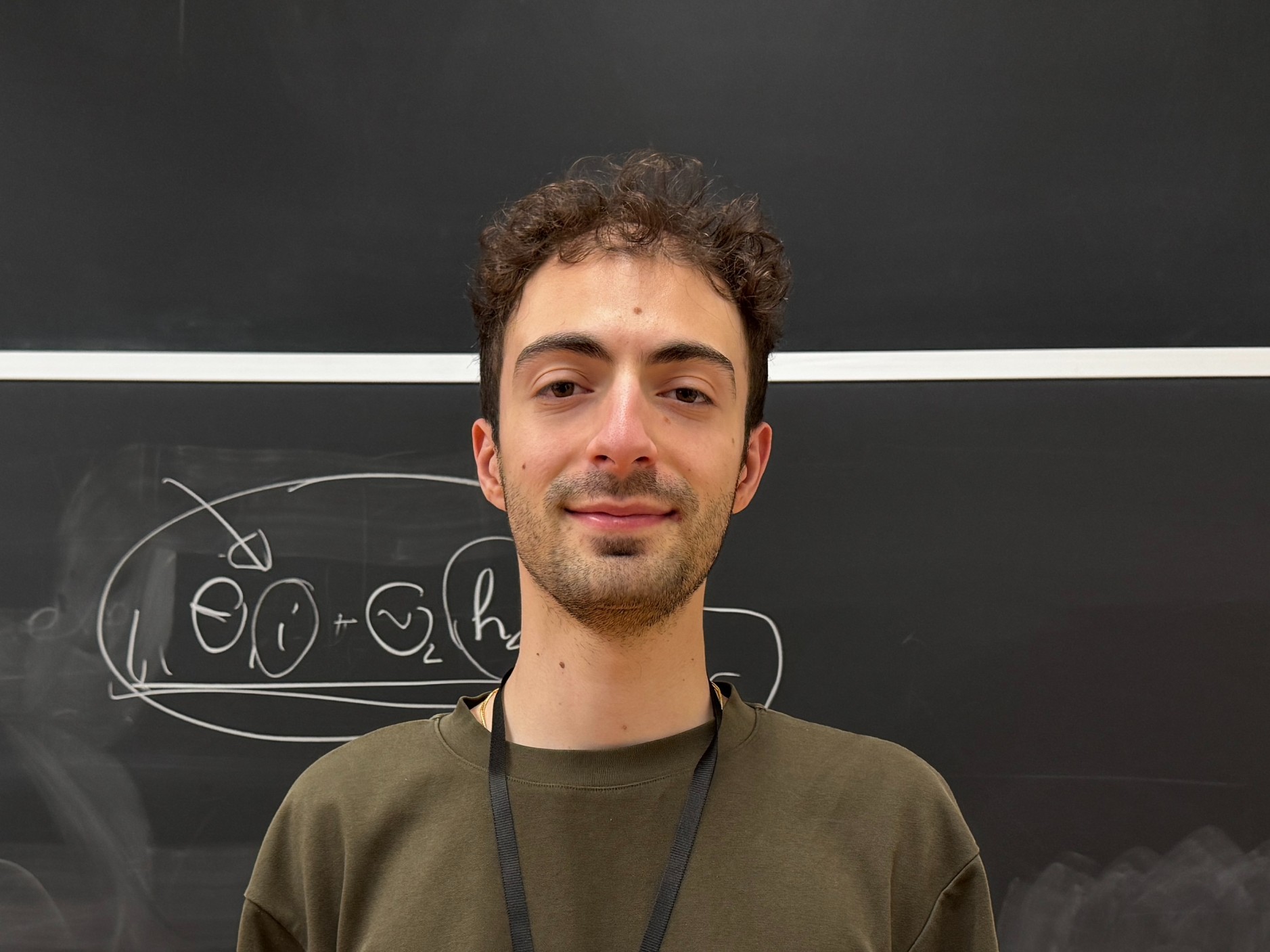
Mattia Altomare
MSc student

Jia Yi Ren
MSc student