Frequently asked questions
Toronto Metropolitan University funding
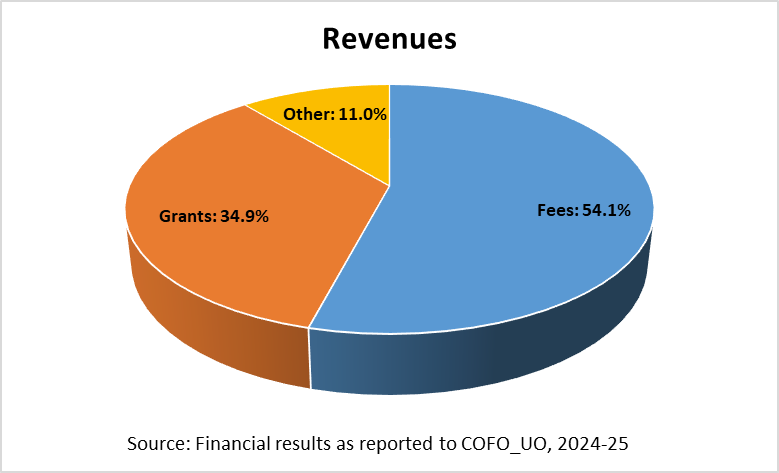
Close to 90 per cent of our operating revenues are related to enrolment. Approximately 54 per cent of our operating revenue comes from tuition fees, 35 per cent from grants, and 11 per cent from other income-generating activities.
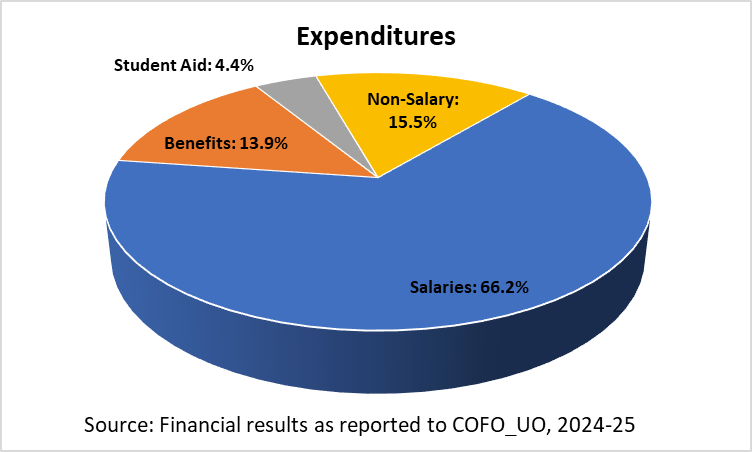
The majority of our expenditures are for academic and student support operations, with remaining funds supporting activities such as building maintenance, campus computing and technological services, research services, and administrative functions.
Four-fifths of our operating expenditures are for salaries and benefits, a share that has been increasing over time. The majority of these costs are determined by negotiated collective agreements with our three main unions: the Toronto Metropolitan Faculty Association (TFA), the Ontario Public Service Employees Union (OPSEU), and the Canadian Union of Public Employees (CUPE).
In 2019-20, the Government of Ontario required universities to reduce domestic tuition fees by 10 per cent relative to 2018-19 levels. This brought fees back to approximately 2015-16 levels. Fees remained frozen at that reduced level through 2025-26 with no adjustments for inflation.
The federal government’s cap on international student visa applications limits TMU’s ability to enroll international students and makes Canada a less attractive destination for potential international students. Lower international enrolment further limits fee revenue for the university.
In February 2026, the Government announced that tuition could be increased by 2% per year for three years beginning in 2026-27, and the lower of 2% of the rate of inflation after that. This change will help the institution as fees represent an important component of our revenues. However, the impact of the previous reduction and freeze mean that initial increases will be based on the decade-old fee level and will not keep pace with annual inflation.
Government operating funding per student also remained frozen for years, and the number of domestic enrolments at TMU exceeded the level that was funded by the province. In February 2026, the Government announced an increase to the per-student operating grant and an increase in funded enrolment levels for colleges and universities. These are welcome investments that are expected to bring a measure of stability to our sector.
The February 2026 government announcement regarding tuition and operating grants has improved the financial outlook for TMU in 2026-27. Early information about government funding suggests that we will not have a budget shortfall for this year, but our financial picture remains constrained for the years ahead as tuition fees will not keep pace with inflation.
Significant work is underway on implementation of the recommendations of the third-party Efficiency and Accountability Review conducted for TMU in 2025. While the implementation of the recommendations is expected to improve efficiency at TMU and improve the university’s financial picture, the efficiencies identified do not fully address the university’s financial challenges.
Toronto Metropolitan University will continue to develop plans and options to address potential revenue shortfalls.
Toronto Metropolitan University’s 2025-2030 Academic Plan incorporates extensive feedback from students, faculty, and staff. In an environment of constrained funding, it is essential that allocations be targeted to our highest priorities. The five priorities identified in the Academic Plan will guide the direction of the university:
- Enhance the learning journey for greater student success;
- Create positive impact through SRC excellence and local and global collaboration;
- Support people and community;
- Continue our commitment to Truth and Reconciliation; and
- Ensure future readiness.
Toronto Metropolitan University has also undertaken broad internal and external consultations on a range of foundational strategies that will help guide and shape our institution. A developing blueprint, these complementary plans (including the Academic Plan) articulate our academic and strategic directions:
Uniting these plans is the Strategic Vision 2020-2030. This overarching framework serves as the foundation or roadmap, moving Toronto Metropolitan University toward the same vision and goals.
Donations tend to be directed to support designated student bursaries, short-term initiatives or specific projects such as capital, rather than being available for general operating purposes.
For permanent staff positions and long-term commitments (e.g., maintenance of buildings, utilities), the university cannot rely on short-term donations or other one-time-only funds such as short-term grants or contracts.
The new School of Medicine is supported by new, incremental revenue that is not related to other TMU programs. The Government of Ontario has committed funding for 94 undergraduate and 105 postgraduate seats per year that are resourced separately from TMU’s existing enrolment. Funding for the School of Medicine’s facilities has come from different levels of government and donations. Private donors have also provided funding for financial assistance for students at the School of Medicine.
Ontario is facing a shortage of primary care physicians who are unevenly distributed across communities, contributing to growing unmet care needs. For example, Brampton is one of Canada’s most culturally diverse and fastest-growing cities. Despite this, Brampton residents experience significant challenges with access to appropriate, high-quality primary care. TMU has engaged with the community and the surrounding region to develop a model for health care that can be adopted throughout Ontario and beyond.
Audited financial statements are available online.
Detailed information, including estimates of annual revenues and expenditures, can be found at the following locations on Toronto Metropolitan University’s website:
The federal government sets a cap for each province, and individual provinces decide on the allocation among their institutions. TMU’s allocation for international student visa applications has resulted in reduced international enrolment in recent years. The implementation of caps has also created a challenging environment for recruiting international students to study in Canada. For 2026, the federal government has announced plans to further reduce the number of international student visas from 2025 levels.
Our university has taken a measured approach to international enrolment, with just over 10 per cent of our enrolment accounted for by international students in recent years, compared to a system average of close to 20 per cent. That said, the decline in international enrolment at TMU has had a material impact on our university.
In 2024-25, TMU undertook a government-funded Efficiency and Accountability review conducted by a third-party. The review led to a series of recommendations to reduce costs and generate additional revenue at TMU.
Increasing efficiency is a priority and TMU is moving forward with assessment and implementation of the review’s recommendations. The University’s budget planning for 2026-27 will take into account the projected savings.
However, the reviewers noted that their recommendations were insufficient to address the university’s financial challenges. Limited operating funding and challenges related to tuition fee revenue present ongoing financial challenges for the university.
Students and enrolment
We understand the financial burden faced by many students. Student support expenditures by the university for 2025-26 to date (as of January 31, 2025) total $48.4 million, up from last year.
In addition, the Government of Canada has suspended the accumulation of interest on Canada Student Loans and Canada Apprentice Loans as of April 1, 2023. We understand that the province announced changes to OSAP, the provincial portion of student assistance, that changed the mix of loans and grants that would be issued.
TMU remains committed to ensuring that students have access to a high-quality university education regardless of their financial status.
More information about financial support is available on the Student Financial Assistance website.
As demonstrated in past years, Toronto Metropolitan University is focused on our core values throughout the budget-planning and consultation process – especially protecting and enhancing the student experience. The 2026-27 budget cycle will continue to prioritize the student community.
TMU’s Academic Plan: Transforming Futures 2025-2030 identifies student experience and supporting people and community as key priorities. A number of faculties and areas have developed plans to support these priorities, in particular initiatives to review and optimize their academic and other supports for students.
TMU will soon open and operate an integrated Student Wellbeing Centre that will bring a number of key services together, enhance service levels and simplify navigation of student supports. The university also continues to prioritize international student support.
TMU participates in the Student Access Guarantee as required by the provincial government, covering direct costs for unmet need as assessed by OSAP through scholarships, bursaries or work-study employment.
Given student demand for Toronto Metropolitan University programs, we are on track to meet domestic enrolment targets for Fall 2026. It is important to note that Toronto Metropolitan University is unable to significantly increase domestic enrolment because the provincial government sets the number of funded spaces.
The federal government’s cap on international student visa applications presents significant challenges with international enrolment planning. Our current level of international enrolment is low relative to other Ontario universities, and increasing this is an important objective.
The G. Raymond Chang School of Continuing Education offers a combination of degree-credit and certificate-credit courses. Degree credit enrolment is counted as part of our enrolment that is funded by the government, which is capped at the overall university level. Other Chang School enrolments that are not degree-credit are not subject to limits and we will work to increase enrolment in these courses.
Approximately 90 per cent of our operating revenues come from tuition fees and grants associated with enrolment. In other words, our financial health as an institution relies on enrolment. Demand for Toronto Metropolitan University programs is strong. That said, funded domestic spaces are set by the provincial government, which precludes us from generating significant additional revenue by increasing the number of domestic students.