Jake Okechukwu Effoduh

Assistant Professor
Department: Lincoln Alexander School of Law
Email: effoduh@torontomu.ca
Education: PhD Candidate (Osgoode Hall Law School)
Discipline: Law
Areas of Expertise:
Artificial Intelligence
Discrimination & Identities Law
International Human Rights Law
International Institutions & Development Law
Law, Communications & Culture
Non-Profit Law
Technology Law & Justice
Third World Approaches to International Law (TWAIL)
Dr. Jake Effoduh’s research focuses on the intersections of AI, human rights, and international law. He has contributed to AI policy development across a broad range of countries, including Canada, the United States, Brazil, Kenya, South Africa, China, and Nigeria. He has also carried out legal advocacy within sub-regional and regional systems like the Inter-American Commission, the ECOWAS Court, the East African Court, the African Commission, and the UN Human Rights Council.
Dr. Effoduh is executing a SSHRC-Explore Grant titled “Codes for Algorithmic Justice”, where he is evaluating regulatory solutions for algorithmic bias against Black Canadians. He is the convener of “Black Futures by Design”, an expert consultation advancing racial justice in AI governance and regulation. Dr. Effoduh has held fellowships at Harvard Law School, Harvard Kennedy School, Carnegie Mellon University, the University of Ottawa, and the University of Cape Town. He is currently a 2025/26 Rogers Cybersecure Catalyst Fellow and the Editor-in-Chief of the Transnational Tech Law Review. He is also an Editor of the Transnational Human Rights Review. He is a UNESCO Expert on AI and the Rule of Law, providing training to judges, law teachers, and legal officers on the use of AI in legal and judicial contexts.
Dr. Effoduh has delivered lectures at universities in Canada, Nigeria, Kenya, South Africa, Germany, Spain, and the UK. As a Vanier Scholar and Ph.D. candidate at Osgoode Hall Law School, Effoduh is examining how the legitimization of AI is impacting the pursuit and realization of human rights in Africa and investigating whether the technology will solve or exacerbate the “popular legitimization crises” that activist forces face in the region.
Some of his works have been published in the Harvard Human Rights Journal, Oxford University Press, Cambridge University Press, the Journal of Robotics, AI & Law, the Journal of Scholarly Publishing, the Journal of Sustainable Development, Law and Policy, the African Journal of Legal Studies, and the TWAIL Review.
Scholarly Calling
My current research investigates new ways in which artificial intelligence is legitimized across various jurisdictions and its impact on human rights praxis. I am exploring the potential for the critical governance of artificial intelligence systems to effectively address algorithmic bias against Black people, Africans, and people of African descent, as well as discrimination and unfair treatment from algorithmic decision-making based on protected characteristics such as race, gender, identity, and ethnicity.
I teach content that intentionally includes representation from a broad cross-section of Canadian and international society. For me, diversity is strength. It is in the broadest sense knowing that our community is comprised of students and faculty from all over the world who have a wide variety of backgrounds, nationalities, skills, characteristics, and social identities.
I pay close attention to the ways that status, privilege, opportunity, and access to resources systemically correlate with social identities.
Related Content
- Effoduh, J.O “Colonial Judicial Legacy as a Latent Challenge for the Adoption of Algorithmic Sentencing in African Courts” (Opinio Juris), October 2024 [peer-reviewed article]
- Effoduh, J.O (2024). Africa’s Energy Poverty in An Artificial Intelligence (AI) World: Struggle for Sustainable Development Goal 7. The Journal of Sustainable Development, Law and Policy. Vol. 15:3. 32-63. DOI:10.4314/jsdlp.v15i3.2. ISSN: 2467-8406 (Print) 2467-8392 (Online) Journal homepage: [peer-reviewed journal article]
- Effoduh, J.O “Africa’s AI Odyssey: Surfing the waves of innovation amidst digital storms” (Econolicy Africa), September 2024 [opinion editorial]
- Effoduh, J. O., Akpudo, U. E., & Kong, J. D. (Cambridge University Press, August 2024). “Toward a trustworthy and inclusive data governance policy for the use of artificial intelligence in Africa”. Data & Policy, 6, e34. doi:10.1017/dap.2024.26 [peer-reviewed journal article]
- Effoduh, J. O “A Global South Perspective to Explainable Artificial Intelligence” (Carnegie Endowment for International Peace) April 2024 [peer-reviewed journal article]
Before joining Lincoln Alexander Law, Effoduh served as Chief Counsel of Africa–Canada AI and Data Innovation Consortium, mobilizing AI and big data techniques to build governance strategies. He is also the project coordinator of Canada’s Rights Role in Sub-Saharan Africa, a multi-year interdisciplinary SSHRC-funded partnership between Canada and several African countries.
For the latest updates, please visit the faculty page linked below.
Selected Media & Activities
 (opens in new window)
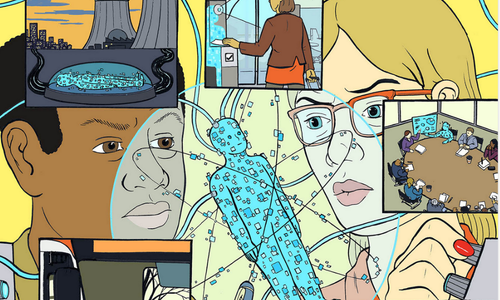
How TMU’s Jake Effoduh prepares law students for AI’s real impacts, written by Toronto Met University Magazine
 (opens in new window)
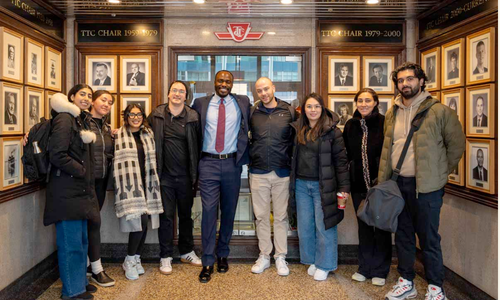
Article written by Lincoln Alexander School of Law titled "Prof. Effoduh empowers law students to tackle TTC fare evasion"
 (external link, opens in new window)
Fighting For Justice Beyond Borders: Jake Okechukwu Effoduh’s journey from grassroots advocacy to cyber law