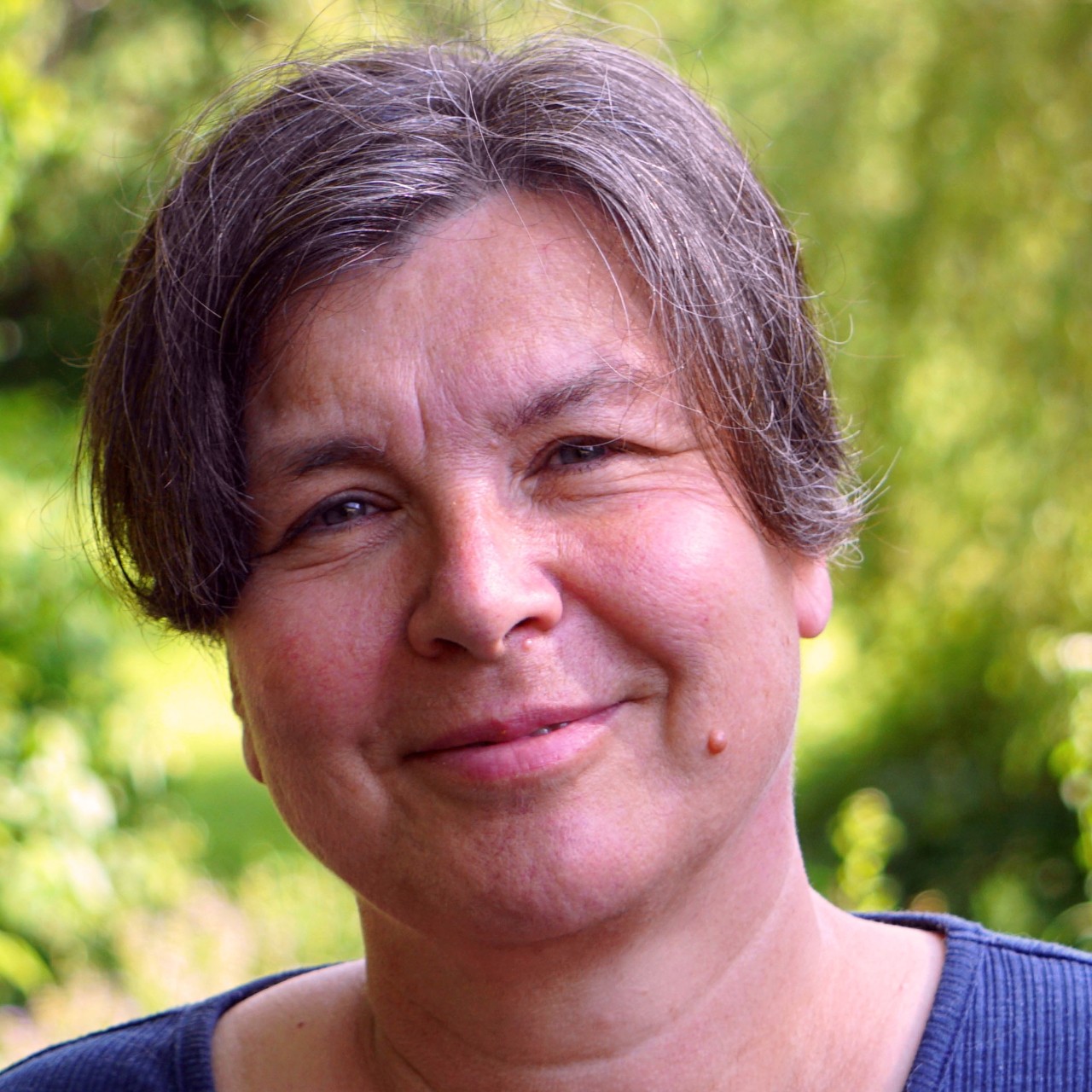
Dr. Alex Bal
Dr. Alexandra Bal is an associate professor in the new media program and a member of Slolab at York University. She has done funded research focused on the impact of social digital media on children and youths. As a neurodivergent person, she got interested in how we communicate through the body. She researches and writes about how to counter the impact of western culture on our senses and our environments by develop regenerative creative practices, which can thrive once a human develops their own unique sensory literacy and forms of communication. Her digital photography focuses on creating nature vivante photographs, portraits that celebrate natural sentience. She also participates in ecological art by decolonizing land. For the last 21 years, she has stewarded farmland that has now become a young forest. She teaches courses focused on creativity, media ethics, new media art history, regenerative justice cultures and new media creative practices.
- Regenerative cultures, eco and body justice, neurodivergence ways of being, communicating and knowing.
- Embodied knowledge and communication.
- Highly sensitive people's ways of knowing literacy.
- Humans as planetary technology.
- Botanical creative technologies.
Funded Projects:
- 2025 - The Arts Impact Project (TAIP), SSHRC Partnership Grant, PI: Dr. Natalie Alvarez.
- 2016-2018 Posting 4 Peace/Publicar para la Paz (P4P) study on youth, social media and violence in Trinidad. Funded by the Social Sciences and Humanities Research Council of Canada (SSHRC), PI Dr. Hernández-Ramdwar.
- 2010-2012 Voices from digital natives: informal learning and sociable media in child and youth cultures. Funded by the Social Sciences and Humanities Research Council of Canada (SSHRC), PI Dr. Jaon Nolan.
Contributions:
- Oskam, Pierre, Bal, Alexandra & Louise Raclet. Exploring More-Than-Human Agency in Design: Bio-Inclusion in Prototyping Urban Reefs, WAD?2024, Oct 9th, 2024.
- Bal, Alexandra. “(Re)discovering embodied sentience as a way out of the Anthropocene.” International Society of Electronic Arts 2020.
- Hernandez-Ramdwar, Bal Alexandra and Berti Olinto “Posting 4 Peace / Publicar Para la Paz Pilot Project”, Trinidad in 43rd Annual Conference, Caribbean Studies Association (CSA) Education, Culture and Emancipatory thought in the Caribbean Havana, Cuba, 4th to 8th of June 2018.
- Bal, Alexandra, Camille Hernandez-Ramdwar, Berti Olinto. “The Role of Social Media in Trinidad and Tobago’s Youth Relationship to Violence”, 13TH Annual Caribbean Child Research Conference, UWI, ST. Augustine, Trinidad & Tobago, Nov. 15, 2018.
- Bal, Alexandra, Yukari Seko and Jason Nolan “Digital Space as Semi - Permeable Membranes”, AoiR 12 Performance and Participation, Seattle, October 12, 2011.
- Bal, Alexandra. “Learning in Liminal Spaces”, in symposium: Informal Learning and Sociable Media in Children’s Culture, American Education Research Association Annual Meeting, New Orleans, April 9th, 2011.
- Bal, Alexandra. “Future DIY Citizenship: A Question of Autonomy”, DIY Citizenship: Critical Making and Social Media, University of Toronto, November 13, 2011.
- Bal, Alexandra. “Communities of praxis: The Second Life and OLPC components of a mixed-reality primer,” IR 9.0 - Rethinking Communities, Rethinking Place, Copenhagen, presenter, October 2008.
- Bal, Alexandra. “Second life: émergence de communautés de pratiques humaines et artificielles?” Colloque « Web participatif : mutation de la communication? », 76e congrès de l’ACFAS, Institut national de la recherche scientifique, Québec, May 6th and 7th, 2008.
- Bal, Alexandra. “Can Second Life House Artificial Organisms?” Toronto/Montreal/Lille: TOGETHER ELSEWHERE - A biennial of artistic exchange -third edition January 31st through February 2, 2008. Montreal: Presse de l’Université du Québec.
- Bal, Alexandra. “L’autonomie de l’apprenant: un enjeu pour la globalisation de l’éducation virtuelle,” in Bugs 2001, Globalism and Pluralism, Colloquium proceedings, UQAM.