Dr. Vaseem Shaik
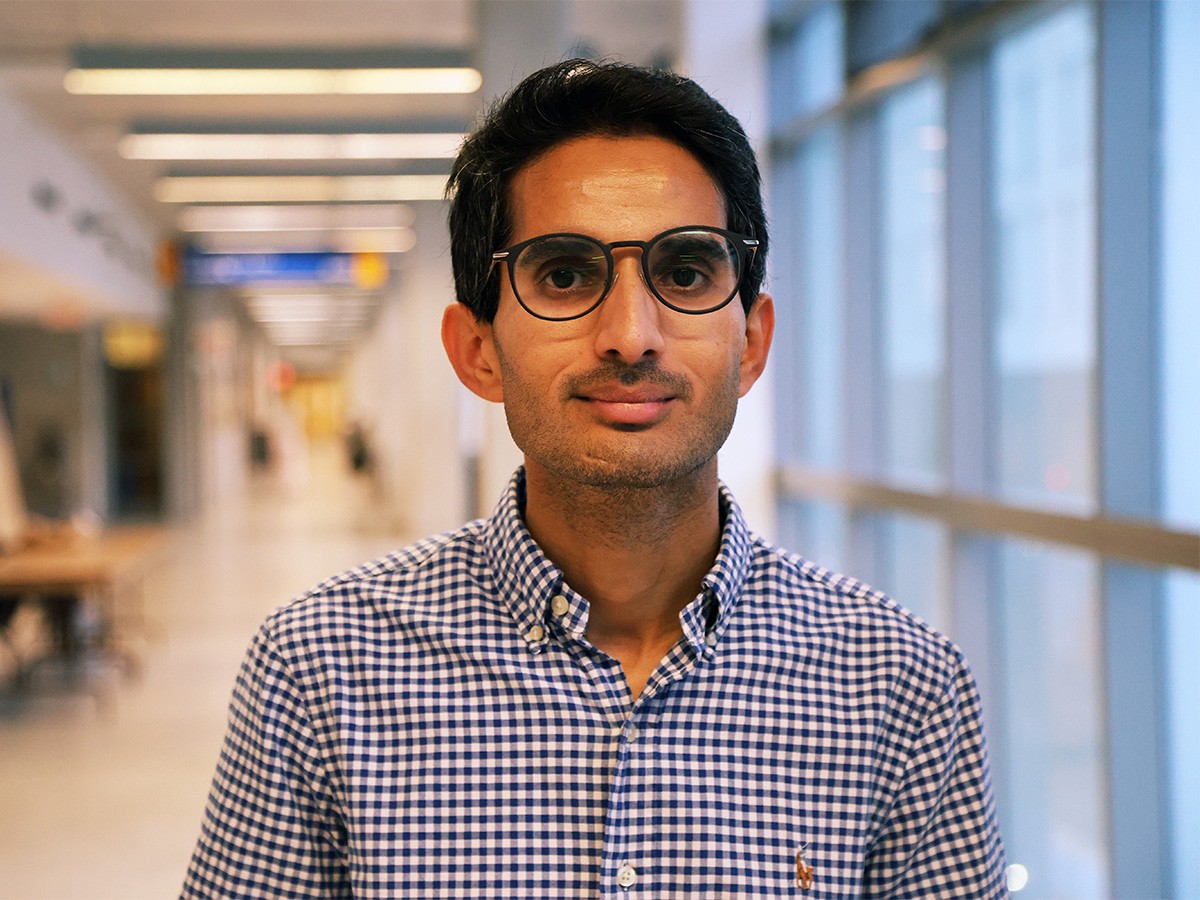
“I use math and physics to reveal how microscopic life moves and adapts.”
Dr. Vaseem Shaik investigates the fluid-dynamics principles governing the motion of small swimming organisms. Motivated by naturally occurring phenomena and laboratory experiments, his research uses applied mathematical tools, such as asymptotic analysis and numerical modelling, to uncover the physical mechanisms that govern swimmer motion in complex fluid environments. Shaik’s work aims to advance our understanding of active matter—suspensions of self-propelled entities such as swimming organisms—and informs a range of applications, including targeted drug delivery, biofuel production and climate change.
Throughout his research journey, Shaik has embraced interdisciplinary collaboration and explored emerging technologies to advance his research, and he has recently begun incorporating artificial intelligence and machine learning tools into his work. Before joining Toronto Metropolitan University as a professor in the Department of Mechanical, Industrial and Mechatronics Engineering, Shaik was a Visiting Assistant Professor at Northwestern University and a Postdoctoral Research Fellow at the University of British Columbia.
Research Highlights
Investigating how tiny swimmers navigate ocean density gradients.Shaik and fellow researchers uncovered how small (μm-mm sized) organisms like plankton swim through the density gradients prevalent in oceans, lakes, and ponds. These organisms exhibit directed motion in response to density gradients—a behavior that may, in turn, aid or hinder the diel vertical migration. |
Exploring how swimmers cross sharp viscosity gradients.Recent experiments show that green algae encountering a sharp viscosity gradient (or interface) can either cross the interface by undergoing some reorientation or reflect from it, much like light refracting or reflecting between optical media. Building on this analogy, Shaik and team members developed a Snell’s-like law that predicts how microorganisms reorient across viscosity interfaces. |
Additional Info
1. V. A. Shaik, J. Gong and G. J. Elfring, "Durotaxis in viscoelastic fluids", Physical Review Fluids, 10, L071301, 2025
2. V. A. Shaik and G. J. Elfring, "Densitaxis: Active particle motion in density gradients", Proceedings of the
National Academy of Sciences, 121, e2405466121, 2024
3. J. Gong, V. A. Shaik and G. J. Elfring, "Active spheroids in viscosity gradients", Journal of Fluid Mechanics, 984, A26, 2024
4. V. A. Shaik, Z. Peng, J. F. Brady and G. J. Elfring, "Confined active matter in external fields", Soft Matter, 19, 1384-1392, 2023
5. J. Gong, V. A. Shaik and G. J. Elfring, "Active particles crossing sharp viscosity gradients", Scientific Reports, 13, 596, 2023
6. V. A. Shaik and A. M. Ardekani, "Drag, deformation, and drift volume associated with a drop rising in a density-stratified fluid", Physical Review Fluids, 5, 013604, 2020
Member, American Physical Society (APS)
Research published on EurekAlert! (external link) and covered by Tech and Science Post (external link) , Eco Magazine (external link) , MirageNews (external link) , and Phys.org (external link)
- Visiting Assistant Professorship, Northwestern University, 2024
- Bilsland Dissertation Fellowship, Purdue University, 2019