Implementation Plan
This project is conducting primary research on the decision-making of English-speaking and French-speaking highly skilled migrants and international students to migrate to Canada. Starting by reviewing the relevant literature, the research adopts a mixed-methods approach using complementary quantitative (an online survey), qualitative (semi-structured qualitative interviews and focus groups, conducted online, or in person if possible), and quasi-experimental methods (where a group of highly skilled migrants are faced with a fictitious context within which they have to make decisions).
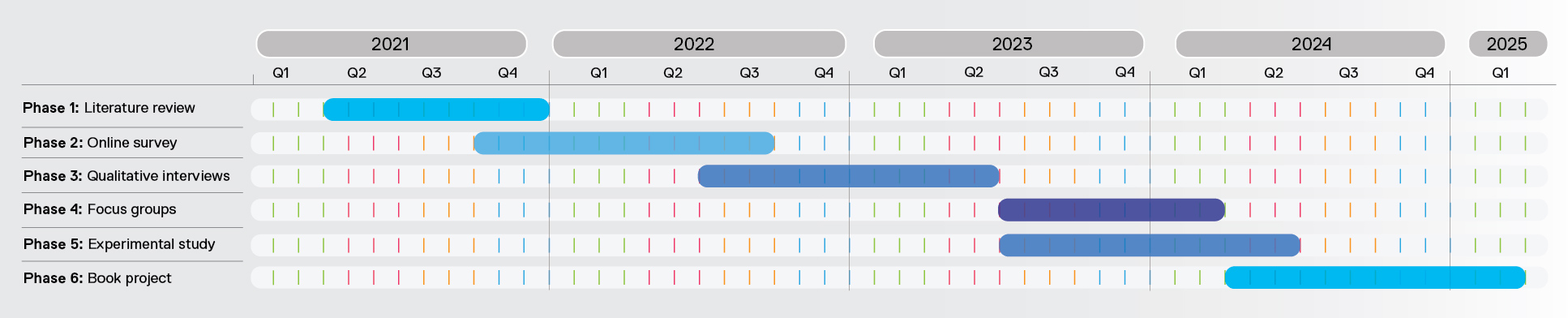
In this phase, we conducted a comprehensive literature review and expert interviews with relevant English-speaking and French-speaking stakeholders involved in Canadian immigration management. We conducted semi-structured in-depth interviews with 22 English-speaking and 12 French-speaking stakeholders. These included government officials, settlement service providers, immigration lawyers, credential evaluation providers, trade union representatives, journalists, and post-secondary education institution representatives.
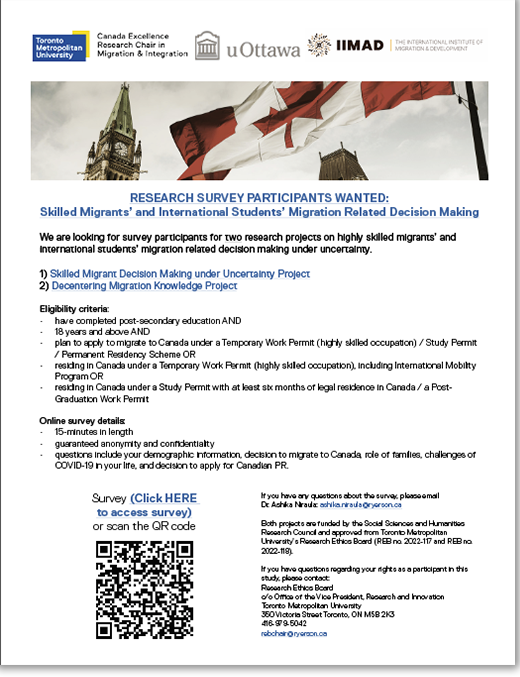
We conducted two parallel online surveys targeting prospective and actual highly skilled migrants and international students who intend to migrate to Canada. The same questionnaire was administered in both English and French surveys to ensure linguistic inclusivity and comparability.
The English language survey gathered responses from more than 1000 participants, while the French language survey included over 400 participants. The survey examined how the COVID-19 pandemic influenced migration decisions, including the timing, key motivations and concerns, and other factors, such as family and intermediaries, shaping migration plans.
The survey also explored sources of information influencing migration plans; the role of socio-demographic characteristics (such as age, gender, sector of employment, family situation, and country of origin), and how changes in immigration policies, employment opportunities, and health risks influenced decisions to migrate to Canada and apply for permanent residency.
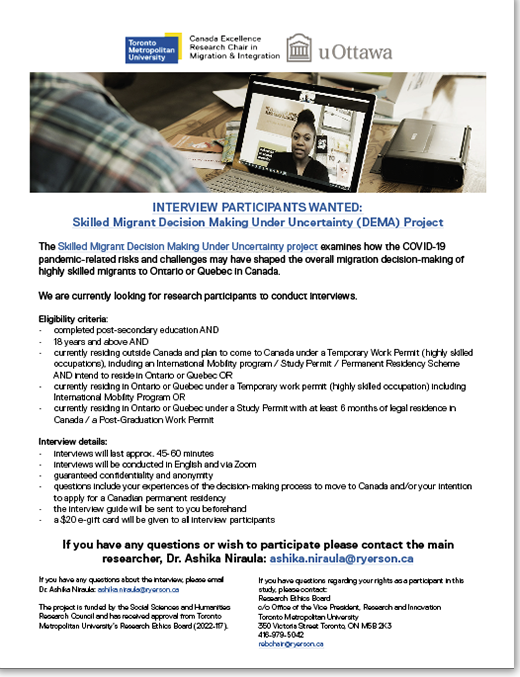
In this phase, we conducted 130 semi-structured, in-depth interviews with prospective and actual English-speaking highly skilled migrants and international students, and 55 interviews with prospective and actual French-speaking highly skilled migrants and international students. The same interview guide was used for both groups, with interviews conducted in the participants’ preferred language.
All participants were either residing in or intending to reside in Ontario and Quebec, the two largest provinces and primary destinations for immigrants in Canada. Interviews examined when and how migration decisions were made and the individual and family strategies adopted to address disruptions caused by the COVID-19 pandemic. We also explored the role of social networks and migrants’ interactions with relevant stakeholders in shaping migration-related decision-making.
- Focus group discussions were conducted among English-speaking highly skilled migrants under the following categories: (1) International Students in Canada (2) Temporary and Permanent Resident skilled migrants in Canada (3) Prospective skilled migrants to Canada. The FGD served as both follow up meetings with former one-on-one interview respondents, and centred around themes of migration decision making, including the role of social media and online platforms, and the policy changes taking place in Canada.
Two rounds of experiments designed by the research team in University of Waterloo (Psychology) were conducted under two different online platforms. Respondent recruitment through the first platform was done in coordination with World Education Services. The second experiment was conducted via Prolific. Both experiments were conducted with respondent groups actively applying for permanent residency in/outside Canada. Currently in the data synthesis stage, these survey responses will reveal how services and programs offered to mitigate risk and address uncertainty affect their decision making. These experiments will make possible a deeper understanding of the decision making of highly skilled migrants when faced with critical junctures such the current immigration policy pivot.
This final phase is comprised of a book project that will bring together the results of the project.