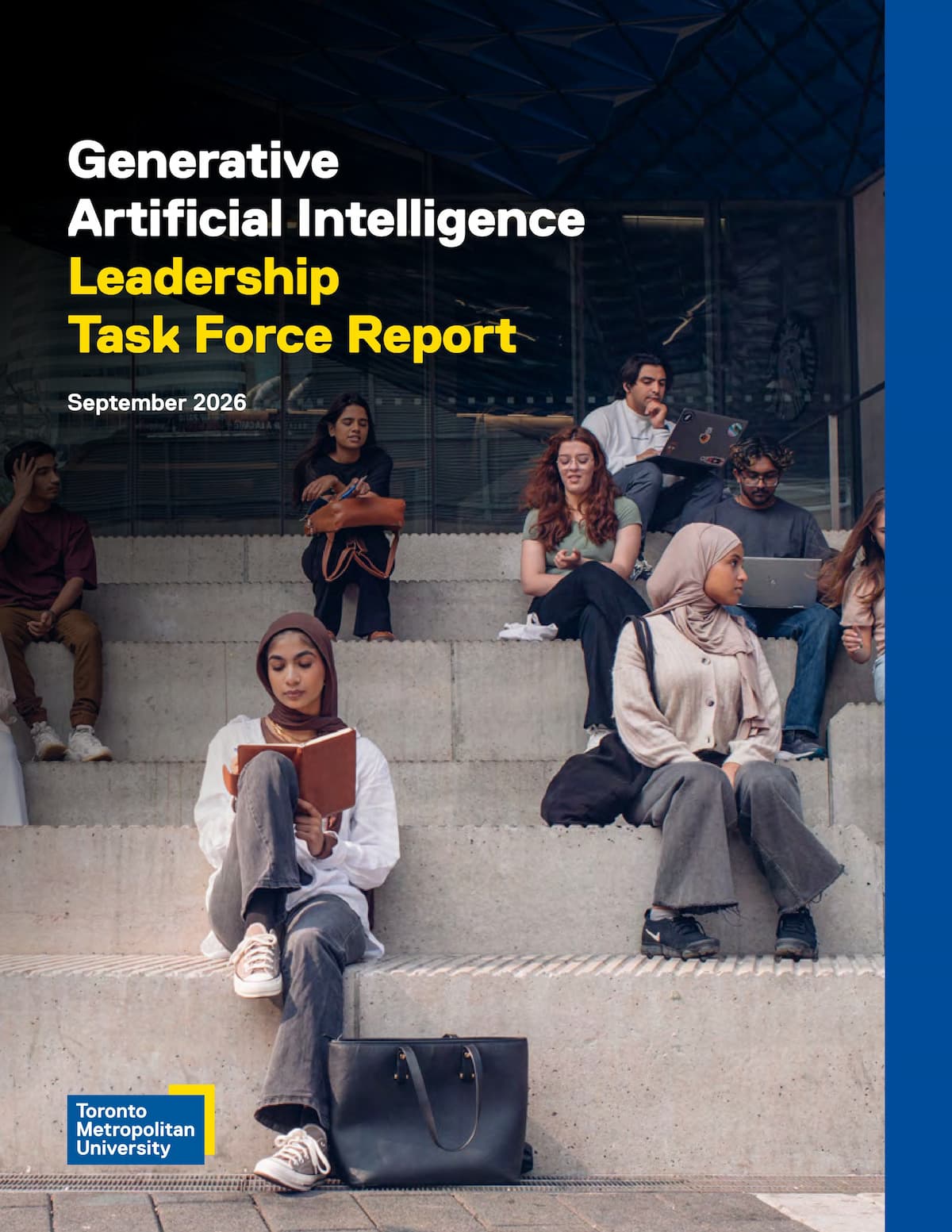
Generative Artificial Intelligence Leadership Task Force Report

Guiding TMU through the opportunities and challenges of rapidly evolving AI technologies.
In 2025, Toronto Metropolitan University established the Leadership Task Force on Generative Artificial Intelligence to guide TMU in navigating the opportunities and challenges presented by rapidly evolving AI technologies. The Task Force brought together academic leaders, educators, researchers, staff, students, and administrators to ensure that the university’s approach to generative AI reflects our values of innovation, integrity, equity and inclusion.
This report provides advice, recommendations, and guidance on how the university may adapt to generative AI technologies and support the responsible use of such technologies for human flourishing across all aspects of university operations (learning and teaching; scholarly research and creative activities; student experience; and administration and operations) while ensuring compliance with all relevant laws, regulations, and university policies.
The report proposes a set of institutional principles and a framework for adaptation to AI that provides structure rooted in common institutional values and flexibility in crafting local guidelines to enable the pursuit of new knowledge, the dissemination of knowledge through scholarly communication and teaching, and the achievement of operational efficiencies and improvements. This approach is respectful of academic freedom, mitigates potential risks, and prepares the university to take advantage of the opportunities associated with AI technologies.
Seven principles guide TMU's approach to AI adaptation
The proposed principles for AI adaptation include the following:
Commitment to human flourishing
Reponsbile innovation and continuous evaluation
Equitable access and inclusion
Transparency
Ethical and responsible use
Accountability and human oversight
Data privacy, security, and regulatory compliance
The framework includes three strategic areas of focus:
1
Adaptation and innovation in learning and teaching
2
Catalyst for scholarly, research and creative activity
3
Safe and secure operational efficiencies
The task force conducted a preliminary analysis of existing Senate and administrative policies to identify gaps and opportunities for future policy revisions. Because AI adaptation in higher education cuts across so many different areas of the university’s mission, this report advises that AI adaptation can best be facilitated by updating existing policies rather than attempting to establish a single, standalone policy.
This report makes numerous recommendations grouped in five themes:
Policy, Guidelines & Governance
- Establish university-wide AI principles and the development of guidelines for learning & teaching, SRC, and administrative uses
- Update relevant Senate and administrative policies to ensure alignment with institutional principles of generative AI
- Create an advisory committee on artificial intelligence
- Create an AI web portal
- Review license agreements for restrictions on AI use
- Monitor sector practice and legal status of copyright and AI
Technological Infrastructure
- Establish secure AI environments for experimentation and innovation
- Collaborate on shared platforms and computing infrastructure
- Enable expanded access to advanced institutional AI tools
- Exercise prudence and caution in the adoption of new enterprise AI software and services
- Adhere to clear procurement protocols for AI technologies
Training & Professional Development
- Offer comprehensive AI fluency training opportunities
- Create internal AI knowledge base
- Expand and enrich AI communities of practice
Learning, Teaching & Student Success
- Continue and expand support for digital learning, teaching development, and curriculum development programming in CELT
- Expand support for assessment security and academic integrity
- Support pedagogical research on artificial intelligence in higher education
- Explore the integration of AI in student success services
- Integrate accessibility and inclusive design in AI adaptation
Scholarly, Research & Creative Activity
- Create an AI Action Lab as a neutral cross-disciplinary hub connecting faculty and students experimenting with AI in scholarly research and creative activity
- Build or adopt AI tools for grant proposal development
- Expand and update research ethics training on AI

Acknowledgements
In late March 2025, the university established a Leadership Task Force on Generative Artificial Intelligence to guide TMU in navigating the opportunities and challenges presented by rapidly evolving AI technologies. The task force was convened to develop a report for the Executive Group through the Provost & Vice-President, Academic and the Vice-President, Administration & Operations.
Thank you to the Task Force and working group members for their time and expertise, and to the community members who participated in the consultations.
The task force members included:
- Sean Kheraj, Vice-Provost Academic (co-chair)
- Mark Robertson, Dean of Libraries (co-chair)
- Wendy Lawrence, General Counsel
- Brian Lesser, Chief Information Officer
- Steven Liss, Vice-President Research & Innovation
- Tanya (Toni) De Mello, Vice-President, Equity and Community Inclusion
- Ebony Gittens, Executive Director, Office of the Vice-Provost Students
- Stefanie Ellul, Executive Director, HR Operations and Technology
- Michael Forbes, Assistant Vice-President, University Relations
- Cynthia Holmes, Dean, Ted Rogers School of Management
- Sri Krishnan, Dean, Faculty of Engineering and Architectural Science
- Carl Kumaradas, Vice-Provost & Dean, Yeates School of Graduate and Postdoctoral Studies