Texting Wilde: A Biography Exegesis Project
Director: Jason Boyd
The aim of the Texting Wilde Project (TWP) is to explore and develop the use of text encoding combined with computer-assisted methods for the identification and analysis of common types of content and textual structures that occur across and interconnect large corpora of life-writing texts relating to an individual or network of persons.

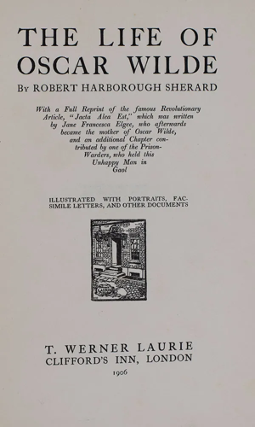
(Title page of the first full length biography of Wilde:
Robert Harborough Sherard’s The Life of Oscar Wilde, 1906)
The Anglo-Irish writer Oscar Wilde (1854-1900), famous as an iconoclastic thinker, wit, media celebrity and gay martyr, continues to be a perennial favorite for biographical treatments. Our knowledge of ‘Oscar Wilde,’ however, is not comprised of a corpus of pure and simple facts that allows us an unmediated apprehension of a real person separated from us only by time, but rather this knowledge is comprised of a densely complex and often contradictory accretion of texts created in that intervening time that constitutes the only Wilde we can know. Many of the ‘facts’ of Wilde’s life originated as narrative elements within particular textual and contextual moments and have acquired factive status through their repetition without attribution or with misattribution in text after text, losing in the process of this continual redeployment their textual provenance, a situation, given the volume and variety of material to be mastered, that has frustrated what might be characterized as an exegetical analysis of Wilde biography.
Consequently, the aim of the Texting Wilde Project (TWP) is to explore and develop the use of text encoding combined with computer-assisted methods for the identification and analysis of common types of content and textual structures that occur across and interconnect large corpora of life-writing texts relating to an individual or network of persons. It is developing these methods through the creation of a corpus of texts relevant to early (pre-1945) Wilde biography, prepared in such a way as to be tractable to computer-assisted methods of analysis. The first period of Wilde’s posthumous biography—from Wilde’s death in 1900 to his censorious and litigious former lover Lord Alfred Douglas’s death in 1945 (which ushered in a new openness in treatments of Wilde's sexuality)—was formative because during that time the majority of primary accounts were created either by persons who had personally known Wilde (or who could convincingly claim a personal acquaintance) or who had access to persons who had personally known Wilde. However, since post-1945 biographical and other studies of Wilde are interested in early accounts primarily as sources to be plundered for ‘factual’ information, the complicated and conflicted history of their writing, publication, and reception has largely been ignored and obscured. Such ‘fact-grubbing’ often results in the context in which these ‘facts’ were initially employed being lost. To isolate a fact from the context in which it was articulated is to sever it from its history, which in many cases is essential for an evaluation of the degree to which it partakes of the factual. By returning to early biographical treatments of Wilde, not as sites of reusable facts, but as links in a genealogy of a biographical discourse of Wilde, we can begin to understand the extent to which contemporary interpretations are shaped by the early struggles over Wilde’s representation.
Over the course of its explorations, the TWP has developed an extensive customization (currently in its third iteration) of the Text Encoding Initiative’s P5 Guidelines for Electric Text Encoding and Interchange (external link) designed to deal with the particularities of the content of biographical texts and to facilitate intertextual, exegetical analysis. It has developed this customization by encoding two of the earliest biographical texts on Wilde, both by Robert Harborought Sherard: Oscar Wilde: The Story of an Unhappy Friendship (1902) and The Life of Oscar Wilde (1906) along with a number of smaller texts. The TWP’s goal is to publish these materials along with the other scant biographical texts used by Sherard in the writing of his Life. Together, these will demonstrate how text encoding can be leveraged for biographical research, as well as revealing the inception of Wilde’s posthumous biography.
Papers on the TWP have been presented at conferences of the North American Victorian Studies Association (NAVSA), the Association of Community College and University Teachers of English (ACCUTE), the Canadian Society for Digital Humanities/Société canadienne des humanités numériques (CSDH/SCHN), the Text Encoding Initiative Consortium, and at conferences held at Drew University, the University of Virginia, and McGill University. The work of the TWP was funded by a SSHRC Insight Development Grant.
Project Director Jason Boyd offers this reflection on the work of the TWP: “When the project began, I did not have a full appreciation of the depth and complexity of the encoding that was possible with TEI. As well, unlike other digital editing projects that are mostly interested in encoding the structural and presentational aspects of texts for the purpose of producing online editions for reading, I was interested in exploring TEI’s semantic markup capabilities for encoding biographical texts for intertextual analysis. Developing an encoding customisation proved to be a challenging and iterative process because it was an exploratory undertaking--there were no existing projects that were approaching the encoding of biographical text for the purposes of exegetical study. Each text selected for encoding raised new, unanticipated, and surprising encoding dilemmas that required careful consideration and experimentation with multiple potential approaches. Proposed encoding strategies often had to be revisited, revised, refined, and sometimes rejected, which required returning to and revising the earlier markup of texts that had already been encoded.
In the course of iterating a customization of the TEI P5 Guidelines for the TWP, I discovered a great deal about the vagaries and oddities of biographical texts--aspects that I would not have noticed or paid much attention to had I not been reading the text from the perspective of an encoder. I therefore believe that TEI encoding is a valuable close reading strategy, even if one does not end up producing a digital edition from undertaking this encoding.”
The project is in development but currently on hiatus.
Contact: Jason Boyd, jason.boyd@torontomu.ca