SDG 6: Clean Water and Sanitation
2025 SDG report
SDG 6: Clean Water and Sanitation
TMU ranked 78th among universities around the world in the 2025 Times Higher Education Impact Rankings for its impact on clean water and sanitation. The university’s achievement in this area is largely attributed to the excellence of Urban Water TMU, a multidisciplinary consortium of researchers who are working together, and with students, to solve today’s complex clean water and sanitation challenges through dynamic research, strong external networks and collaborative action.
TMU ranked 78th in the world for impact on SDG 6: Clean Water and Sanitation (2025 Times Higher Education Impact Rankings).
Urban Water TMU and Facilities Management have partnered with WWF-Canada to reduce the university’s use of road salt by one third (more than 6 tonnes) with a view to mitigating the impacts on water quality and aquatic ecosystem health.
Our goals in action
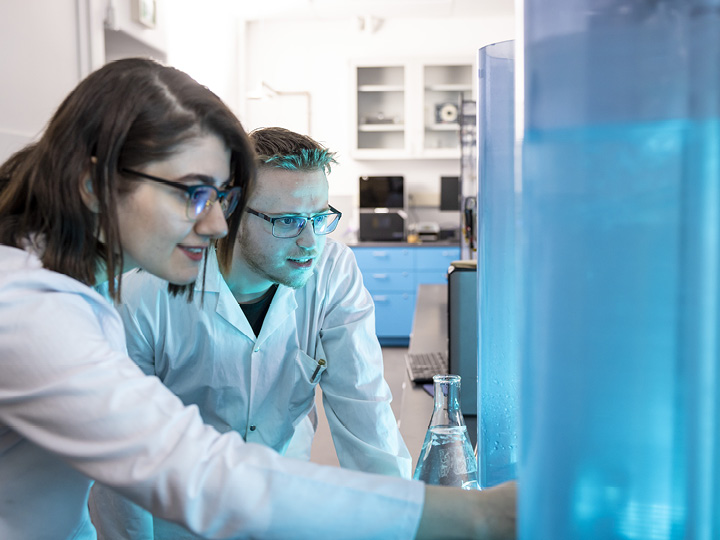
TMU aspires to develop pathways for all students to access sustainability learning and research opportunities that will prepare them to take action on the complex challenges facing our world today. To that end, our faculty members and researchers are currently teaching sustainability through hundreds of courses, programs and research initiatives, providing opportunities for students of any academic background to advance their sustainability knowledge and skills, with a particular focus on water.
- TMU has several graduate programs that are affiliated with the Urban Water TMU research centre, giving students a chance to learn about supporting the goal of clean water and sanitation in a variety of disciplines. Multidisciplinary course offerings in green infrastructure and the First Nations water crisis are also available to students across campus.
- Apathy to Empathy is an interdisciplinary curriculum-based project that was first piloted for several undergraduate courses in civil engineering, chemistry, geography and social sciences in the Fall 2021 semester. The project provides students and faculty with the opportunity to better understand multiple facets of the First Nations water crisis, including learning about the lived experience of Indigenous people in Canada and the challenges associated with Indigenous access to safe drinking water, and how to apply solutions that surpass what is taught in colonial structures.
- In November 2025, Urban Water TMU hosted Downstream 2025, an immersive networking experience for young professionals. Participants gather in round table microsessions to pose questions to experienced professionals from the water sector. Ambitious youth from eight universities received advice and guidance about careers in the water sector from experts. This event highlighted Urban Water TMU’s commitment to fostering inclusive spaces where early career talent can connect, learn, and imagine pathways into impactful careers.
TMU is home to a number of research centres and institutes that are studying and innovating to solve a range of sustainability issues, including clean water and sanitation. Urban Water TMU is a leader in transdisciplinary solutions to complex urban water challenges. The centre prioritizes research and networks in: urban water management and governance; urban natural systems and green technologies; and freshwater science and governance.
TMU co-operates with various levels of government to support water security.
- Researchers at the Yousefi Lab for Self-assembled Nanomaterials took inspiration from kitchen sponges to develop filter material that attracts and captures plastic particles while still allowing water to flow freely through. In lab tests using plastics released from real food containers, these specially coated sponges achieved high removal efficiencies, capturing up to 94 per cent of certain particles. The lab is testing durability and real-world performance to understand how the sponge behaves in water containing minerals, organic matter and other compounds that can interfere with filtration.
- They are also working to determine whether the same sponge system can remove other contaminants beyond microplastics, including pharmaceuticals, endocrine-disrupting chemicals and persistent “forever chemicals” like PFAS (per- and polyfluoroalkyl substances).
- TMU co-operates with various levels of government to support water security. At the regional level, TMU’s Emerging Contaminants Lab is working with the Ontario Ministry of Environment (external link) to determine if plastic additives are entering the environment from wastewater effluent.
- Nationally, Urban Water TMU is building bridges with Indigenous communities and developing relationships in which traditional and western knowledge is shared and researchers collaborate with communities to undertake research and find solutions to community-identified needs.
- From a global perspective, Urban Water TMU is proud to be a partner of the International Water Decade Alliance (IWDA), which includes 20+ academic institutions, non-government organizations, associations and private sector interests seeking to develop solutions needed globally to achieve the SDGs that relate to water.
TMU’s Sustainability Office is working towards advancing sustainability across our campus, and encourages active participation from the entire TMU community to reach our goals of building a more sustainable university and community. The office provides programming, education and outreach on ways to reduce waste, promote circularity and resource recovery, reduce energy and water consumption, increase awareness of the benefits of sustainable choices and more.
- TMU is committed to employing technologies and encouraging behaviours that minimize water waste. Our Sustainability Office tracks water consumption through the analysis of monthly utility bills and works to reduce water consumption through environmentally sustainable practices.
- Another important component of TMU’s Sustainability Action Plan is stormwater management, which is accomplished by designing water-efficient landscaping. By managing stormwater locally, TMU helps the City of Toronto (external link) with its management, which translates into significant environmental benefits. Vegetated landscaping and roofs help with stormwater management by reducing the runoff and absorbing most of it before it gets to the city sewers. TMU has installed vegetated roofs on the Centre for Urban Innovation (CUI), DCC, George Vari Engineering and Computing Centre (ENG) and Student Learning Centre.
- TMU’s (google doc) Sustainable Buildings Guidelines (external link) apply to capital and deferred maintenance projects on campus. The guidelines provide project-specific energy, GHG emissions and water efficiency targets in new construction and renovation projects; calculate energy and GHG project budgets; and introduce streamlined modeling, benchmark comparison, documentation submission, and approvals approach. Section 9 of the guidelines outlines information on indoor and outdoor water use specifications, in alignment with Leadership in Energy and Environmental Design (LEED) requirements.
As a university located at the centre of Canada’s largest city, TMU has deep connections with our neighbours, with whom we share many of the same challenges and benefits of our urban location. We are committed to advancing conversations on culture, economics, technology, social justice and the environment that lead to policies and actions designed to contribute to building inclusive, resilient, sustainable and dynamic cities. Through knowledge sharing and collaborations with experts from other cities and institutions across Canada and around the world, we aim to find solutions to critical issues affecting water and the environment.
- TMU faculty and students have participated in sector dialogue and organized community events to provide educational opportunities on good water management. These include Faculty of Science professor Roxanna Suehring identifying water contaminants in fishing equipment; and faculty members from the Faculty of Science working with Canadian and Colombian partners on the Strengthening Coastal Aquifer Resilience and Groundwater Use Against Climate Change Effects in the Caribbean project, which aims to advance groundwater sustainability and freshwater quality in Colombia by disseminating knowledge on aquifers and salinity intrusion to Colombian communities, policymakers and students.
- Urban Water researchers and graduate students from public health, architecture, and civil engineering are partnering with Credit Valley Conservation (CVC) to monitor their newly installed Smart Blue Roof on CVC Headquarters in Mississauga. The goal of the research project is to assess the real-world performance of the SMART blue roof system on CVC headquarters with respect to: facilitating stormwater retention, assessing public health issues associated with standing water, and monitoring the impact of standing water on the building structure.
- Urban Water TMU convenes experts, policy makers, students and community members for important discussions on water management and policy. Representatives from government and industry joined with technical experts for a September 2025 workshop (external link) at TMU on managing PFAS (also known as “forever chemicals”) in water.
- In February 2025, Urban Water TMU hosted a seminar on the Modernization of the Canada Water Act. Led by legal scholar Dr. Patricia Hania and Canada's foremost policy expert Mr. Mike Goffin, the seminar attracted researchers, students, and partners alike. The event was timely as the Government of Canada had just invited public consultation on this foundational piece of water legislation. The seminar sparked thoughtful dialogue on how law, policy, and science can collectively shape Canada’s water future and how the speed of climate change and social media and political considerations may impact the process and longevity of legal and policy frameworks.