TMU instructors use improv to build classroom confidence

Standing in a circle, one instructor mimes handing over a flower to a colleague. The colleague thanks them for the straw. The mix-up gets laughs. It also teaches a lesson: You may think you're being clear, but the person you're communicating with may not get the message.
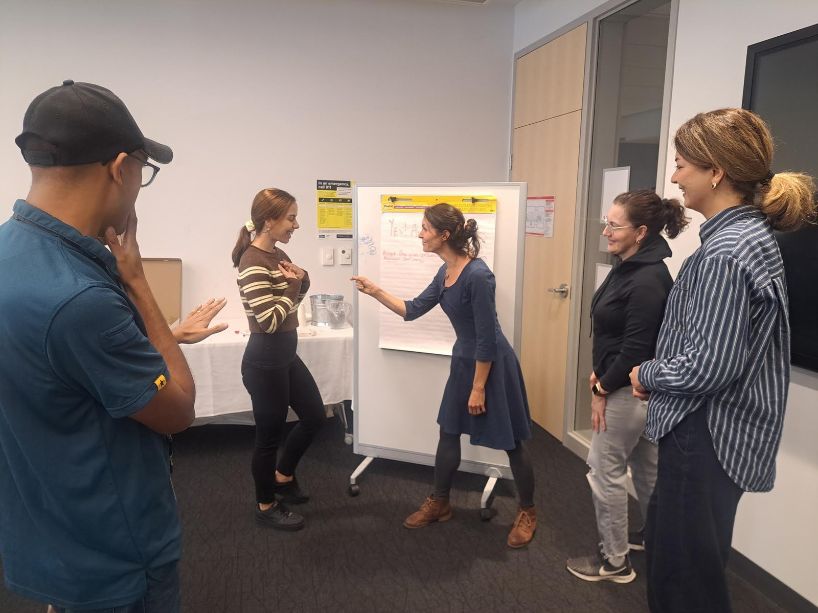
Instructors participate in an improv exercise, miming scenarios like handing over a flower—or a straw—to practice clear communication and highlight how messages can easily be misinterpreted.
Teaching rarely goes exactly to plan. A lesson falls flat, a discussion veers off course or a student unexpectedly shares something deeply personal. Even skilled instructors can doubt themselves in those moments, and how they respond shapes the whole classroom.
Three workshops this fall at TMU's Centre for Excellence in Learning and Teaching (CELT) give educators a place to practise those moments. Improv for Educators helps instructors practice the concept of "yes, and..." accepting the given circumstances and moving forward--with confidence, presence, care for others, and good humour Imposter Phenomenon explores where feelings of self-doubt originate and how these cycles can be disrupted. Navigating Student Disclosure prepares instructors for sensitive conversations.
Read on to learn more about these workshops this fall.
Thinking on your feet
Improv for Educators is a three-part series that shows instructors how to bring improv skills into the lecture hall.
Improv can sharpen clarity, says facilitator Lauren Spring. It also builds confidence, curiosity and spontaneity. That helps when a lesson plan falls apart or a student takes a discussion in a new direction.
"A big lesson from improv is commitment," says Spring, who studied theatre and education and has taught in many environments, including university, corporate and public settings. "Let's say 5 minutes into a planned active learning session in class, it becomes clear that students haven't really understood a learning exercise you planned. You might have the impulse to say, 'Forget it. Let's pretend this never happened and move on,' but if you opt instead to slow down, connect with learners about what’s going on for them, and commit to the plan, you'll likely be successful."
She points to a guessing game often played in improv class. One person mimes riding a motorcycle, turning the key and making big faces as they speed up. Another makes half-hearted gestures to avoid attention.
"You realize it's the person who doesn't commit who ends up looking a bit silly," she says. “The one who went all in, allowed themselves to be vulnerable in taking bold physical risks is the ones who holds your attention, who you’ll feel more connected to.”
"Yes, and" also works in teaching, Spring says. In improv, it means accepting a partner's idea and building on it instead of shutting it down. The best improv scenes occur when both parties make the other look good. In class, this would look like a teacher showing up with a strong intention to teach, students meeting them halfway with a strong intention to learn. Instructors may also employ this tactic if a student responds in a surprising or “incorrect” way to a question the instructor has posed to the class. Instead of correcting them right away, or shutting a student down by saying the answer was wrong, the instructor could instead validate the effort and bravery behind the offering–and ask the student to explain their thinking and unpack the misunderstanding together.
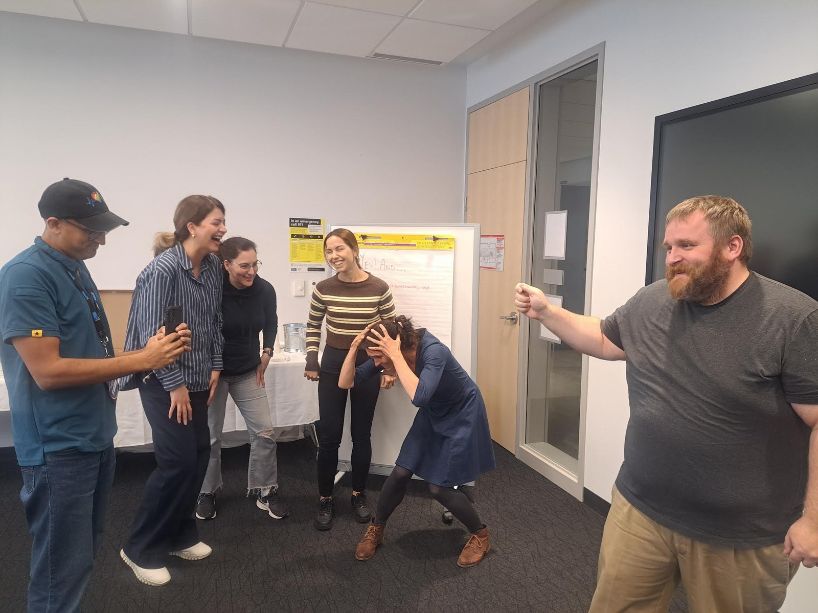
Workshop participants engage in a collaborative activity, using visual aids to practice adaptable teaching techniques and navigate unpredictable classroom scenarios.
Above all, Spring wants participants to accept that things won't always go perfectly.
"I hope it helps our faculty feel like they have strategies, including knowing how to laugh at yourself, when things don't go according to plan," she says.
Understanding imposter phenomenon
Spring also leads Imposter Phenomenon, a workshop on why capable educators may feel they don't deserve to lead a classroom, and what to do about it.
She avoids the more common term "imposter syndrome" on purpose.
"I don't want to pathologize these feelings," she says.
These feelings come from messages people receive throughout their lives, some subtle and some not. That makes the problem a societal one, not a personal failing. In academia, imposter feelings are common among women, people born outside Canada, racialized people and students who are the first in their family to attend university, Spring says.
Understanding where these feelings come from can help weaken self-doubt, Spring says. The workshop also offers practical tips, such as setting a limit on prep time to avoid exhaustion and burnout. People who feel like impostors often overprepare.
The workshop also asks participants to think bigger.
"We look at what factors institutionally or in your discipline have contributed to you feeling like your voice isn't as valid, and what changes you can suggest in your workplace," Spring says.
"I don't want to pathologize these feelings."
Practising sensitive conversations
Students who ask for an academic accommodation sometimes share private details about a relationship or their health. They may not want to, but feel they have to, says Esther Ignagni, CELT's executive director and a professor in TMU's School of Disability Studies.
Navigating Student Disclosure uses live actors to help instructors practise how to manage these sensitive conversations. Presented in partnership with Academic Accommodation Support and Positive Space Faculty and Staff Network, the workshop shows instructors how to make clear that accommodation requests don't need personal details. It also helps them respond with care and professionalism when students do share them.
During the simulation component of the workshop, participants can pause, ask others for help in how best to respond to the situation or hand the scene to a colleague. Watching others handle the same situation shows there's more than one good response.
"There isn't usually one single solution," Ignagni says. Engaging with an actor instead of a student is valuable, she says. It gives instructors a chance to hear something they didn't expect, notice their first reaction and then adjust. "It gives you that practical, embodied opportunity to hear something that you maybe didn't expect to hear, experience your first reaction, and then reassess it and refine your approach," Ignagni says.
By building confidence and letting educators learn from each other, the workshop helps faculty adapt to changing needs and diverse students.
"How we teach and what we teach is constantly in flux, so it is important for us to continue to revisit our teaching approaches," Ignagni says.
Join a workshop
Want to build these skills? TMU instructors can learn more and register for these and other offerings through CELT this fall. For more information, including dates for workshops, visit the CELT website.