TMU hosts bold call to action on Canada's housing crisis
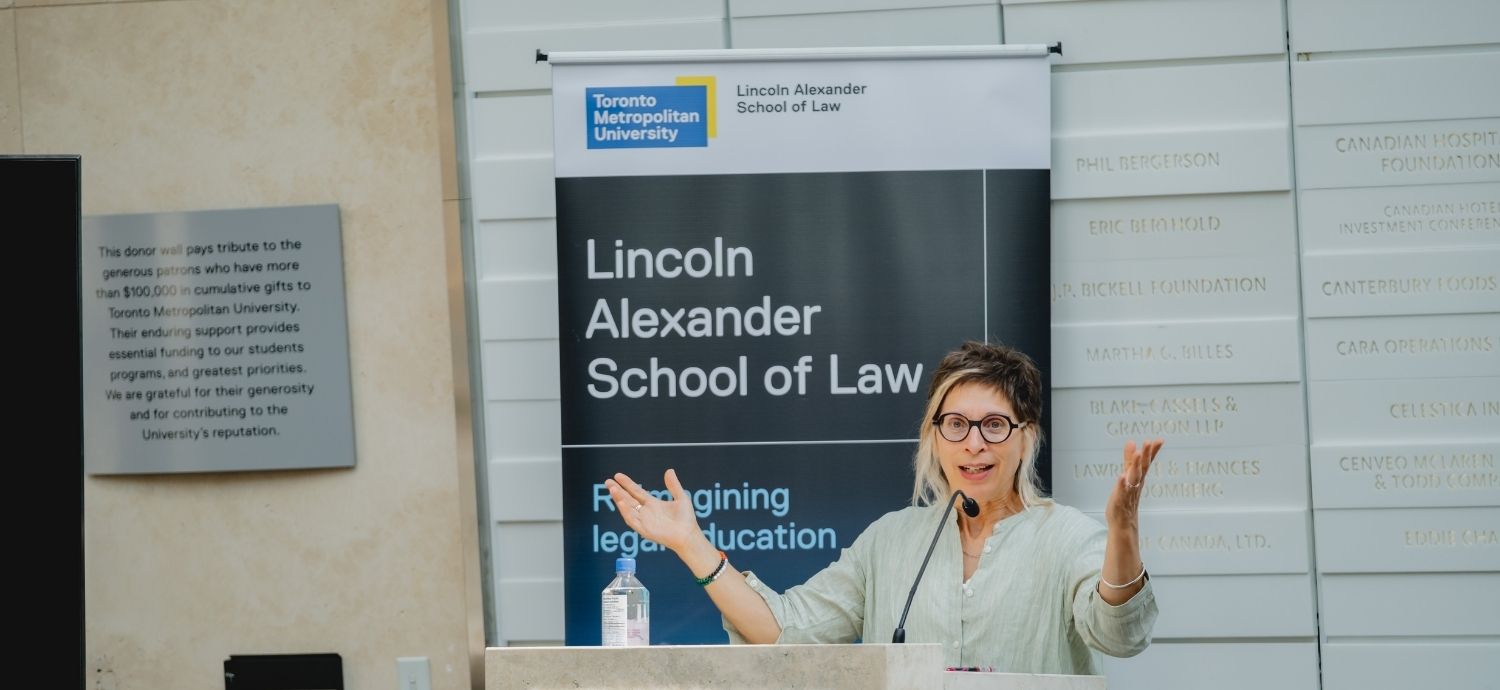
TMU welcomed human rights lawyer Leilani Farha to campus last week for a Massey Lecture event that put the financialization of housing under the microscope.
Hosted by the Lincoln Alexander School of Law and its International Law and Global Justice Initiative, alongside TMU's School of Interior Design, the event brought together students, faculty and legal advocates to examine how housing has shifted from a basic need to a corporate asset.
A TMU connection runs through the story
Farha's own history with the city gave the event a personal throughline.
As a law student in Toronto, she lived in a one-bedroom apartment just a six-minute bike ride from school.
Decades later, her daughter encountered a very different housing market as an undergraduate.
The options were either too far from campus or far beyond her budget. She eventually settled for a two-bedroom unit in a corporate rental building, shared with a roommate.
Farha wondered whether her daughter would get the chance to enjoy "the exhilarating and scary experience of living on her own" – a question that resonated with the TMU students in the room, many of whom face similar struggles finding affordable housing near campus.
The lecture: how housing became a financial product
Farha, a former UN special rapporteur on the right to housing, delivered a CBC Massey Lecture based on her book Housing, Inc. She's also the global director of The Shift (external link) , an organization advocating for housing as a basic right.
She explained to the TMU audience how, over the past 20 years, private equity firms, asset managers, banks and pension funds have taken over more and more of the housing market – turning homes into investment vehicles.
This didn't happen by accident, she said. Governments in Canada and elsewhere opened the door for financial firms and real estate investment trusts to buy up residential housing. Banks were also allowed to bundle mortgage debt into tradable financial products, a practice that pushed borrowing limits higher and drove up home prices.
Financial and environmental crises accelerated the trend. In Puerto Rico, Farha said, the U.S. government gave tax breaks to mainland investors buying short-term rentals on beachfront land that had been "powerwashed" after hurricanes destroyed people's homes. Short-term rentals on the island jumped from 1,000 in 2014 to 25,000 in 2023, turning once-vibrant neighbourhoods into "ghost neighbourhoods with reduced public safety and street life" during the off-season.
She noted a similar pattern played out after the 2008 financial crisis, when Airbnb partnered with cities like Miami. Entire buildings are now designed and marketed as short-term rental investments, often owned by corporations with no local stake.
TMU law faculty lead the panel discussion
Following the lecture, the Lincoln Alexander School of Law's own Jake Effoduh moderated a panel discussion featuring Farha, Jennifer Stone, executive director of Neighbourhood Legal Services, and Aliah El-houni, a staff lawyer at the Lincoln Alexander School of Law Legal Clinic – which provides free legal services to low-income communities.
Stone described tenants facing eviction who can't navigate proceedings due to disabilities or lack of internet access for virtual hearings. "We are seeing so many people being evicted in absentia," she said.
She encouraged the TMU audience to advocate at both the local and provincial levels, noting that Ontario removed rent control on new buildings – a policy that, she pointed out, ultimately drives up health-care costs the province itself must cover.
El-houni, speaking from her work at the Lincoln Alexander legal clinic, described community organizing as a powerful tool. She has represented tenants who staged rent strikes and took over building maintenance to protest unfair rent hikes.
"We don't have the power of huge financial resources, but we have the power of our numbers and our complicity with a system that … we can withdraw," she said.
Solutions Farha left with the TMU community
Farha shared concrete recommendations for the students, faculty and advocates in attendance:
- Cap rent at 30 per cent of a tenant's income
- Ban financial firms from buying residential real estate
- Take over investment properties left vacant for more than a year and convert them into affordable rentals
These solutions might seem radical, she said, but between 1993 and today, real estate investment firms and asset managers went from owning almost none of Canada's housing stock to owning about a quarter of it, (PDF file) according to a report (external link) commissioned by the Canadian Human Rights Commission.
Her proposed solutions, she told the TMU audience, "are proportional to the crisis at hand."