This TMU student is helping bring sign language AI to Waterloo airport
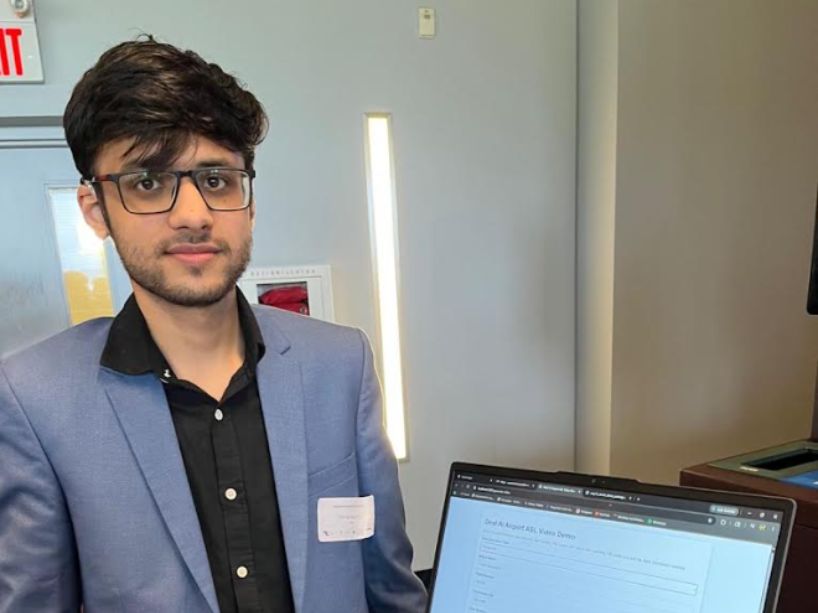
What started as a six-week student placement has taken TMU Computer Engineering student Wajeeh Ul Hassan all the way to Waterloo Airport.
Ul Hassan first connected with Deaf AI through a Student Impact Placement Program run by TMU’s Social Venture Zone (SVZ). Now, he’s completing a 12-month internship with the Ontario-based startup and has played a pivotal role in its pilot project at Waterloo Airport.
For Ul Hassan, who has hearing loss himself, the opportunity combined his interest in technology with a chance to work on something personally meaningful.
A student placement opens a door
Ul Hassan first heard about the SVZ program in his second year at TMU, when an email about it landed in his inbox.
“Maybe I should give this a try,” he remembers thinking.
He signed up to build new skills, including communication, and started attending the program’s workshops. During one session, he spoke with an SVZ team member about his hearing loss, which led to an introduction to Mehdi Masoumi, co-founder of Deaf AI.
Deaf AI (external link) is working to make public and digital spaces more inclusive for Deaf people through AI-based voice-to-sign language interpretation.
Ul Hassan stayed in touch with Masoumi after the placement ended. When the chance came to pilot Deaf AI’s technology at Waterloo International Airport, Masoumi invited him to join the project.
Since then, Ul Hassan has supported the pilot through ASL video processing, API testing, cloud deployment and other technical work. He also researches emerging AI models and technologies and helps the team figure out what could work best.
“He’s not a person to just get the job done,” Masoumi said. “He comes back with more questions,” often offering suggestions that help move the work forward.
Bringing accessible AI to the airport
At airports, gate information usually comes through audio announcements. Deaf AI wants to make that same information available visually, through sign language shown on screens.
Masoumi says sign language poses unique challenges for AI. It varies across countries and communities, and meaning can depend on facial expressions and other visual cues. That’s why Deaf AI focuses on environments like airports, where the range of announcements is fairly predictable.
The company also works with members of the Deaf community and a Deaf mentor to make sure its technology is built with the people it’s meant to serve.
At Waterloo Airport, Ul Hassan has helped tackle everything from improving AI-generated video quality to adjusting resolution and testing APIs. The pilot is currently running, with Deaf AI continuing to refine the technology, improve accessibility and explore new features.
The project has even shaped Ul Hassan’s studies at TMU. As he got more involved in computer vision through Deaf AI, he decided to take a computer vision course to deepen his knowledge in an area he was already exploring on the job.
“I got lots of experience,” he said, adding that the role has also helped him better understand the realities of building a startup and, importantly, make connections in his field.
Building experience beyond the classroom
Ul Hassan’s story is a strong example of what the SVZ hopes students take away from its programming: interactive experience that opens doors beyond the classroom.
“We want to really prepare these students to enter these ventures and not just gain knowledge and expertise, but really assist the ventures as well and help them thrive,” said Jake Hamilton, communications coordinator with the SVZ.
“I think TMU is working hard to create opportunities that don’t just propel students forward, but set them apart,” said Hamilton. “They’re looking for resume-ready experience that they can speak to at length, and carry with them into their careers .”
For Ul Hassan, that started with a six-week placement and grew into an ongoing role, new technical skills and the chance to contribute to an accessibility project with real-world impact.
Students interested in similar opportunities can keep an eye on the SVZ website for upcoming programming.