5 summer health risks Canadians should know

Summer brings longer days, outdoor activities and gatherings with friends and family. The season also comes with public health risks Canadians should be aware of.
From extreme heat to wildfire smoke and changing environmental conditions, climate change is reshaping some of the health challenges people face during the summer months.
TMU experts say preparation and awareness can help people better understand these risks and take steps to protect themselves.
Here are five summer public health concerns TMU experts say people should pay attention to. The experts are also available for media interviews to expand on these topics:
- Extreme heat and heat-related illness
- Tick bites and summer insects
- Food safety during summer gatherings
- Water safety and quality
- Air pollution and wildfire smoke
Extreme heat and heat-related illness

Kateryna Metersky is a nursing professor and School of Occupational and Public Health interim director.
Heat waves are becoming more frequent, intense and long-lasting, leading to record-breaking temperatures.
“Heat waves are becoming one of the deadliest weather-related hazards that we're starting to see now,” says Kateryna Metersky. “Extreme heat is not just an inconvenience. It is a significant public health concern.”
Metersky says heat waves put extra stress on the body and our ability to regulate temperature. This can lead to heat exhaustion, heat stroke, dehydration and the worsening of existing medical conditions.
Older adults, young children, pregnant people and individuals living with chronic conditions face a higher risk. Outdoor workers and people without access to air conditioning or cooling spaces may also face increased risks.
Common signs to look out for include dizziness, nausea, confusion and stopping sweating in the heat.
“When you sweat, your body's able to regulate temperature. But when you stop sweating all of a sudden, that should be a red flag or something to explore further,” says Metersky.
Even if you are outside for a short time, Metersky recommends drinking water regularly before you feel thirsty, seeking shade or air-conditioned spaces, wearing lightweight clothing and sunscreen and avoiding strenuous outdoor activities during peak heat periods.
She also encourages people to check in on family members, friends and neighbours who may be more vulnerable during extreme heat.
Contact for media interviews:
Kateryna Metersky: kateryna.metersky@torontomu.ca.

Tick bites and summer insects

Timothy Sly is a professor emeritus in the School of Occupational and Public Health.
Warmer winters and hotter summers are helping ticks survive and reproduce, resulting in record numbers of tick-borne diseases across Ontario.
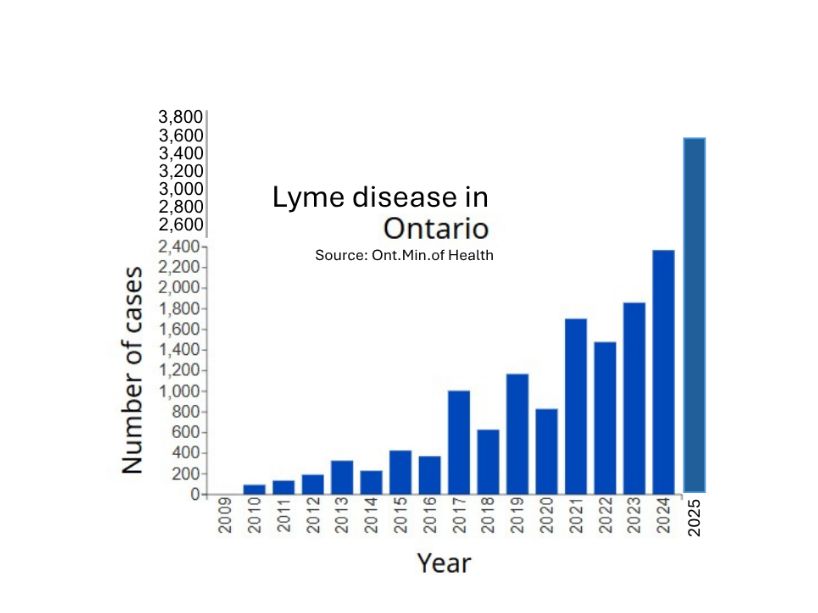
Graph showing the trend in Ontario for Lyme disease, a bacterial disease spread by the bite of the blacklegged tick. This year, ticks are breaking records and are on track to continue upward.
Blacklegged ticks, which can spread Lyme disease, are found across Canada, but the Greater Toronto Area is an active area for tick-borne diseases.
The insects attach themselves to humans and animals and feed on their blood. They can also spread other infectious agents, resulting in symptoms like:
- Severe headache
- Nausea, vomiting or diarrhea
- Extreme fatigue
- High fever, chills and drenching sweats
- Muscle and joint aches
- Headaches
- Loss of appetite
“Ontario health unit ‘sweeps’ are collecting more ticks than before, and 30 to 50 per cent of the ticks contain Lyme agent or another infectious virus or parasite,” says Timothy Sly.
Since the insects are small and hard to see, Sly recommends avoiding long grass, wearing repellent, checking yourself and your pets after a walk and removing ticks right away.
You can find out if it’s a blacklegged tick by submitting a photo of the tick to etick.ca. (external link)
Contact for media interviews:
Timothy Sly: tsly@torontomu.ca.
Food safety during summer gatherings

Ian Young is a professor at the School of Occupational and Public Health.
Keeping food at the right temperature during the summer can be challenging, but is one of the most important steps to preventing foodborne illness, says Ian Young.
“It's recommended normally that you try to avoid keeping food at room temperature for more than two hours to minimize any food safety risks,” says Young. “During hot summer days, it's recommended to not have food out longer than one hour at room temperature, because the risk of harmful bacterial growth may be higher.”
For outdoor gatherings, like barbecues and picnics, Young recommends using ice packs and keeping food chilled. He also advises extra caution when preparing food for vulnerable groups, including children, pregnant people and older adults.
Common causes of foodborne illness, including Salmonella and Campylobacter, can be found on various meats, vegetables and fruits. Young recommends washing raw produce to reduce dirt and using a thermometer to ensure meat is cooked to the correct internal temperature.
He also warns that some fruits, particularly melons, may be risky and have been linked to outbreaks. Cut melons should be handled carefully to prevent bacteria from multiplying.
When it comes to leftovers, Young recommends refrigerating food as soon as possible.
“The longer it sits there, any bacteria that might be on the food will have a chance to grow and then potentially produce toxins, which can be harmful even if the food is reheated,” says Young.
Contact for media interviews:
Ian Young: iyoung@torontomu.ca.
Water safety and quality
Swimming is a popular summer activity, but swimmers should be aware of water quality conditions.
A new study led by Ian Young found that the water quality at publicly monitored beaches in Canada is generally safe for swimming, while also showing that seagull contamination is a previously under-recognized contributor to health risks.
Young recommends checking beach water quality (external link) and swimming advisories to avoid illness when E. coli levels are elevated.
Young also shares what swimmers should know about water safety in public pools

Dr. Farhan M. Asrar is an associate dean at the School of Medicine and a practicing family physician and public health physician.
Summer air quality is becoming an increasing public health concern as higher temperatures, wildfires and other environmental factors contribute to worsening air pollution, says Dr. Farhan M. Asrar.
“Air pollution can lead to an increased risk of respiratory, cardiovascular and other chronic illnesses. This also results in a greater strain on health-care systems due to the related increases in ER visits, hospitalizations and premature deaths,” says Asrar.
Poor air quality can be caused by several factors, including wildfire smoke and related exposure, vehicle and industrial emissions, construction and weather conditions that trap pollutants.
While everyone can experience health impacts from air pollution, some groups face greater risks, including children, seniors, pregnant people and those living with chronic conditions such as asthma, chronic lung disease, cardiovascular disease and diabetes.
Asrar says everyone should take precautions when poor air quality warnings are issued, and seek immediate medical attention when experiencing any symptoms
“The risks are not limited to those with underlying health conditions, healthy individuals can also be affected, particularly those who work outdoors and people engaging in intense outdoor activities such as sports and exercise,” he says.
To reduce exposure, Asrar recommends monitoring air quality alerts, limiting or rescheduling outdoor activities when air quality is poor and considering tools such as air purifiers or N95 masks.
He also encourages people to check in on those who may be more vulnerable during poor air quality events to ensure they have the support and resources they need.
Contact for media interviews:
Dr. Farhan Asrar: farhan.asrar@torontomu.ca.