It’s not rocket science: how TMU student’s co-op strategy launches aeronautics career
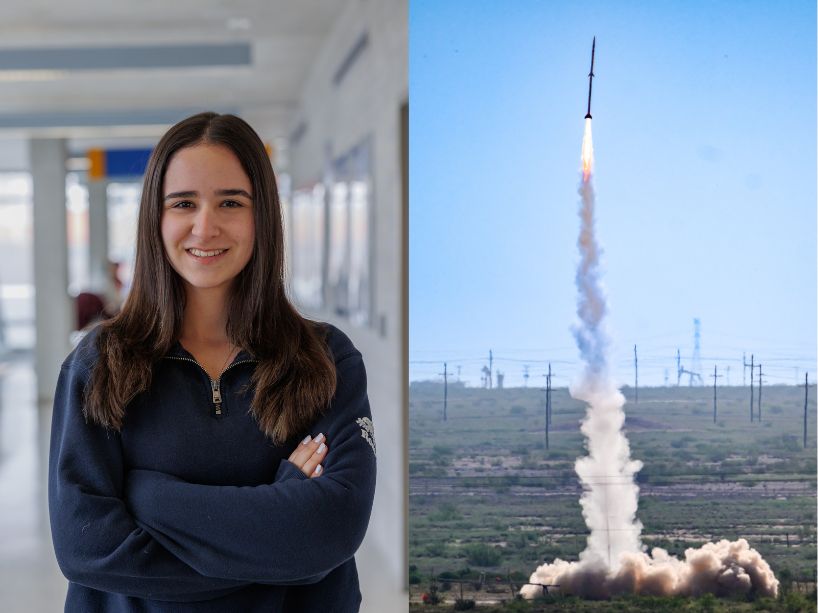
50. That’s how many job applications fourth-year aerospace engineering student Isabella Furlan sent out in a single month to land a co-op placement in her field.
“I got them out early in the term, and created a spreadsheet to track them,” she says.
She applied through TMU’s co-op portal and job postings on LinkedIn and Indeed to maximize her chances. Her top tip to students: “apply early because it relieves the pressure hanging over you during the school year.”
The strategy worked. Furlan landed a co-op placement as a design and analysis engineering intern at Safran Landing Systems, a Canadian division of an international aviation and aerospace company.
She believes her portfolio helped her stand out from the crowd.
“I was able to show all the design projects I’d ever done in my entire life,” says Furlan. “My employer valued being able to see how I approached those projects, my thinking process and the kinds of solutions I came up with.”
Reaching for the stars
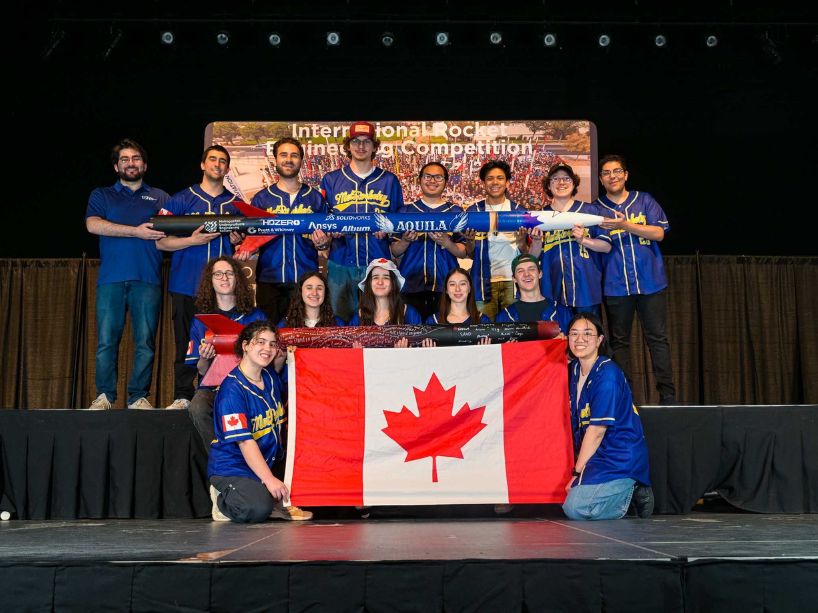
MetRocketry Represents TMU on the World Stage at IREC with their high-powered rocket design.
Furlan is the team captain of MetRocketry, TMU’s student rocketry club, which designs, builds and launches high-powered competition rockets.
Working on the team gave her real projects to add to her portfolio, while doing something she loves. “I included work I did on the team rocket, from creating a camera mount to developing an air brake system,” she says.
"My portfolio showed my design process, from initial concept through to implementation for various projects."
What she learned on the job
Landing gear may not be the most exciting aspect of aircraft design, but it’s one of the most critical systems on any aircraft. Furlan’s co-op placement gave her a new appreciation for it.
“I started to see the level of precision and engineering behind the design,” she explains. “Everything on the landing gear serves a purpose. Every rivet, every screw has been carefully thought through. If you change anything, everything will fail which means changing one small thing leads to changes and redesign to the entire system.”
The constant chain of problem-solving is what made it most fun for her.
“There’s so much intention and thought and real work that goes behind even the smallest design elements of the system.”
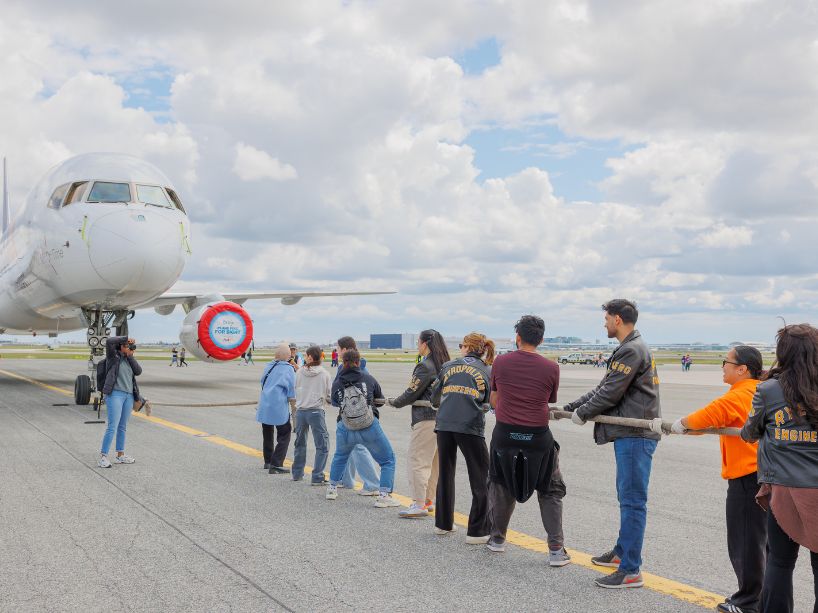
In May, Career & Co-op staff along with the MetRocketry team pulled a 60-tonne FedEx 757 cargo plane 20 feet across the tarmac at Pearson International Airport to raise funds for blindness prevention. Photography credit: Ashvin Kalaivannan
Furlan says the aerospace engineering program gave her the launchpad she needed, but co-op is where things got real.
“In class, you’re working through ideal scenarios, but on the job, you deal with constraints and navigate challenges you’ve never considered before.”
Her placement also opened her eyes to the size of Canada's aerospace sector.
Working with a company that collaborates with Boeing and Airbus, alongside smaller firms, gave her a clear picture of the industry’s depth and reach. “You don’t necessarily have to go to the U.S. to build a career in this field,” she says.
Furlan sees real possibilities for building a career and a future right here at home.
Taking flight
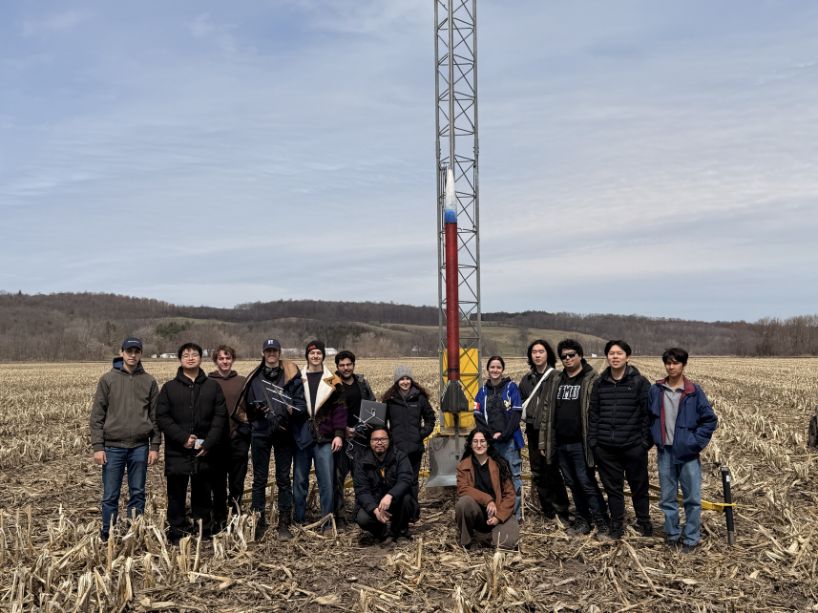
MetRocketry team captain Isabella Furlan is looking forward to tackling new challenges in Midland, Texas, like desert heat and potential winds, as they prepare to launch a two-stage rocket.
This June, MetRocketry heads to Midland, Texas, to compete in the International Rocket Engineering Competition (IREC), the world’s largest university rocket engineering competition.
They’ll be one of 175 teams competing from around the world. TMU’s 12-person team is aiming to become the first to win in the competition’s new multistage category. They’ll be building and launching a two-stage rocket designed to reach 45,000 feet — well above the typical cruising altitude of a commercial aircraft, which flies at about 32,000 feet.
“This is MetRocketry’s third attempt at a two-stage project,” Furlan says.
For Furlan, the competition is a fitting way to close out her undergraduate degree.
"There’s this mix of excitement and nerves, but more than anything, I feel ready,” says Furlan. “Being in my final year and having the chance to lead the team into a major competition means everything to me."