Nelson Mandela's great-grandson brings leader’s legal legacy to TMU
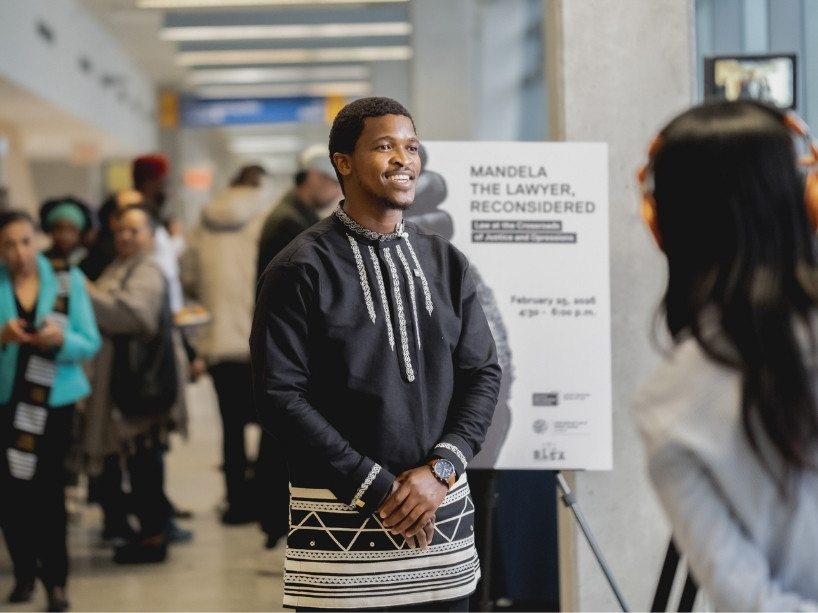
Most people know Nelson Mandela as a revolutionary. But at a packed event held at TMU in February, his great grandson offered a different lens: Mandela as a lawyer – and what that training meant for everything that followed.
Siyabulela Mandela traced his great-grandfather's long, difficult pursuit of a law degree, and how that journey shaped one of history's most consequential political careers. Siyabulela Mandela grew up in Eastern Cape, South Africa, and holds a PhD in International Relations and Conflict Resolution from Nelson Mandela University. He now works in human rights, conflict resolution and sustainable development.
The event, which coincided with Black History Month, was organized by the International Law & Global Justice Initiative and the Black Law Students’ Association (BLSA) at the Lincoln Alexander School of Law.
From civil servant to freedom fighter
Siyabulela Mandela began his story in 1939, when Nelson Mandela started his Bachelor of Arts at the University of Fort Hare. At the time, his goal was modest: Become a civil servant who could help his family navigate the language barrier between “the colonizers and the administrators of the colonial system,” Mandela explained.
That changed. In 1940, Nelson Mandela was elected to the Student Representative Council – then resigned to join a student protest over the council’s lack of real authority. “He articulated his position on constitutional law grounds,” Mandela explained. It was a sign of what was to come.
After being expelled for refusing to take his council position, Nelson Mandela moved to Johannesburg and worked as a security officer at Crown Mines. He completed his Bachelor of Arts by correspondence. In 1943, he enrolled in law at the University of the Witwatersrand – the only Black student admitted, and only after applying for a special exemption.
Law school under apartheid
While Nelson Mandela was attending law school, South Africa was becoming more racially segregated. In 1948, the Dutch settler (Afrikaner) National Party came to power and formalized the system of apartheid.
“We’re talking about whites-only, coloured-only and Blacks-only spaces in public and private settings. We’re talking about social control, prohibition of interracial marriages, and we’re talking about the pencil test,” Mandela told the crowd, describing the test whereby a pencil was placed in an individual’s hair to determine if they were considered Black.
Mandela described how his great-grandfather struggled academically – sometimes failing courses – as he balanced studies with his increasing involvement in the anti-apartheid African National Congress (ANC). At one point, the dean of law discouraged him from completing his law degree altogether, suggesting he qualify as an attorney instead.
Nelson Mandela pressed on. In 1952, the same year he organized the Defiance campaign – a national strike in protest of apartheid laws – he and ANC comrade Oliver Tambo opened the first Black-owned law firm in South Africa, offering affordable legal support to Black South Africans.
When law was no longer enough
By 1960, Nelson Mandela had reached a turning point. Police officers had killed 69 peaceful protestors and injured another 180 people in Sharpeville. He concluded “that the law is no longer viable as a tool to advance justice” and that revolution was the only alternative, Siyabulela Mandela told the crowd.
So Mandela helped launch the armed wing of the ANC, which targeted power plants and government buildings. In 1962, he was arrested and sentenced to life in prison for conspiring to overthrow the state.
He represented himself in court and challenged the legitimacy of the proceedings, saying he did not consider himself “legally nor morally bound to obey laws made by a parliament in which I have no representation.”
The challenge failed, as he knew it would. He spent 27 years in prison, 18 of them in a bedless cell at the infamous Robben Island prison.
Finishing the degree – 46 years later
Still, Nelson Mandela didn’t let go of the law degree. Through the 1960s and 1970s, he wrote letters from prison to multiple universities asking to complete it. In 1981, the dean of law at the University of South Africa persuaded the government to allow it. Mandela earned his degree 46 years after he began pursuing it and just months before his release in 1990.
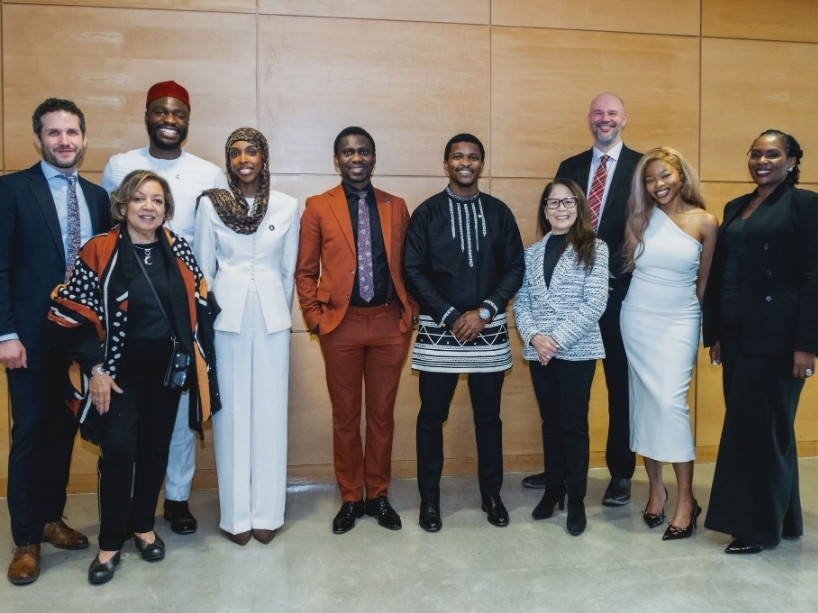
Siyabulela Mandela is joined by TMU Chancellor Donette Chin-Loy Chang and event organizers from the International Law & Global Justice Initiative and the Black Law Students’ Association (BLSA) at the Lincoln Alexander School of Law.
What it meant to the TMU community
Graham Hudson, interim dean of Lincoln Alexander Law, said Mandela’s remarks were a powerful reminder of “where our values have come from, what it means to protect them, and that each of us has the ability, power, and responsibility to do so” – particularly at a time when “it can be easy to feel discouraged, and maybe even fearful or anxious about the future.”
Rebecca Mesay, a Lincoln Alexander Law graduate now working as an immigration and refugee lawyer, said the talk reminded her that “an unfair legal system persists and the work we hope to do as lawyers is to try and reduce the gap between legitimacy and legality as much as we can.”
Suwayda Sheikh-Mohamed, president of the Black Law Students’ Association at Lincoln Alexander Law and incoming chair of BLSA Canada, co-emceed the evening. She connected Mandela’s message to the law school’s founding pillars – access to justice; equity, diversity and inclusion; innovation and entrepreneurship; and academic excellence. “Creating space for these discussions is part of how we continue pushing the profession forward.” she said.
Kien Azinwi, a third-year law student and past president of the Lincoln Alexander Law Students' Society, who also co-emceed, put it plainly: The law can be "an oppressor, but also a liberator. That which it becomes really depends on those who are courageous enough to shape it."