Ryerson film student wins 2020 Glenn Gould Protege Prize
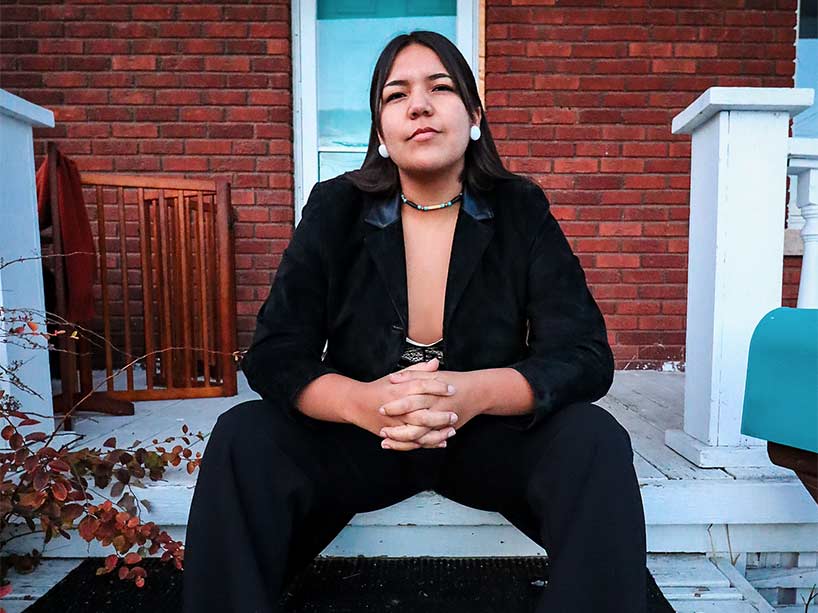
Victoria Anderson-Gardner (above) impressed Abenaki filmmaker Alanis Obomsawin with her award-winning documentary Becoming Nakuset.
“It was one of those moments that didn’t seem real, like all the other sound in the world disappeared for a little while.”
This is how Victoria Anderson-Gardner described the moment when one of their idols – renowned Abenaki filmmaker Alanis Obomsawin – called with the news that she had chosen the Ryerson film student for the Glenn Gould Foundation’s $15,000 Protégé Prize.
Unfortunately, Anderson-Gardner was driving at the time and got stopped by the police, near their home outside Thunder Bay.
“I was shaking because I’d never gotten a ticket before, but when I explained, the officer was nice and let me off with a warning,” said the Ojibwe filmmaker, who completes a bachelor of fine arts degree at the School of Image Arts this year.
“Alanis has been an idol of mine for many years and I was overwhelmed by the fact that she knew my number and was calling me, let alone that she’d watched one of my films and thought I should receive this award from her.”
Ready for a close-up
As winner of the 2020 Glenn Gould Prize, Obomsawin – whose distinguished career spanning five decades includes more than 50 documentary films with the National Film Board – was given the opportunity to select an emerging artist to receive the Protégé Prize.
“Victoria is very talented – Becoming Nakuset was such a wonderful discovery for me,” said Obomsawin. “It was so rich and well made. I felt so good about the fact that Victoria was really listening to Nakuset, not having an opinion and deciding what the story was but listening and being respectful to the subject and the story. I was impressed with the way Victoria handled the film.”
Obomsawin first saw the film at the 2020 imagineNATIVE film festival, where it won Audience Choice Award for Best Short Film. The 12-minute documentary weaves animation, archive footage and interviews to tell the story of Nakuset, a survivor of the Sixties Scoop who was taken by Indian agents from Thompson, Manitoba, and adopted into an affluent Jewish family in Montreal.
Nakuset’s story struck a deeply personal note with Anderson-Gardner, who is from Eagle Lake First Nation, Ont. “Making the film was a bit difficult,” they said. “Because my mom was part of the Sixties Scoop so I experienced a lot of similar trauma. But I think talking about it helps, it lifts a bit of the weight instead of carrying it within yourself all the time.” (View “Becoming Nakuset” here (external link) .)
Putting career into focus
While in high school, Anderson-Gardner was first inspired to pick up a camera after seeing the 2011 film Another Earth. “I was going through a difficult time in my life, I lost a sister when I was 10 and it really impacted me,” they said. “And being a teenager at the time, with all the angst you feel, that film really spoke to me in a way that all the therapy and counseling I’d had never could, and I realized just how much of an impact a film can have on a person.”
When Anderson-Gardner enrolled at Ryerson, they planned to become a cinematographer, but professor Manfred Becker encouraged them to pursue directing.
“In my third year, he brought me onto a feature documentary project with CBC, ‘In Search of a Perfect World,’ as additional director, with Peter Mansbridge as the host,” they said. “Professor Becker really guided me into the documentary world, and opened me up to a lot of more opportunities, as well.”
The new direction paid off. By fourth year, Anderson-Gardner’s thesis project, The Hurt That Binds Us, won Best Documentary at the Ryerson University Film Festival (RUFF) Awards. And a month later, a private film company, Art With Impact, flew the filmmaker down to Los Angeles to propose using the film as an educational tool “to discuss mental health aspects in Indigenous communities” – it’s now being screened at mental health workshops at colleges and universities across Canada.
“The film explores intergenerational trauma and what it means to my family. So it was difficult to make at times. There were a lot of really hard conversations that I think needed to be had,” they said. “Since then, it's actually brought a lot of my family closer together, which is really nice.”
Ryerson ‘the foundation for all of it’
Anderson-Gardner credits Ryerson for grounding her in the fundamentals of filmmaking, both theoretical and technical. “It really gave me the foundation for all of it, along with the connections and network I’ve built. I feel like I wouldn’t be where I am today without Ryerson.”
Next up for Anderson-Gardner is a short feature film for Reel Canada called Namid, to be released on April 21, National Canadian Film Day. They are also in development as co-director and producer for Tenaya, a feature-length film that won the Audience Choice Award at TIFF’s Big Pitch 2020. “We’re hoping it will premiere at TIFF if things go well.”
Much like her idol, Obomsawin – who’s still busy working on projects for the NFB – Anderson-Gardner is focused on creating Indigenous content, showcasing under-represented communities and using their skills as a filmmaker to educate and inspire.
“Something I try to keep in mind with every film I make is this thought of wanting to impact one person,” they said. “As long as I impact one person, then I'm doing what I set out to do.”
The Glenn Gould Prize is awarded for a unique lifetime contribution that has enriched the human condition through the arts. Each Laureate also chooses an outstanding young artist – one who shows the promise of an exceptional lifetime contribution to enriching the human condition through the arts – to receive the Protégé Prize. Both recipients will be presented with their awards in the fall of 2021 in Toronto. The Glenn Gould Foundation celebrates the life, career and enduring influence of Canadian pianist, writer and broadcaster Glenn Gould. Learn more at glenngould.ca (external link) .