A life in photos
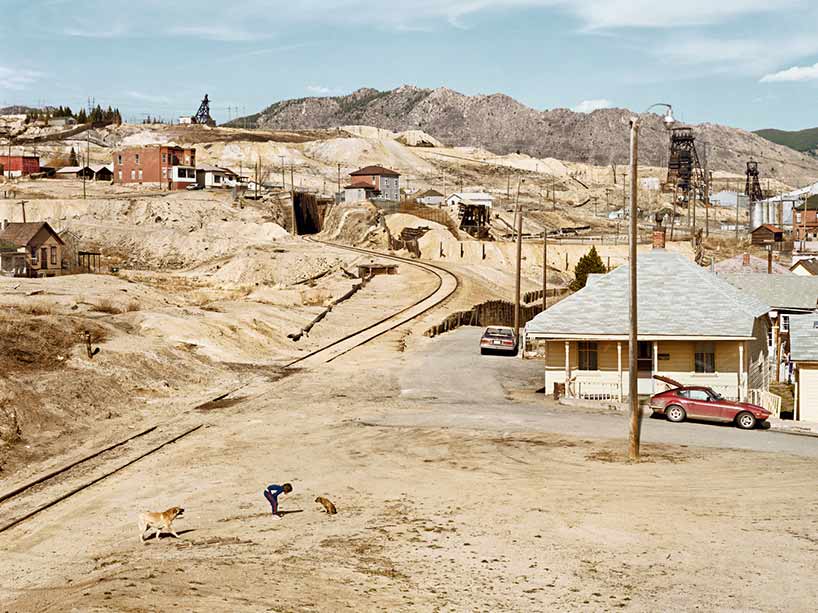
Homesteads #29, Walkerville, Montana, 1985. A “very artful, but also very deadpan” depiction of human-shaped landscapes. Photo: Edward Burtynsky.
Edward Burtynsky (Photographic Arts, ’82) is world-renowned for his massive, incredibly detailed and arresting vistas of places we wouldn’t otherwise see: the turquoise pools of lithium mines; oil pump jacks and rigs that stretch into the vast horizon; jagged slabs of a gargantuan marble quarry. His works give you the feeling that you’ve stepped into them. This is not only because of their scale—his photos are frequently displayed as 60-by-80-inch prints, and more recently, a select few have been released as 10-by-20-feet murals. It’s also their detail, like how you can make out the logo on a plastic bottle in a mountain of garbage. His career documenting human-created landscapes began at Ryerson, when his instructor, Rob Gooblar, assigned the class to photograph “evidence of man.”
‘Free pass to be an alien’
“It literally gave me a free pass to be an alien, as if I was an alien looking at what this species, humans, is doing to the planet,” explained Burtynsky, through his electric car’s Bluetooth speaker, as he drove from a meeting in Toronto in early March. For Gooblar’s assignment, Burtynsky shot old shipping canals in St. Catharines, where his parents, newcomers from Ukraine, raised him and his siblings. His father, who worked at an auto plant, purchased cameras and a dark room from an amateur photographer when Burtynsky was 11, sparking an early fascination.
The black and white shipping canal prints are part of a donation that Burtynsky is giving to the Ryerson Image Centre (external link) (RIC) this year. This gift is the first of a multi-year donation, each representing about a decade of Burtynsky’s career. With the archive, Ryerson will hold the largest institutional collection of his work. Burtynsky, an Alumni Award Achievement recipient and founding board member of the RIC, says the centre is “near and dear to my heart” and he wants his work to be accessible to students and researchers when it’s not being exhibited.
“It’s kind of a live, active place to put my collection,” he says. “It was important to me that my life’s work be housed in a Canadian institution, and it felt like a fitting homecoming to entrust these works to the same place where I first developed as a photographer.”
Paul Roth, director of the RIC helped to curate the collection, one that powerfully chronicles the progression of Burtynsky’s vision. “Ed was really preternatural. He had a sense of what he wanted to do right from the beginning. But in another sense, he was very much like any other art student, he was trying out different styles,” says Roth.
Having benefited from the instructors who exposed him to a number of different influences, Burtynsky was driven to help shape the next generation of artists. “He doesn’t trumpet it, but he’s donated more money than anybody to support the growth of our collection,” says Roth.
An early move to colour
The first installment of 142 images, with a selection of about 25 images now made public in a virtual gallery (external link) on the RIC’s website, reveals Burtynsky’s transition to bigger and bigger projects, from farms to factories to rail cuts. The photos made between 1976 and 1989, primarily in Ontario and Western Canada, show his early move to colour. In the late ’70s, Burtynsky explains, almost all art photographers were shooting in black and white, and colour was taught for those interested in commercial photography—“cars, bottles, clothing.” The fact that colour was “so lightly explored” in art photography at the time was what drew him toward it. “I find it interesting to push boundaries,” he says.
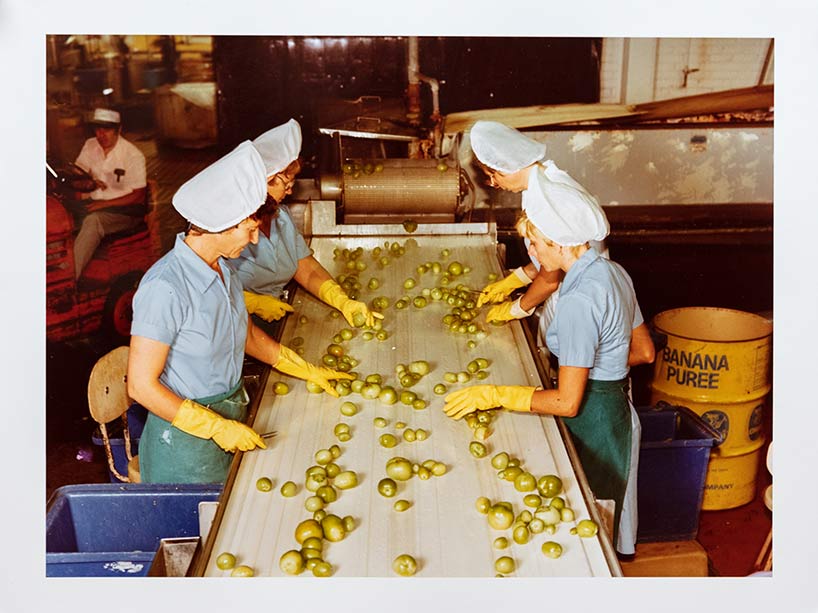
Holland Marsh, Ontario, from the series Packing, 1983. This photo shows Burtynsky’s early adaptation of colour. Photo: Edward Burtynsky.
Burtynsky’s eye for colour is evident early on. In one image in the collection, women chat across a conveyor belt, packing apples. The blues and yellows pop and harmonize like an ad, in juxtaposition to the everyday banality of the scene. These early photos may not look like what we know “a Burtynsky” to be today, notes Roth, but we see themes in his oeuvre appearing.
“You can absolutely feel his vision, how he’s looking at the interaction between man and machine, between man and nature,” says Roth. Burtynsky experienced these interactions in a more visceral way than most—before he started at Ryerson, he worked in factories building trucks and cars, and he worked in a gold mine in northern Ontario to help pay for his schooling.
“New Topographics”
As Burtynsky’s lens widens, the influence of the “New Topographics” movement on his work becomes apparent. In one of Burtynsky’s photos from 1985, a boy plays with dogs in a dusty Montana town with a railway just metres from houses. Burtynsky said he was inspired by photographers like Stephen Shore and Lewis Baltz, who captured the uniformity of suburban developments with a subtle critique. It was a shift away from centuries of landscape photography that “was a celebratory act towards nature” toward a “very artful, but also very deadpan” depiction of human-shaped landscapes, Burtynsky explains.
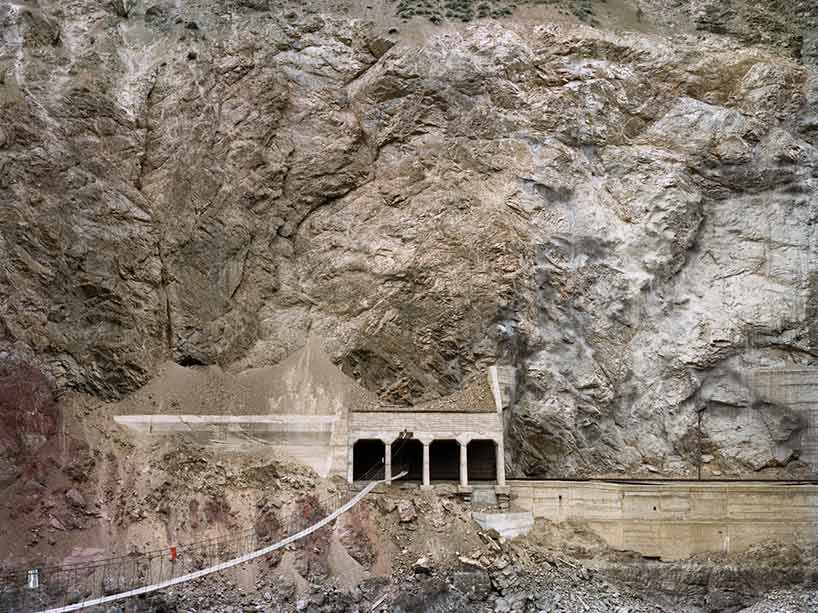
Railcuts #11, C.N. Track, Thompson River, British Columbia, 1985.The rail cut images show the “beginning of a Burtynsky viewpoint.”
The rail cut photos represent the “beginning of a Burtynsky viewpoint,” says Roth. “You’re looking at a place from seemingly impossible locations, and you ask yourself, ‘is he floating?’” While drones make these images possible today, in the 1980s, Burtynsky was climbing mountains with a large-view camera and equipment in his backpack, Roth notes.
Reshaping landscapes with human systems
Burtynsky has been criticized for the clean lines and beauty in his photos, given that they’re documenting the destruction of forests and toxic pollution. Roth sees it differently. “There’s a whole tradition in landscape art, about the conflict between beauty and terror or fear, and it’s called the sublime. Ed is one of the foremost practitioners of the sublime today,” he says.
It’s because of the gripping power of his images that we gaze long enough to take in the terror, “which is the realization we have when we understand that ‘Oh my gosh, this is something that was done at a huge scale for us so that we can have marble counters or so that we can drive our car.’”
Indeed, for the most part, Burtynsky avoids including people’s faces in his landscapes and often excludes people altogether.
That’s because, as he explains it, the landscapes he photographs aren’t created by a handful of individuals, they’re created by all of us, to feed our lifestyles. He wants to show “how we, as humans, collectively reshape the landscape with large-scale human systems.” His work “stands in lament for the loss of biodiversity in nature.”
To drive home our collective role in this loss, Burtynsky cites the work of William Rees, a University of British Columbia professor emeritus, who calculated that the average person in the world requires 2.2 hectares to survive. But in the West, we each consume 8.8 hectares for the food, minerals, lumber and other raw materials our lifestyles require. “For everybody else to meet our standard, we’re short three planets. Everybody’s wanting to have a life like us in the West, but there’s not enough planet to do it. So we are on this crazy trajectory,” says Burtynsky.
On the right side of history
But rather than be a source of sadness, his work gives him hope. “The one thing I can do is be on the right side of history and add my voice to a growing group of citizens, artists, engineers, scientists and politicians who are sounding the alarms.”
Describing Burtynsky as “ the premier photographer dealing with the issues surrounding global climate change—the critical subject of our time—and one of the most influential landscape photographers in the history of the medium,” Roth says, “we are thrilled to be chosen as the place that will preserve Edward Burtynsky’s work for posterity.”
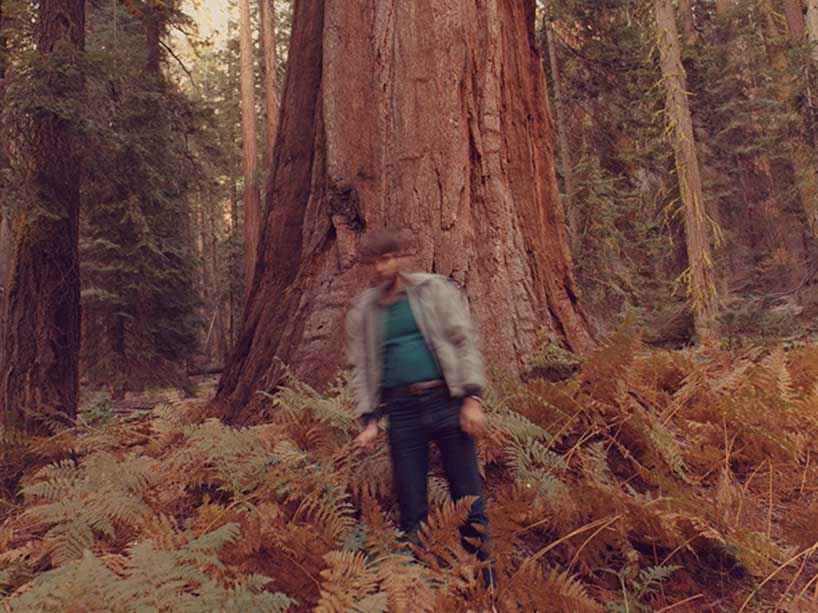
Edward Burtynsky: A self-portrait taken in 1983.
Each annual donation will add another chronological stage of Burtynsky’s career to the museum’s holdings until his entire career is represented. Once fully comprised, the collection will span five-plus decades of his photography on a range of subjects related to industrial manufacturing; landscapes altered for the economic exploitation of oil, water, stone, and other resources; waste and recycling; and the incursion of transportation routes and commercial and residential development into nature.
Burtynsky’s photos can take years of preparation. The first time he asks for access to a mine, factory or oil field, the answer is typically no. “You spend anywhere from months to years converting the no into a yes,” he says, adding that now he has staff who will call on his behalf. Sometimes, he thinks people agree simply so he “stops bugging them.” But it helps that Burtynsky shows up with his own steel-toed shoes and helmet, and that he can say he was a miner himself. It helps too that his photos are “revelatory, not accusatory.” He doesn’t do “a takedown of a corporation,” he says. “I’m interested in reconnecting people to the worlds that are important to their lives.”
Due to the pandemic, Burtynsky ’s planned photoshoots in Africa and exhibits around the globe have been postponed. In the meantime, he’s doing his part to help frontline workers: Think2Thing (external link) , a 3D printing atelier he co-founded in 2014, has created a design for a 3D-printed, snap-together face shield, which is available for download and printing. He produced a limited edition isolation series last spring called Natural Order (external link) .
For more information, visit edwardburtynsky.com (external link) .
All images: The Edward Burtynsky Collection, Ryerson Image Centre/Nicholas Metivier Gallery, Toronto. Gift of the artist.