Shaping the next 100 years in Canadian politics
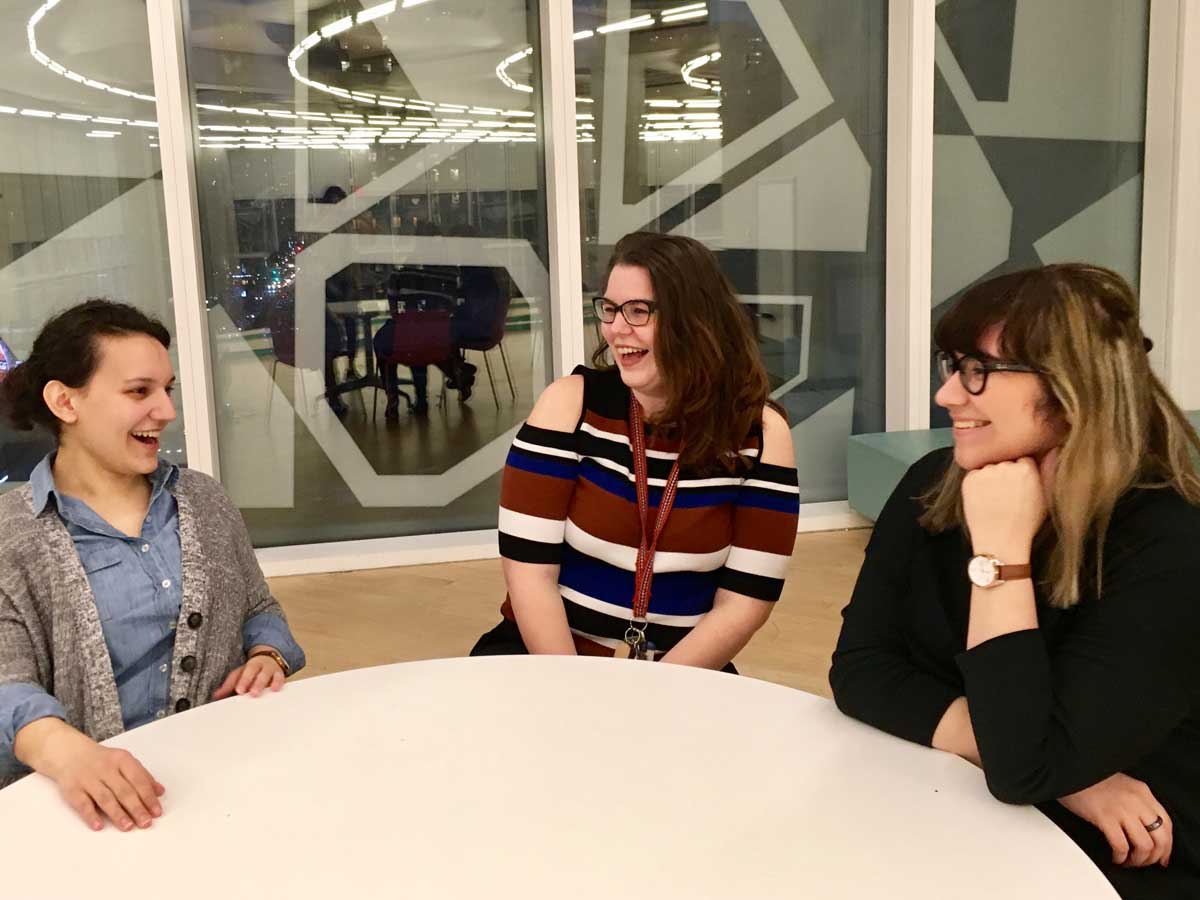
From left: Jessica Machado, Jamie Lee Morin and Arezoo Najibzadeh, delegates of the Daughters of the Vote conference share a laugh in the Ryerson University Student Learning Centre. Photo by Emerald Bensadoun.
“Wouldn’t it be cool to think that 20, 30, 40 years from now, one of the women attending the Daughters of the Vote conference could be the next Prime Minister, and last longer than a year?” asked Jamie Lee Morin.
After a lengthy application process Ryerson alumni Jessica Machado, biology ’16, and Jamie Lee Morin, English ‘16, alongside Ryerson students Mehma Kaur, social work, and Arezoo Najibzadeh, public administration and governance, were selected to attend the Daughters of the Vote conference at Parliament Hill, marking the 100th anniversary of Canadian women’s right to vote.
Daughters of the Vote (external link, opens in new window) (DOV) is an initiative of Equal Voice, whose main focus is to encourage and support women in becoming elected representatives at all levels of government.
As delegates and representatives of their respective electoral districts, Machado, Morin, Kaur, and Najibzadeh, will join 338 young women leaders from across the country. During the conference they will take their seats in the House of Commons, meet members of parliament, and attend meetings with committees and interest groups to further familiarize themselves with Canadian politics.
The event aims to celebrate women’s contributions to Canadian politics, as well as inspire the delegates to take on leadership roles within political institutions in Canada. There was an application process for the conference, and only one delegate was chosen for each riding.
“This is such a phenomenal opportunity to not just be in the House of Commons and sit in our MP’s seat, but to better understand what our institution looks like, how our government system works and the nuances of that system,” said Machado.
In 2016, a CBC news report (external link, opens in new window) revealed that while women account for roughly 50 per cent of Canada’s population, they only make up 25 per cent of Canadian politics.
Referring to Parliament Hill as a traditionally “foggy old gentleman’s club,” Machado and Morin explained the regional divisiveness existing in Canadian politics.
“The system isn’t broken, it just that this system wasn’t designed for [women]. It’s designed exactly for who it was for and it’s working for them,” said Machado. “We need to redesign our system to be inclusive of all of the intersections of identities that these 338 women are representing.”
As the first person in her family to receive post-secondary education, Morin embraces the chance to speak on behalf of other indigenous women who have been marginalized.
“My whole way of living is political,” said Morin. “I am a Métis woman, the fact that I am living here today, the fact that I am in a university, the fact that I got a university degree, that I even finished high school – that’s a political act.”
While a commemoration of women in politics is a step in the right direction, Kaur explained there is room for improvement in Canadian politics.
“It was only white women who got the first vote. Its important to address the different intersectionalities and all of the different women that are showing up, and to look at the factors that do stop us from running [for positions in politics].”
As a celebration of the past 100 years, Najibzadeh noted the DOV as a celebration of “white women’s history,” “a chapter in the Canadian experience where a lot of women’s voices weren’t heard.” For Najibzadeh, this conference represents an opportunity to help reshape the next 150 years, setting the tone for women in Canadian politics.
“To be able to go to this celebration and to set the agenda for the next 100 years and to say, ‘“I was part of this new chapter’” in history that’s beginning – I think that has a lot of power in it,” said Najibzadeh. “This era will say, “I will not be silenced anymore.””