BMO Newcomer Workforce Integration Lab
BMO Newcomer Workforce Integration

Leveraging the skills and talents of newcomers to Canada
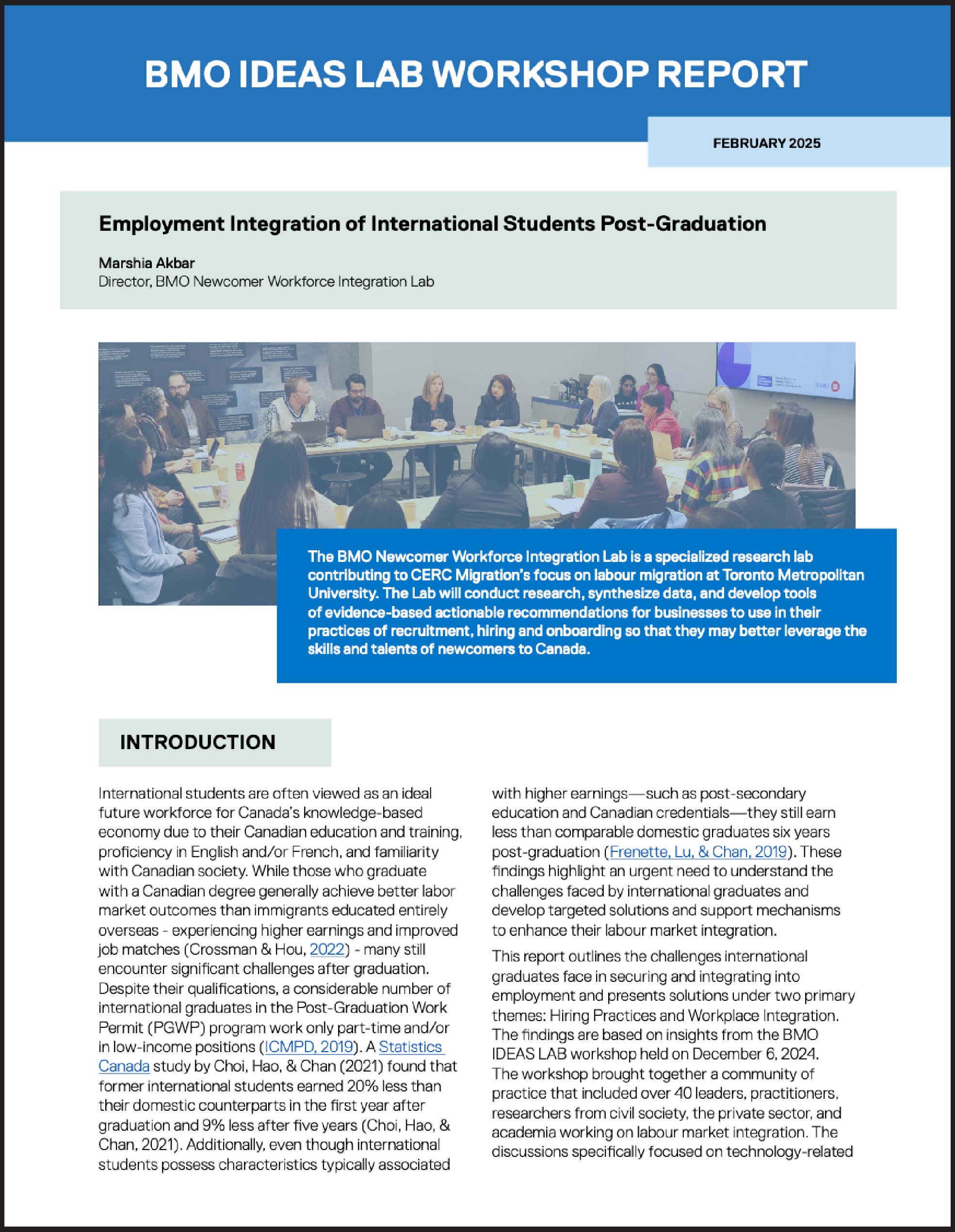
The BMO Newcomer Workforce Integration Lab (BMO Lab) is a specialized research lab through which the Global Migration Institute conducts the majority of its research on labour migration, made possible through a generous gift of $3 million from BMO. The Lab is dedicated to advancing research on labour migration and creating practical, evidence-based tools that businesses can use to strengthen their recruitment, hiring, and onboarding practices. By equipping employers with strategies to better leverage the skills and talents of newcomers to Canada, the BMO Lab contributes directly to building a stronger, more inclusive workforce.
Canada’s future prosperity depends heavily on immigration. With nearly one in five Canadians born abroad and an aging workforce poised to exit the labour market in large numbers, newcomers are essential to filling critical roles across sectors such as health care, construction, and technology. Yet despite ambitious immigration targets and a growing pipeline of highly skilled immigrants, employers often lack the resources to effectively attract, integrate, and retain this talent. This gap places significant strain not only on businesses but also on newcomers seeking meaningful employment that matches their skills and experience.
Led by Lab Director Marshia Akbar, the BMO Lab works at the intersection of research and practice. With BMO as its champion, the Lab has a unique opportunity to develop and test new insights and methodologies that can have a lasting impact on immigrant workforce integration in Canada.


The BMO Newcomer Workforce Integration Lab will seek to address pressing questions which consider both the newcomer and the employer perspectives:
- What immigration policies and settlement services do skilled newcomers look for when deciding to choose Canada as their destination? And what are the experiences and service needs of recently arrived newcomers seeking to enter the Canadian workforce?
- What are the challenges or barriers that skilled newcomers face in entering Canada’s workforce?
- What are the skills and labour gaps Canadian businesses are facing, and how do the skills of newcomers match?
- What are the challenges that employers face in hiring and onboarding foreign talent?
- What best practices do businesses need to follow to successfully attract, hire and onboard skilled newcomers, and how can they support the work-life integration experience of newcomer employees to ensure maximum success in their new country?

The BMO Newcomer Workforce Integration Lab conducts research, synthesizes data, and develosp a package of evidence-based, actionable recommendations that can support businesses in their recruitment strategies, and hiring and onboarding practices to better leverage the skills and talents of newcomers to Canada.
Lead action-oriented roundtable discussions and workshops
Develop a toolkit that businesses can use to guide their processes for hiring and onboarding newcomers across provinces and industries
Build partnerships across employment, government, not-profit and service sectors
Publish white papers and peer-reviewed journal articles, policy briefs and other publications on key research findings
Test the toolkit through applied approaches (e.g. hiring events, job fairs)

Anna Triandafyllidou
Scientific Director, Global Migration Institute
Chair, CERC in Migration and Integration Program

Marshia Akbar
Director, BMO Newcomer Workforce Integration Lab and Research Lead on Labour Migration
CERC in Migration and Integration Program
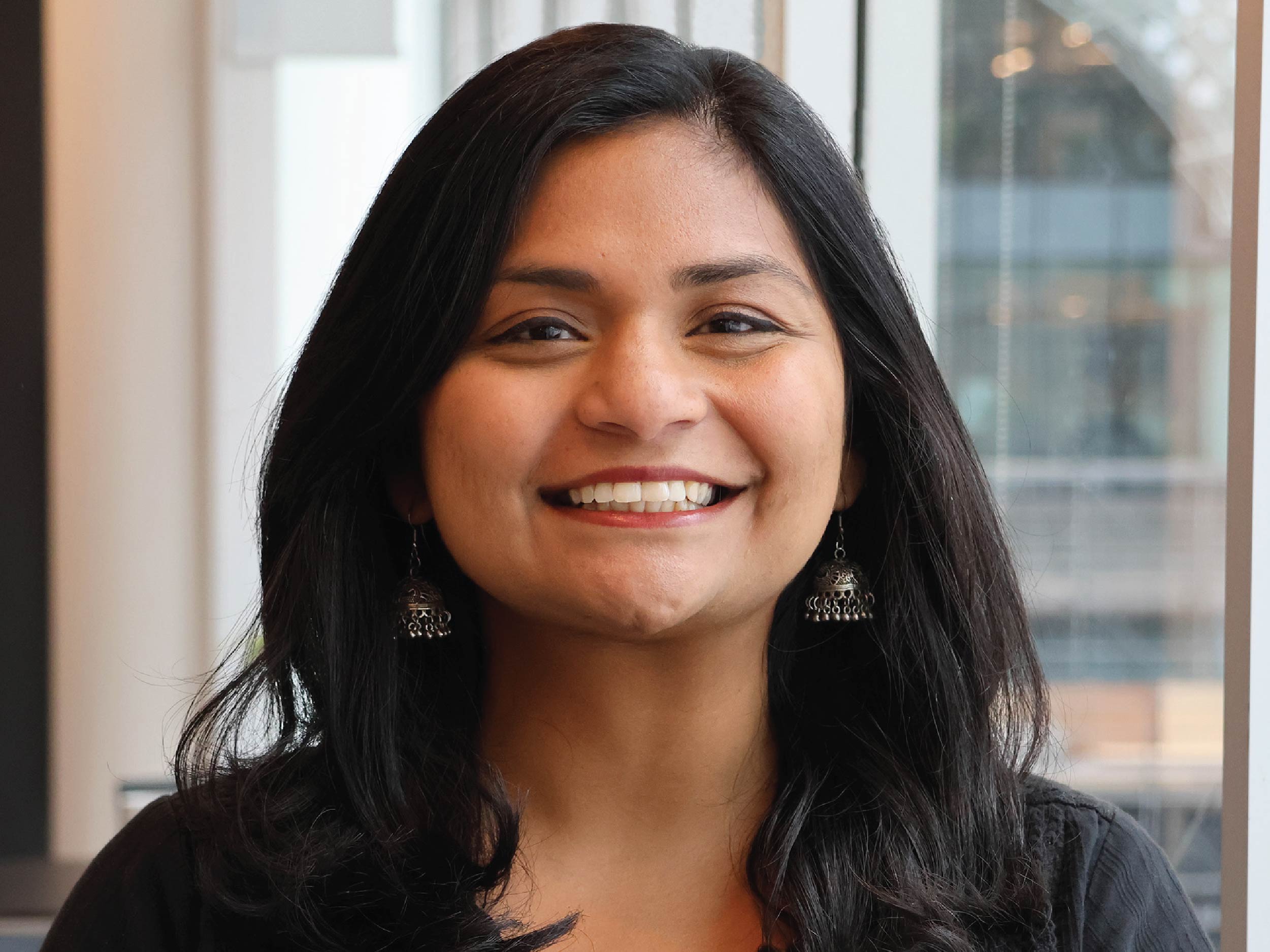
Asma Atique
Research Fellow
CERC in Migration and Integration Program
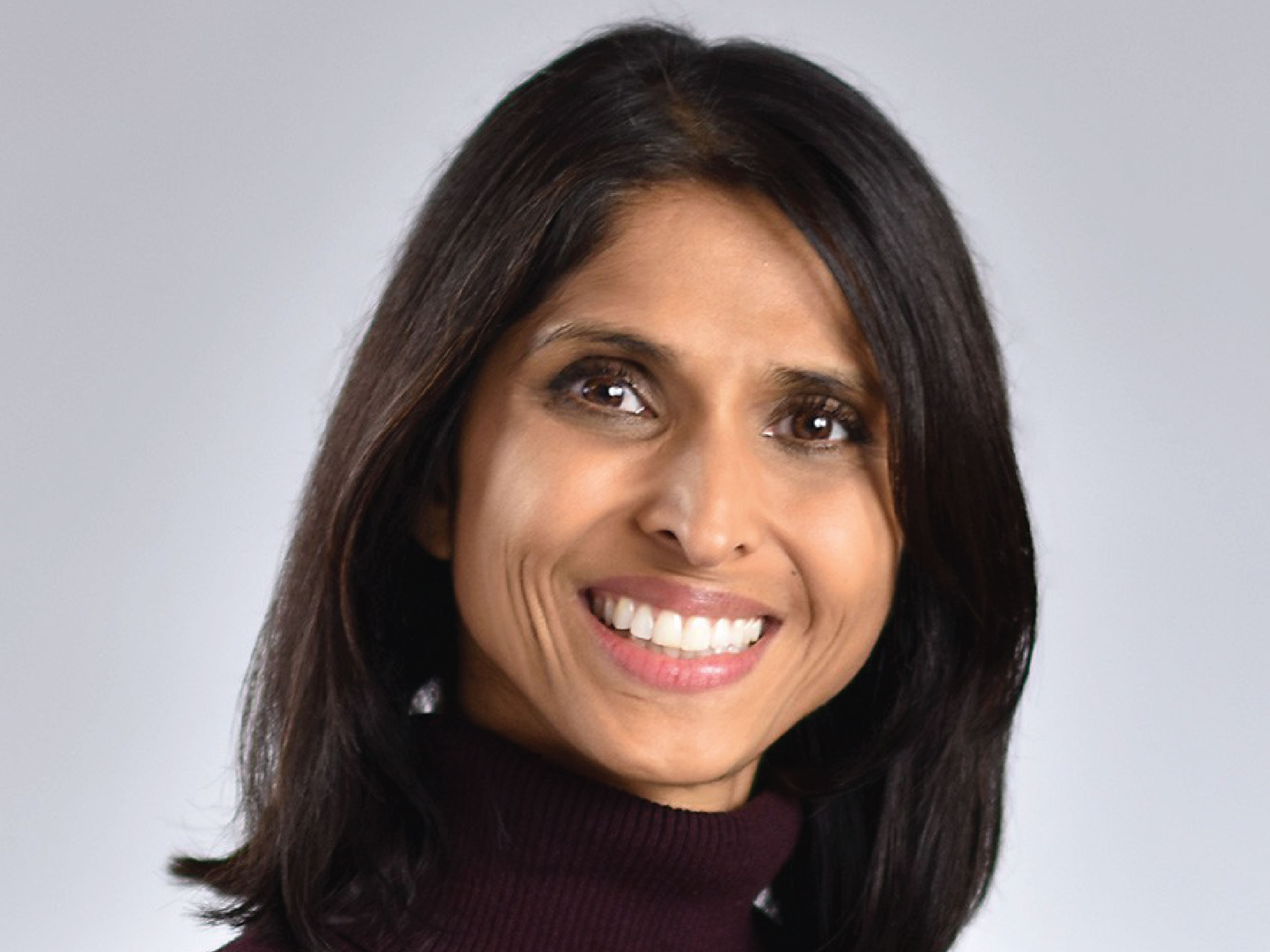
Rupa Banerjee
Research Affiliate
Ted Rogers School of Management

Evelyn Siu
Manager, Partnership Engagement
CERC in Migration and Integration Program
Akbar, M. (2024). Challenges Facing International College Students in Canada (external link) . In S. Irudaya Rajan (Ed.), India Migration Report 2023: Student Migration (pp. 138-160). Routledge.
Akbar, M. (2025). Placing Muslim identity: Experiences of Bangladeshi immigrant women operating businesses in Toronto. (external link) In A. Jamal et al. (Eds.), South Asian Feminisms in Diaspora: Critical Perspectives from Canada (pp. 185-202). University of Alberta Press.
Akbar, R., & Banerjee, R. (2025). Assessing the Impact of the Post-Graduation Work Permit Program on the Earnings of International Students: Evidence from the Canadian Employer–Employee Dynamics Dataset (external link) . Labour: Review of Labour Economics and Industrial Relations, 1–14.
Banerjee, R., Reitz, J., Hou, F., & Adjetey, W. N. L. (2025). Second-generation education and earnings across birth cohorts: Ethno-racial variations in Canada. (external link) Ethnic and Racial Studies, 1–25.
Dreher, N., & Triandafyllidou, A. (2025). Understanding digital nomadism: a three-level framework for migration studies. (external link) Journal of Ethnic and Migration Studies, 1–20.
Formanowicz, D., Zhang, T., Banerjee, R., Ahmed, R., & Garcia-Sitton, I. (2025). Privilege and Precarity: Migration Journeys of Former International Students in Canada Through the Lens of the Aspirations and Capabilities Framework (external link) . Journal of Immigrant & Refugee Studies, 1–21.
KC, Hari, & Triandafyllidou, A. (2025). Digital Nomadism and the Emergence of Digital Nomad Visas: What Policy Objectives Do States Aim to Achieve? (external link) International Migration Review, 0(0), published online on January 22, 2025.
Leach, B., Biswas, N. U., Jijina, P., & Niraula, A. (2024). Navigating uncharted trajectories: Skilled Indian women migrating to Canada (external link) . In I. Rajan (Ed.), India Migration Report 2024: Student Migration. Routledge.
Mathurin, G. Lam, L. Al-Alaoui, S. & Triandafyllidou, A. (2025) A Fine Balance: Exploring Job Quality in Platform Work Between Migrants and Nonmigrants. (external link) International Migration Review, 0(0), published online on April 13, 2025.
Monteiro, S. (2022). Extended family migration decisions: Evidence from Nepal (external link) . SN Soc Sci, 2:238, 1-22.
Monteiro, S. (2024). Economic assimilation of Indians in Canada (external link) . In I. Rajan (Ed.), India Migration Report 2024: Student Migration. Routledge, 97.
Monteiro, S. (2024). Searching for settlement information on Reddit (external link) . International Migration, 62(3), 100-119.
Preston, V., & Akbar, M. (2025). Gender, Immigration, Essential Work, and Resilience. In V. Preston et al. (Eds.), Social Resilience and the Urban Migrant Experience (pp. 24–40). Montreal & Kingston: McGill-Queen’s University Press.
Preston, V., Shields, J., & Akbar, M. (2025). Social resilience and settlement agencies responding to a crisis (external link) . In V. Preston, J. Shields, & T. Bedard (Eds.), Social resilience and international migration in Canadian cities (pp. 24–40). Montreal & Kingston: McGill-Queen’s University Press.
Sanderson, K., Butt, I., Banerjee, R., & Hron, R. (2025). Voices of belonging: Integrating immigrant perspectives in workplace inclusion theory (external link) . Human Resource Management Review, 35(4), 101100.
Triandafyllidou, A. (2024). (excel file) Migration and Globalisation: Dynamics and Contradictions. In A. Triandafyllidou (external link) (Ed.), Handbook of Migration and Globalisation. Edward Elgar Publishing, pp. 1-24.
Triandafyllidou, A. (2025). Migration, Advanced Digital Technologies and the Future of Work (external link) , International Migration Review, 0(0).
Triandafyllidou, A. (Ed.) (2025). Temporary Migration: Category of Analysis or Category of Practice? (external link) Routledge. New edition of the Special Issue with the same title that appeared in the Journal of Ethnic a
Akbar, M. (2025). What the voter gender divide means for Canada’s political future (external link) , The Conversation, March 15, 2025.
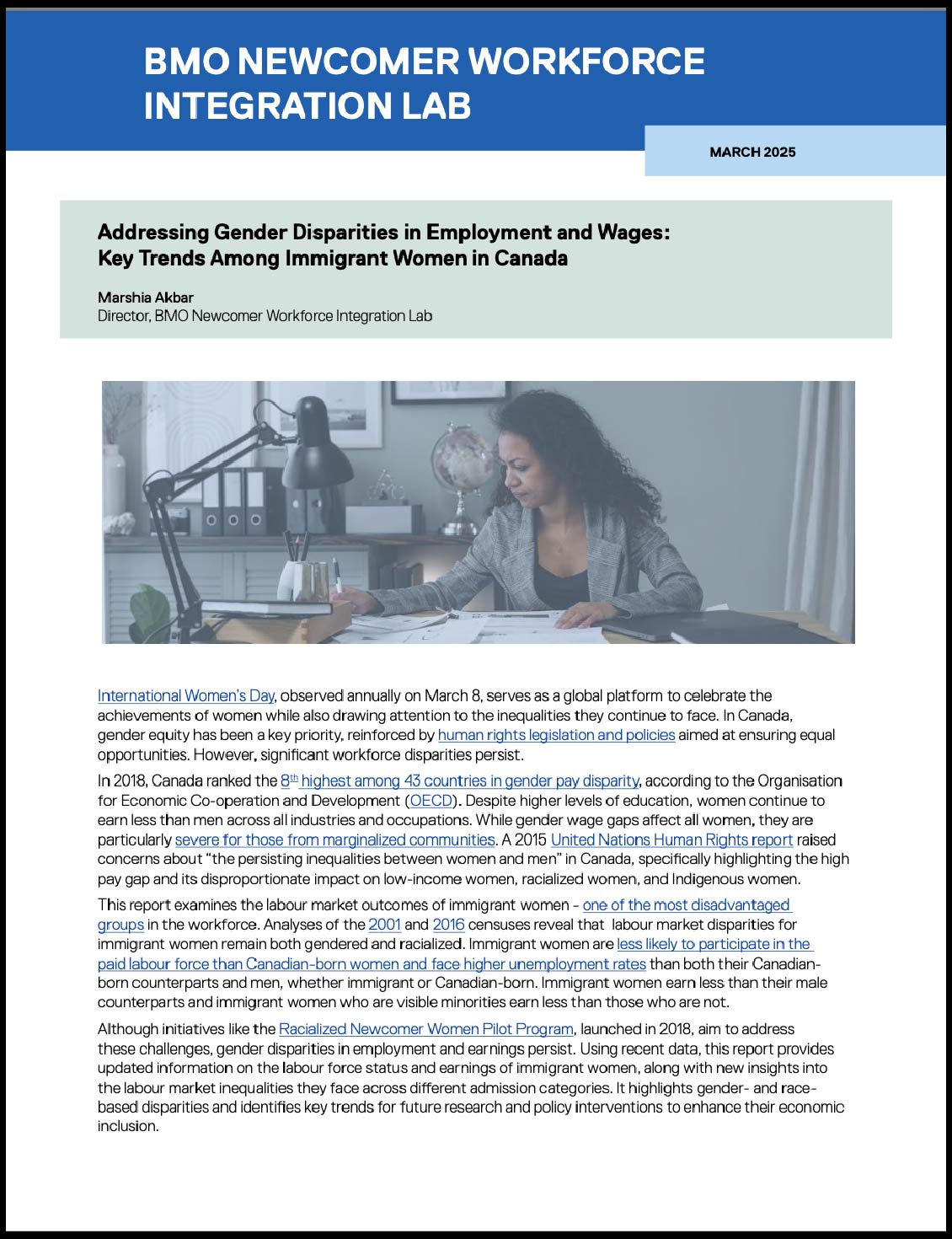
Akbar, M. (2025). (PDF file) Addressing Gender Disparities in Employment and Wages: Key Trends Among Immigrant Women in Canada, BMO Newcomer Workforce Integration Lab, Toronto Metropolitan University, March 8, 2025.
Akbar, M. (2025). Canada’s labour market is failing racialized immigrant women, requiring an urgent policy response (external link) , The Conversation, April 3, 2025.
Akbar, M. (2026). Tariffs are reshaping Canadian manufacturing, but not all workers are being impacted the same way (external link) , The Conversation, February 2, 2026.
Akbar, M. & Triandafyllidou, A. (2025) Canadian immigrants are overqualified and underemployed — reforms must address this (external link) , The Conversation. February 17, 2025.
Akbar, M., Deegan, H., & Aziz, A. (2024). (PDF file) Labour migration policies: Case study series Canada (external link) . Picum, March 2024.
Alboim, N., Cohl, K., & Akbar, M. (2024). (PDF file) Ontario colleges and international students: A pivotal time. CERC Migration Policy Brief 18, February 2024.
Mohan, S. (2024). MIrreM Country Brief on Migration Policy Context – Canada (external link) . In MIrreM Report. Krems: University for Continuing Education Krems (Danube University Krems).
Monteiro, S., & Triandafyllidou, A. (2024). Migration narratives on social media: Digital racism and subversive migrant subjectivities (external link) . First Monday, 29(8-5).
Triandafyllidou, A. & Akbar, M. (2025) How Canada Can Unlock the Full Potential of Skilled Immigrants and International Graduates (external link) . TheFutureEconomy.ca. March 19, 2025.
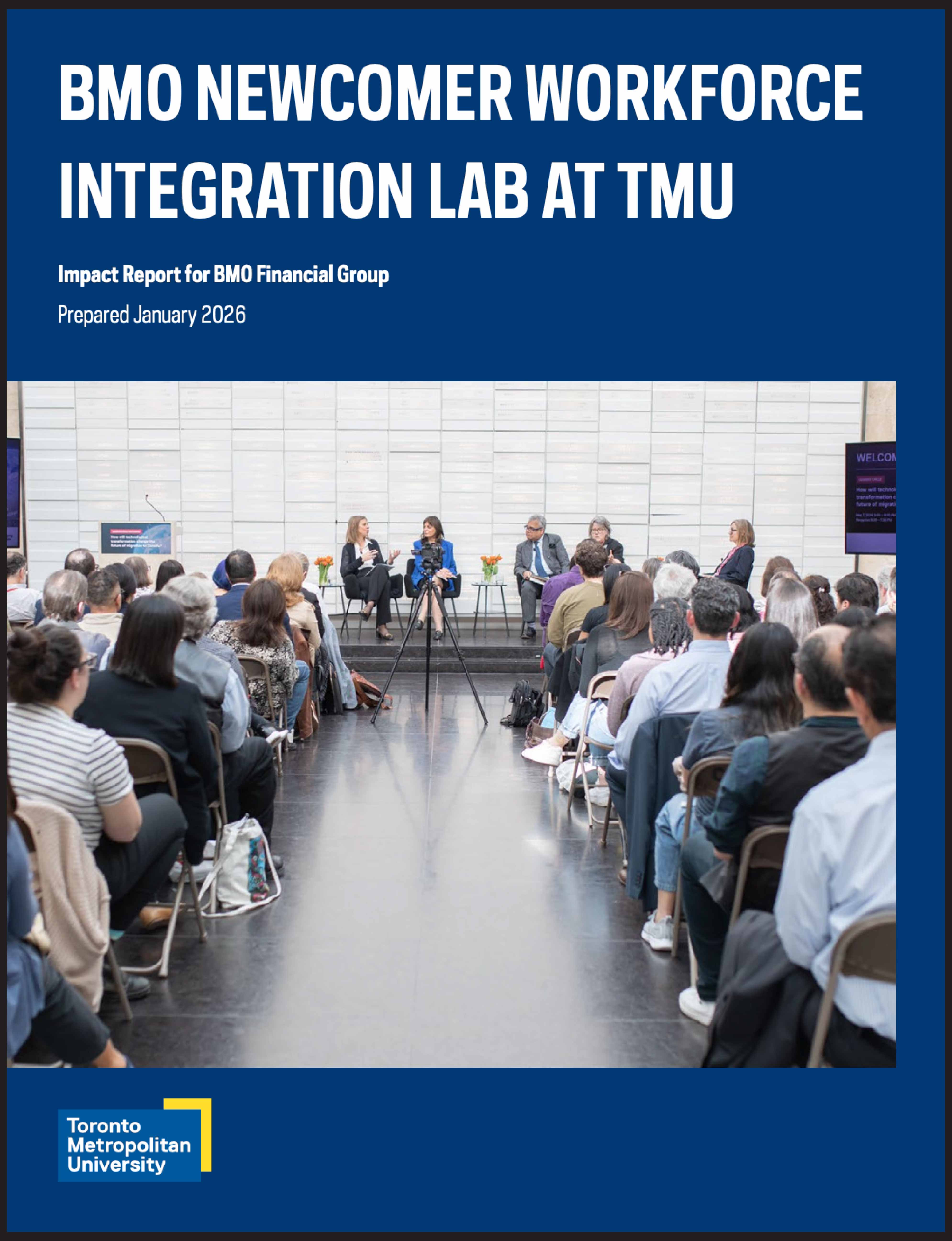
(PDF file) BMO Newcomer Workforce Integration Lab
2024 Progress Report (PDF file)