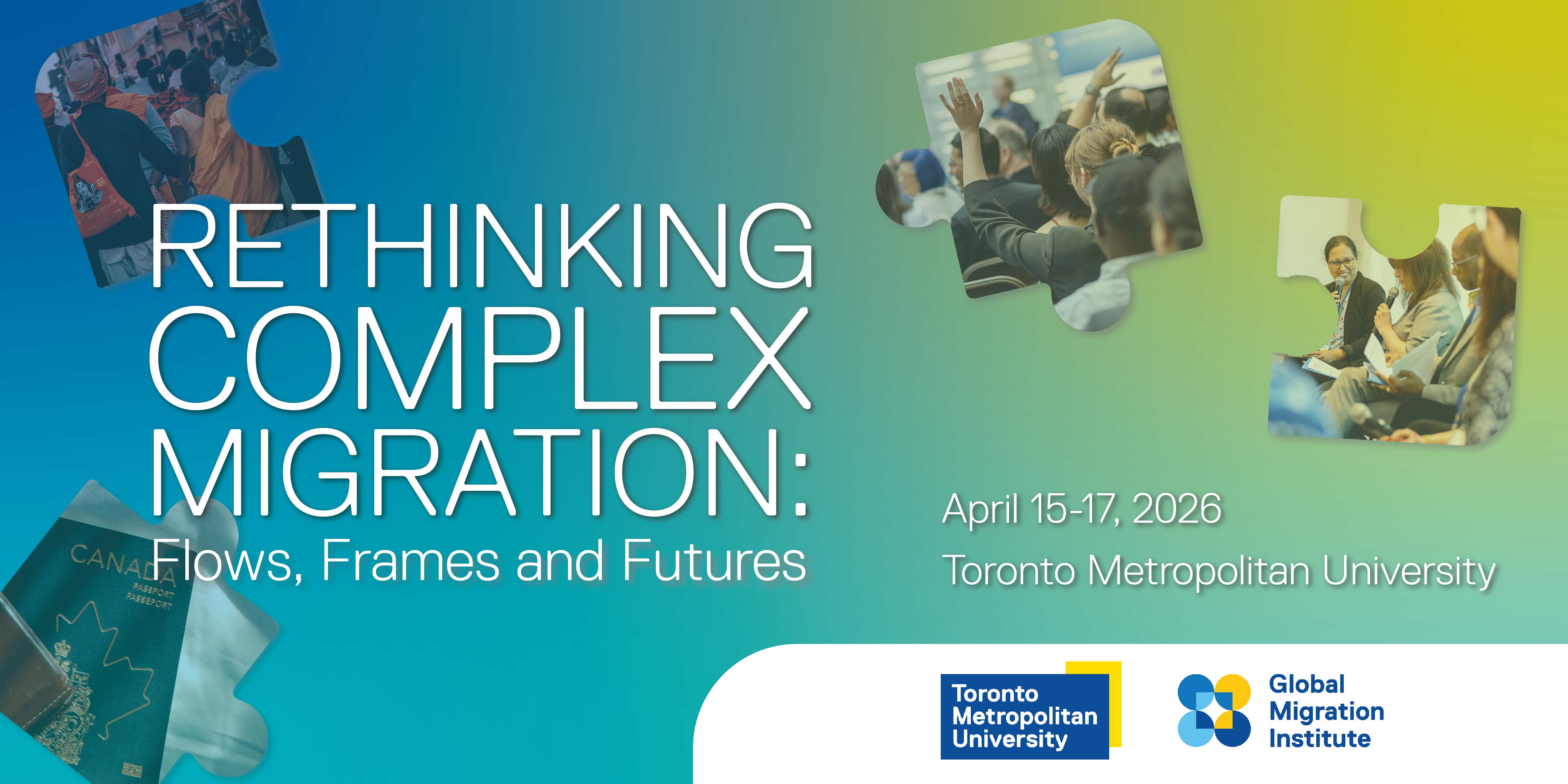
Rethinking Complex Migration: Flows, Frames, and Futures
- Date
- April 15, 2026 - April 17, 2026
- Time
- All Day
- Location
- In person, Toronto Metropolitan University
International migration is increasingly diverging from the neat categories that policy and scholarship use to describe it. Unlike the past, when migration was thought to be a linear trajectory from a country of origin to a country of destination, with the intention of settlement, migration today is becoming more complex, often involving multiple journeys and under different policy categories. Migrants today do not easily fit the policy categories of labour migrant, refugee, or international student – they tend to have mixed motivations: economic, political, and family-related. Digital mobility further complicates migration: digital nomads have emerged as a new type of lifestyle migration while many migrant workers are engaged in digital platforms to provide their services to overseas employers. Further, international migration is often intertwined with internal migration or forced displacement making it even more difficult to fit human mobility into legal structures of ‘safe, orderly and regular’ migration.
This conference offers a reflection on what is considered ‘regular’ or ‘normal’ migration, and what is now viewed as ‘complex’ migration, through a series of dedicated plenary panels. We will examine the weaponization of migration and the emergence of migration diplomacy in an increasingly unstable world. We will also offer analytical reflections on the dimensions of complexity that characterize migration and its governance today. The conference also presents two sets of panels discussing different methodologies in studying complex migration – big data and AI on one hand, and participatory creative methods on the other.
This conference serves as the concluding annual event of the Canada Excellence Research Chair in Migration and Integration program at Toronto Metropolitan University, as well as the Inaugural Conference of the Global Migration Institute at TMU.
| 5:00 - 5:30 PM | Welcome and Launch of TMU’s Global Migration Institute Anna Triandafyllidou, Founding Director of the Global Migration Institute, Toronto Metropolitan University Mohamed Lachemi, President, Toronto Metropolitan University |
| 5:30 - 7:00 PM | ROUNDTABLE: The State (and Future) of Migration in Canada Canada is at a crossroads in building a stronger economy and more resilient society in the face of demographic decline, stagnant productivity. economic aggression from the United States, and growing geopolitical uncertainty around the world. The new context presents challenges but also opportunities for Canadian immigration. Prime Minister Carney has emphasized the importance of attracting ‘top talent’ as well as making sure that immigration takes place at sustainable levels. This year’s budget includes a drastic reduction in temporary immigration levels, while levels of permanent immigration have remained stable, including facilitating transitions of those already settled in Canada to permanent status. Several questions arise, including: What will be the impact of the strict cap on new international student admissions on the country’s post-secondary education sector? How will we ensure that Canada not only attracts the best and brightest, but also puts their talent to good use? How are advanced digital technologies changing workplaces and professions, and will this impact migrants? Can we utilize AI-powered tools to improve recruitment and recognition of skills in the Canadian labour market? Are immigrants part of the problem or part of the solution in relation to the future of work and the growth of green technologies, for instance? Is Canadian public opinion more polarised today compared to pre-2023 levels regarding attitudes on immigration and multiculturalism? This opening panel aims to provide reflections and answers to the above questions. Speakers:
|
| 7:00 PM | Cocktail reception |
| 8:00 AM - 9:00 AM | Registration and continental breakfast |
| 9:00 AM - 9:15 AM | Welcome remarks, Martha Munezhi, Executive Director, Bridging Divides, Toronto Metropolitan University Welcome, Steven Liss, Vice President for Research and Innovation, Toronto Metropolitan University |
| 9:15 AM - 10:30 AM | Keynote Panel: Why We Need a Global Migration Institute In the age of global value chains, instant connectivity around the world, and growing transnational challenges, such as climate change and uneven demographic growth/decline, migration research needs to address increasingly complex questions and realities that require both a national and local lens, and an engagement with comparative analysis and transnational socio-economic processes. This panel will discuss the role of a Global Migration Institute, based at the heart of a global city like Toronto, building on decades of research and public engagement on migration. The panel seeks to de-centre our engagement and thinking by inviting scholars from different world regions with significant experience and expertise in the academic and policy world. Chair: Anna Triandafyllidou, Toronto Metropolitan University Speakers:
|
| 10:30 AM - 11:00 AM | Coffee break |
| 11:00 AM - 12.30 PM | Panel 2: Migration Diplomacy Migration diplomacy has come to occupy an important place in international relations during the last ten years. Destination countries have used it as a lever to exert pressure on origin and transit countries, externalising border controls. Countries of origin or transit have used migrants and asylum seekers to negotiate preferential treatment whether for legal migration, visa waivers or trade agreements. Overall, there has been a growing trend of instrumentalisation and even of weaponisation of migration which, more often than not, has led to increased human rights’ violations for people on the move. This panel will offer empirical and analytical insights on migration diplomacy from a variety of world regions, including South and Southeast Asia, West Asia, East Africa, and the Middle East. Chair: Richa Shivakoti, Toronto Metropolitan University Speakers:
|
| 12:30 PM - 1:30 PM | Lunch break |
| 1:30 PM - 3:00PM | Panel 3: Parallel Panels Papers selected through a call for papers on complex migration |
| 3:00 PM - 3:15 PM | Tea break |
| 3:15 PM - 4:30 PM | Panel 4: Roundtable on Rethinking complexity in Migration governance In the 20th century, migration was generally understood as a movement from origin to destination, followed usually by settlement – and at times by return after either a short or long period. The distinction between labour migrants and asylum seekers or refugees was clear, and policies governing each population were distinct. In the 21st century, however, we note that understanding and governing migration becomes increasingly complex. We have increasingly acknowledged that motivations (economic and protection-related) are mixed, and the direction of movement is not linear (people move onwards or return and depart again). Even countries that used to mainly deal with migration for settlement, like Canada or Australia, are increasingly experimenting with both temporary and permanent migration categories. Migrants’ intentions become also more volatile, opportunities for international remote work increase, and time and space seem more compressed than ever before. Taking stock of these developments, this panel will present empirical and analytical insights on defining and analysing complexity in migration looking at motivations, legal categories, duration, spatial scale, physical or digital character, and the challenges that arise for migration governance. Chair: Anna Triandafyllidou, Toronto Metropolitan University Speakers:
|
| 4:30 PM - 5:45 PM | Panel 5: Discussion tables with conference participants How can migration policy better reflect the realities of mixed migration flows (economic migrants, asylum seekers, climate migrants, etc.)? How do existing data collection and research methods obscure the complexity of migration journeys? What are some solutions to address this? |
| 6:00 PM | Buffet dinner |
| 8:30 AM - 9:00 AM | Welcome coffee |
| 9:00 AM - 10.30 AM | Panel 6: Using big data to study migration The advancement of digital technologies and the increased connectivity in our everyday activities has generated, almost inadvertently, a wealth of data that can be harnessed and analysed for the study of human migration. Such data can originate from the individual user and their digital trail, or may be generated through computer applications that have the capacity to scrape the internet, collect and systematize data, or simply through social media channels. The availability and ease of use of such data opens up new horizons for the study of human mobility but it also raises a number of methodological, analytical, and ultimately ethical questions. This panel will offer empirical and theoretical perspectives on the use and abuse of big data and related methodological tools in the study of human migration. Chair: Marshia Akbar, Toronto Metropolitan University Speakers:
|
| 10:30 AM - 11:00 PM | Coffee break |
| 11:00 AM - 12:30 PM | Panel 7: Roundtable: Using Participatory creative methods to study migration and integration This roundtable focuses on the use of creative and arts-based methods in analysing migration and integration processes. We understand such methods not merely as tools for disseminating research findings, but as methods in their own right that can lead to new concepts and novel empirical insights which the researchers would not be able to achieve otherwise. The panel also interrogates how we measure and assess the impact of the arts on the migration and integration process considering both career trajectories and overall feelings of identity and belonging in a new country. Chair: Amin Moghadam, Toronto Metropolitan University Speakers:
|
| 12:30 PM - 1:30 PM | Lunch break |
| 1:30 PM - 3:00 PM | Panel 8: Parallel Panels |
| 3:00-3:30 PM | Tea break |
| 3:30 PM – 5:00 PM | Panel 9: Projection of the digital storytelling films from our digital storytelling competition During the Fall 2025 term, CERC Migration launched the Migration Narratives Challenge, an exciting digital storytelling competition designed to enhance knowledge mobilization. Creative students from across Canada have been selected to collaborate with leading migration researchers and work with them to transform their complex migration research into compelling digital stories. This panel presents the works of our creative teams as well as selects the top three films for our awards. Chair: Cyrus Sundar Singh, Toronto Metropolitan University |
| 5:00 PM | Concluding Remarks Anna Triandafyllidou, Toronto Metropolitan University |
| 5:30 PM | Refreshments and buffet dinner |