Sound maps open up new opportunities for exploring intrinsic interests and motivations in children
For the past decade, early childhood studies professor Jason Nolan has been researching and teaching about sound and learning. Nolan has been using an equity, diversity and inclusion (EDI) lens to investigate how sound and learning can be explored as physical and sensory experiences — an approach that goes beyond formal Eurocentric music pedagogy and psychology-based models of social development.
In March, Nolan’s Responsive Ecologies Lab hosted a week-long acoustic ecology residency on Toronto Island. Its purpose was to learn how sound mapping* could translate into new ways of helping young children better explore the world around them and, hopefully, also discover new interests and motivations for inquiry.
*Sound mapping first grew from R. Murray Schafer’s 1977 book, The Tuning of the World, and refers to the creation of sonic representations or maps of physical or imaginary landscapes.
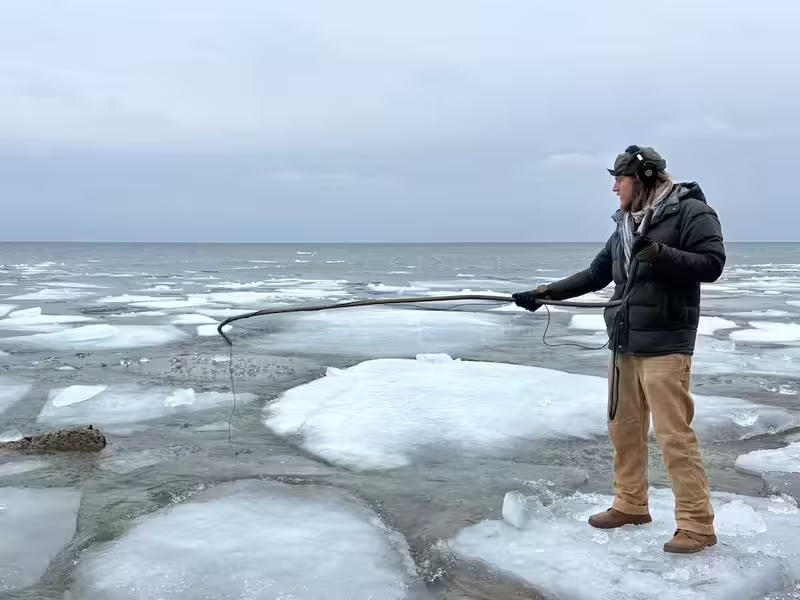
The Sound Maps, Toronto album incoporates recordings of various environmental sounds from Toronto Island. (Photo by Teddy Hunter)
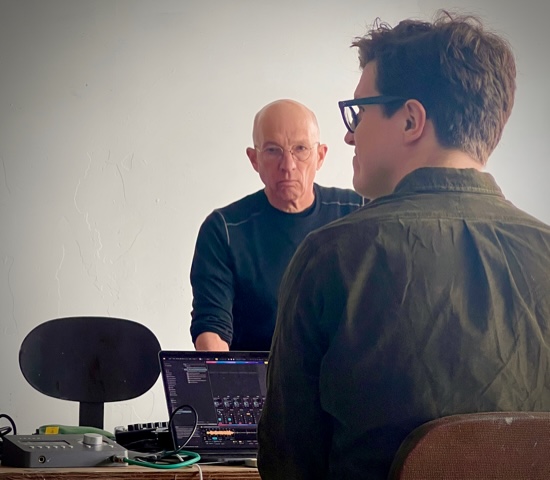
Workshop participants created their own interpretataions of Toronto Island's environmental sounds by fusing them with vocals, electronic manipulations and modular synthesizers. (Photo by JP King)
Sonic landscapes and rapid album-making
The event was the first of such workshops ever held in Canada by Dyski, a U.K. organization that conducts creative retreats for musicians, sound artists, composers and instrument builders.
Varying in backgrounds and experience levels, 16 participants collaborated in the open-ended sonic exploration held at Toronto Island’s Gibraltar Point Centre for the Arts.
This exploration resulted in the creation of (external link) Sound Maps, Toronto (external link) , a music album that combines place-based environmental sounds with human-generated interpretations.
Listeners can hear the sound of crashing ice floes along Lake Ontario, humming ferries in the distance, underwater gurgling, wind whistling through trees, creaking industrial machinery on top of the arts centre — all fused with vocals, electronic manipulations and modular synthesizers.

Music and sound: Children’s earliest experiences
Nolan says this approach to exploring and documenting location, noise and sound is not at all unintuitive. It just doesn’t fit neatly into society’s notion of “proper music”, nor privileges any particular culture.
It does, however, resonate strongly with a child who listens to, explores, and responds to the physical world around it as the child first starts to make sense of things.
“Where did all babies first hear drumming?” Nolan asks. “In the womb, from their mother’s heartbeat.”
“How do babies first experiment with singing? Through crying, as an expression of their emotion.”
“A child might notice the sound of a faucet tap opening and closing, or water flowing and drops hitting the bottom of a cup,” he continues. “It’s the child’s own experience with water that matters.”
“When children are allowed to find out what their intrinsic interests are, they become engaged. Then, you don’t have to ask them to do it; they’ll just do it themselves and learn whatever’s needed to reach their goal.”
Building motivation, inclusion, diveristy
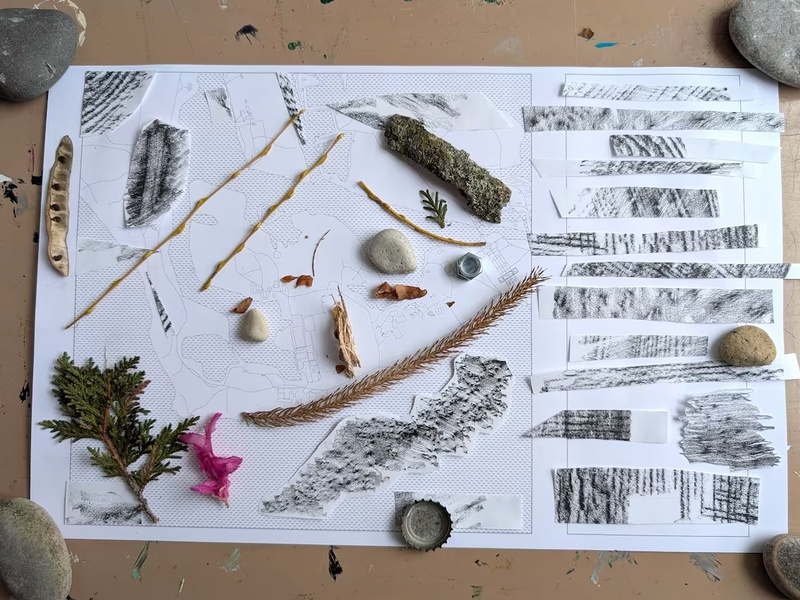
Nolan points out that the Sound Maps workshop also resembles how children explore and learn during early years — often in collaboration with others, and in open-ended ways with no particular agenda or pre-planned outcome. Even the workshops' graphic scores — an open-to-interpretation form of music notation using colour, shapes, drawings, objects instead of notes on a staff — resemble childlike ways of chunking objects into images.
Rather than narrowing children into a specific way of learning, outcomes or normative expectations, Nolan encourages letting children follow their curiosity and find their own intrinsic interest, on their own terms.
“Children can become very engaged with learning — and importantly, they can stick to it if they become intrinsically motivated.”
He remarks that these motivations can energize children to overcome challenges in their learning — moving them to learn new subjects and skills to further their interests.
Ultimately, Nolan says that unconventional learning, teaching, and doing align with the most fundamental ideas underlying equity, diversity and inclusion.
“True EDI cannot be just ‘your EDI’, making space for more of yourself. It’s about making space for diverse voices, supporting people who would otherwise be excluded.”

Find out more about research at TMU’s School of Early Childhood Studies.