“Just checking”: New research probes the impact of unnecessary encounters with child protection agencies among Black families

Child and youth care professor Travonne Edwards has been awarded a Partner Engage Grant from the Social Sciences and Humanities Research Council (SSHRC) for his research on “Parenting Under Threat”. This project brings together Black families, communities, and researchers from across the Greater Toronto Area (GTA), and now across Ontario, to explore how Black families experience the child welfare system and interventions.
The project is being undertaken with community partner One Vision, One Voice (external link) (OVOV), a program funded by Ontario’s Ministry of Children, Community and Social Services (MCCSS) to address the overrepresentation and disparities faced by Black Canadians.
The research is the latest phase of work first started at the University of Toronto’s Youth Wellness Lab on “Mapping Disparities for Black Families”. The originating project was the first to uncover specific policies and practices that contribute to the overrepresentation of Black families in Ontario’s child welfare system.
Professor Edwards is now interrogating a widespread belief among child welfare workers that “just checking” on Black families with “concerns” about child maltreatment is a benign experience.
“Many of these investigations lead nowhere, with allegations often found to be untrue,” says Edwards. “At the same time, many families also don’t receive any services or supports after an investigation.”

Coming into academia from 14 years in the field as a child and youth care practitioner, Edwards now focuses on conducting research that's engaging and accessible to the community.
Edwards grew up in Toronto’s Jane and Finch community where he later moved to Brampton. He spent 10 years as a child and youth worker before becoming a professor at TMU. He’s seen firsthand the very topic he’s now researching.
“The minute that the child welfare system comes around, there’s a fear of apprehension. Families feel threatened by the very system that says they’re trying to help,” he says. “We need to look at finding a better way — one that’s more intentional about when, how and why agencies investigate, and that actually helps and supports Black families.”
After completing focus groups and interviews in the Greater Toronto Area (GTA) with Black mothers, fathers and kin caregivers, Edwards has secured additional funding to expand the project.
In the next phase, data collection will extend beyond the GTA and across Ontario into four new cities (Ottawa, Windsor, London, and Hamilton).
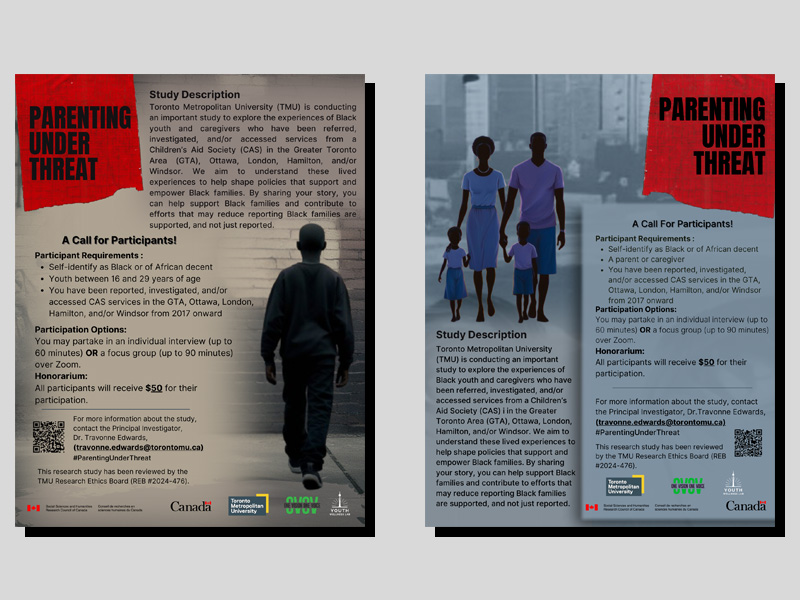
With flyers calling for participation from Black families, caregivers and youth, the study is now expanding across the Greater Toronto Area and into Ottawa, London, Hamilton and Windsor.
Findings from Edwards’ research may have direct implications for practice and policy in Ontario’s child welfare system. It could also help lay a foundation across North America for reframing how child welfare systems interact with Black families and destigmatize encounters with child protection.
Learn more about Professor Edwards' work on his TMU biography page and LinkedIn (external link) profile.

Explore more at TMU's School of Child and Youth Care.