Post-Symposium
The Enhancing Equity in Ontario Elementary Education Symposium was held virtually and in-person at Toronto Metropolitan University, on October 11th and 12th, 2023. Enhancing Equity in Ontario Education is a project led by Dr. Sejal Patel (Early Childhood Studies, Toronto Metropolitan University), in partnership with Dr. Alana Butler from Queen's University, Dr. Adam Davies from University of Guelph, Dr. George Dei from University of Toronto, Dr. Nicholas Ng-A-Fook from University of Ottawa, Dr. Vidya Shah from York University, Dr. Janelle Brady and Dr. Kathryn Underwood from Toronto Metropolian University, Tesa Fiddler from Thunder Bay Catholic District School Board, Max Cooke from EdCan Network, Stephen Hurley from voicEd Radio, Courtnay McFarlane from Regent Park Community Health Centre, and Annie Kidder and Dr. Robin Liu Hopson from People for Education.
The Symposium invited participation by all Ontario district school boards, education stakeholders, and scholars focused on educational equity and human rights (considering Black and Indigenous students, newcomer/international students, racialized students, students living in low socioeconomic neighbourhoods, student who identify as 2SLGBTQIA+, disabled students, and other intersectionalities), to allow for sharing of promising practices around equity-based initiatives, along with providing space to reflect on and commit to greater action in support of enhanced equity for elementary school students.
Symposium Recap
As we begin 2024, we reflect on the inspiring conversations that took place at the Enhancing Equity in Ontario Elementary Education symposium. The symposium provided opportunities to share and consider promising practices regarding enhancing equity for elementary students. We received wonderful feedback about the logistics, moderated discussions, panels, and presentations, and are grateful for all of the dialogue and action that the symposium attendees continue to inspire.
Our heartfelt appreciation goes out to all of the presenters, symposium staff and volunteers. Your collaboration, support, and effort helped to ensure that the symposium ran as smoothly as possible.
Thank you all for your participation in this important event. Stay tuned for podcasts and symposium proceedings, which will be mobilized through this website.
Panel Summary Reports
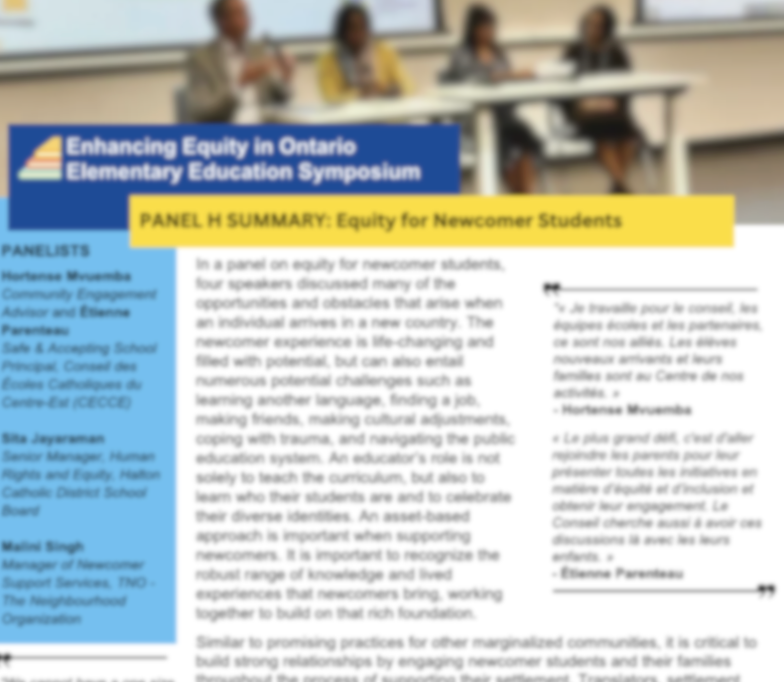
To review a summary report based on each panel presentation from the Enhancing Equity in Ontario Elementary Education Symposium, see the Panel Summary Reports tab.
Symposium Podcasts
Hosted by Stephen Hurley (Executive Director at voicEd Radio) and Dr. Nicholas Ng-A-Fook (Professor and Vice Dean of Graduate Programs, University of Ottawa), who are joined by Kiera Brant-Birioukov (Kanyen’kehà:ka from Kenhtè:ke [Tyendinaga Mohawk Territory], Assistant Professor at York University); Kyrstin Dumont (Band member of the Algonquins of Kitigan Zibi, advocate, educator, and mentor); Stephanie Sanders (Ojibwe Anishinaabekwe from Curve Lake, blended with Spanish and French. M.Ed. student at the University of Ottawa, and an Indigenous Education Learning Partner with the Ottawa Catholic School Board); Marissa Magneson (Cree-Métis artist, photographer, educator, workshop facilitator, PhD student in the Faculty of Education at York University. Elected Youth Representative for the Toronto and York Region Métis Council); Roxanne Gillis (Indigenous M.Ed. student at York University, with a double major in Indigenous studies and Gender and Women’s studies. Indigenous consultant for the City of Toronto, and as a human trafficking survivor, works with the Native Women's Association of Canada); and Melissa Somer (Saulteaux Anishinaabekwe from Little Saskatchewan of the Interlake tribes, Buffalo Clan, blended with Pennsylvanian Dutch. ECE and student in the Masters of Urban Indigenous Education program. Facilitator, educator, and presenter for George Brown College, York University, and the TDSB).
For more information about each speaker and their work, see the Podcasts tab (opens in new window) .
In this podcast, participants shared their perspectives on equity, informed by their Indigenous worldviews and lived experiences. The discussion was guided by the following questions:
- What is equity for each of you in terms of your lived experiences and in terms of your current work in relation to settler colonial K-6 public and private schooling systems in Ontario?
- What are some of the historical and/or ongoing individual, structural, systemic and societal barriers?
- What is some of the professional (un)learning work taking place to support students?

To cite this podcast: Hurley, S. (Host), Ng-A-Fook, N. (Host), Brant-Birioukov, K. (Guest), Dumont, K. (Guest), Gillis, R. (Guest), Magneson, M. (Guest), Sanders, S. (Guest), and Somer, M. (Guest). (2023, April 5). Indigenous perspectives on learning and unlearning (No. 1) [Audio Podcast Episode]. In Educational Equity Podcast. https://www.spreaker.com/episode/educational-equity-indigenous-perspectives-on-learning-unlearning--57934000 (external link)
To access the transcript for this podcast episode, click (PDF file) here.
In this episode of Enhancing Equity in Elementary Education, host Stephen Hurley engages in a powerful Speaker's Corner conversation with Atala Andratis, who is the Equity Lead for the Grand Erie District School Board. They discuss the meaning of and importance of equity in education, the need for dialogue when working to dismantle barriers, and creating inclusive environments for all students. Atala shares her personal experiences as an educator and as someone who is multilingual, emphasizing the need for an asset-based lens when working with diverse student populations.
Some key messages from this episode include:
- Equity in education involves not only providing what everyone needs, but also removing systemic barriers that prevent students from accessing what they require to be successful.
- Building relationships with students through genuine listening and working to understand their diversity, is essential for creating transformative and responsive learning environments.
- Educators hold immense power and responsibility in making decisions that significantly impact student's lives, and they must approach this sacred trust with care and awareness.
To cite this podcast: Hurley, S. (Host) and Andratis, A. (Guest). (2024, August 27). Relationships, dialogue, and listening with Atala Andratis (No. 2) [Audio Podcast Episode]. In Educational Equity Podcast. https://www.spreaker.com/episode/educational-equity-relationships-dialogue-and-listening-with-atala-andratis--57934008 (external link)
To access the transcript for this podcast episode, click (PDF file) here.
In this episode of Enhancing Equity in Elementary Education, host Stephen Hurley engages in an insightful Speaker’s Corner conversation with Ingrid Palmer, the founder of Focus on Ability and the Principal IDEAL Advocate at Realize. Ingrid shares about the importance of educational equity for students with disabilities, including her perspectives on inclusive practices and the role of language in fostering equity. Drawing from her extensive experiences and personal journey, Ingrid offers reflections on creating an educational landscape that is equitable and supportive of all students.
Some key messages from this episode include:
- Language in disability advocacy: The conversation highlights differing perspectives on language around disability.
- Promoting inclusive education: Ingrid discusses strategies for supporting students with disabilities in schools, and advocates for a collective lens and supporting equity to reduce stigma and enhance inclusion.
- Authentic community engagement: Emphasizing the need for community voices in decision-making, Ingrid calls for a shift in how institutions engage with communities, and advocates for community-led initiatives in addressing systemic barriers.
To cite this podcast: Hurley, S. (Host) and Palmer, I. (Guest). (2024, August 30). Community voices and appreciating the whole fruit salad with Ingrid Palmer (No. 3) [Audio Podcast Episode]. In Educational Equity Podcast. https://www.spreaker.com/episode/educational-equity-community-voices-appreciating-the-whole-fruit-salad-with-ingrid-palmer--57934005 (external link)
To access the transcript for this podcast episode, click (PDF file) here (opens in new window) .
In this episode of Enhancing Equity in Elementary Education, Stephen Hurley interviews Karen Murray, a System Superintendent for Equity, Anti-oppression, and Early Years in the Toronto District School Board. Throughout this insightful Speaker’s Corner conversation, Stephen and Karen discuss the importance of equity work in education, Karen's book which provides practical examples from educators, "My Best Idea: Culturally Relevant Pedagogy", and her passion for equity in education. Karen emphasizes the importance of creating learning experiences that affirm and empower all students.
Some key messages from this episode include:
- Equity work needs to be braided into everyday teaching practices, not treated as a separate initiative.
- Educators should honor community and family knowledge by inviting families to share the different ways they engage with subjects at home, and also share their approaches in the classroom with families.
- Culturally Relevant Pedagogy (CRP) is about setting high expectations, demonstrating cultural competence, and developing students' critical consciousness.
To cite this podcast: Hurley, S. (Host) and Murray, K. (Guest). (2024, September 4). Culturally relevant pedagogy with Karen Murray (No. 4) [Audio Podcast Episode]. In Educational Equity Podcast.https://www.spreaker.com/episode/educational-equity-culturally-relevant-pedagogy-with-karen-murray--57934001 (external link)
To access the transcript for this podcast episode, click (PDF file) here (opens in new window) .
In this episode of Enhancing Equity in Elementary Education, host Stephen Hurley engages in a thought-provoking Speaker’s Corner conversation with Pam Agawa, the Human Rights and Equity Lead for Keewatin Patricia District School Board. With her extensive background in education and recent experience working with the provincial government, Pam discusses the complexities and daily challenges of promoting equity and human rights in education, as well as her efforts to support students, families, and staff.
The discussion addresses the shift from research to actionable steps, the importance of community relationships, and innovative approaches to overcoming systemic barriers. This episode provides listeners with practical insights into the strategies being employed to enhance equity in Ontario's elementary education system, highlighting the ongoing efforts to create inclusive and supportive learning environments.
Some key messages from this episode include:
- Action Over Research: Pam emphasizes the need to move from continuous data collection to implementing concrete actions that address educational equity challenges.
- Community and Relationships: Establishing strong, reciprocal relationships within communities is crucial for the success of equity initiatives.
- Innovation and Precedent: Pam advocates for innovation in overcoming systemic barriers. She stresses the importance of collaboration among educational leaders across different districts to set new precedents and push the boundaries of established protocols.
To cite this podcast: Hurley, S. (Host) and Agawa, P. (Guest). (2024, September 4). Human rights and equity initiatives with Pam Agawa (No. 5) [Audio Podcast Episode]. In Educational Equity Podcast. https://www.spreaker.com/episode/educational-equity-human-rights-and-equity-initiatives-with-pam-agawa--57934004 (external link)
To access the transcript for this podcast episode, click (PDF file) here (opens in new window) .
Hosted by Dr. Sejal Patel (Director and Associate Professor, School of Early Childhood Studies), and featuring:
Karen Murray is the System Superintendent for Equity, Anti-Racism, Anti-Oppression in the Toronto District School Board. She most recently was the Centrally Assigned Principal for the newly launched Centre of Excellence for Black Student Achievement which is the first of its kind in public education in North America.
Raquel Walker began teaching in the Toronto District School board in the upper beaches area of Markham and Eglinton at Bliss Carman Senior Public School. Currently she is Coordinating Principal, for African, Black and Afro-Caribbean Student Success with the Peel District School Board and has been an educator in Peel for the past 18 years. She is the proud mother of two children and works every day to improve outcomes not only for students in the Peel region, but also her own children.
Kearie Daniel, with over 20 years of experience, has significantly influenced various sectors as a non-profit leader and communications strategist. She is the co-founder and first Executive Director of Parents of Black Children, a rapidly growing non-profit in Ontario, where she shaped the strategic vision and spearheaded notable growth for the organization.
Charline Grant is the Chief Executive Officer of Parents of Black Children. Charline is a mother of three children and a wife, who led the fight to take on the York Region District School Board to defend and advocate for her children and others against systemic racism. Charline is known for her courageous efforts to improve the York Region District School Board. Her efforts led to provincial changes in education; increased accountability and transparency around finances; and equity training within the York Region District School Board.
For more information about each speaker and their work, see the Podcasts tab.
In this podcast, participants shared their perspectives on equity for Black students. The discussion was guided by the following questions:
- What are some promising approaches to enhancing equity for Black students in elementary schools (ages 4-13)?
- What are some of the challenges that you/your organization has experienced in working to enhance equity for Black students in elementary schools?
- In your view, what actions can be taken by education stakeholders in enhancing equity?
To cite this podcast: Patel, S. (Host), Daniel, K. (Guest), Grant, C. (Guest), Murray, K. (Guest), and Walker, R. (Guest). (2025, July 3). Equity for Black students (No. 6) [Audio Podcast Episode]. In Educational Equity Podcast. https://www.spreaker.com/episode/educational-equity-podcast-equity-for-black-students--66854367 (external link)
To access the transcript for this podcast episode, click (PDF file) here (opens in new window) .
Hosted by Dr. Sejal Patel (Director and Associate Professor, School of Early Childhood Studies), and featuring:
Melissa Jean-Baptiste Vajda - Csc Providence, with the creation of the Human Rights and Equity Advisor (HREA) role, has taken significant steps towards building a more equitable and inclusive school community. Since 2021, initiatives have included a review of policies and procedures through an equity and human rights centered lens, a new training plan for staff and ongoing support and expertise offered system wide, for addressing equity issues and complaints of racism and discrimination, offered through the work of the HREA and the Csc Providence Equity Team.
Micheline Limoges has almost 20 years experience in education. She began her career at the elementary panel with the Conseil scolaire catholique Providence but has taught at the secondary level, become a principal and is now superintendent of education. She currently works with an inspired team in the equity and indigenous education portfolios.
Jacqueline Lawrence is the Equity Advisor for the Ottawa-Carleton District School Board. Her priorities include strategizing with system leaders to identify and address systemic barriers that impact accessible, equitable and inclusive learning and working spaces. She also designs and facilitates experiential learning sessions to transform mindsets and organizational culture. Jacqueline is the former Policy Advisor on Diversity Management at Canada Mortgage and Housing Corporation (CMHC) as well as a former Parliamentary Assistant, Speech Writer, Executive Director of the National Women’s Reference Group on Labour Market Issues and Executive Director of the Multicultural Women’s Association.
Neethan Shan (he/him) is currently the Executive Director of Urban Alliance on Race Relations (UARR) and the Vice Chair of TDSB, representing Scarborough Centre as a Trustee. As the founder of Tamil Heritage Month, he heads the Tamil Heritage Month Council and has been coordinating Tamil Heritage Month activities in Canada for 13 years. He is also the CEO of Tamil Canadian Centre for Civic Action, South Asian Health Alliance and a founding board of director for Tamil Community Centre. Neethan was one of the two first Tamil Canadians to be elected to any public office in 2006. He was the first Tamil Canadian and the first person from a South Asian country to become Toronto City Councillor. He was also the first person of colour and youngest person to become the president of Ontario NDP. He was the youngest Tamil Canadian to be elected to public office. These are amongst the many firsts he has achieved through breaking barriers and paving way for other racialized youth to follow.
For more information about each speaker and their work, see the Podcasts tab.
In this podcast, participants shared their perspectives on equity for students who are Black, Indigenous, and People of Colour (BIPOC). The discussion was guided by the following questions:
- What are some promising approaches to enhancing equity for BIPOC students in elementary schools (ages 4-13)?
- What are some of the challenges that you/your organization has experienced in working to enhance equity for BIPOC students in elementary schools?
- In your view, what actions can be taken by education stakeholders in enhancing equity?
To cite this podcast: Patel, S. (Host), Jean-Baptiste Vajda, M. (Guest), Lawrence, J. (Guest), Limoges, M. (Guest), and Shan, N. (Guest). (2025, July 3). Equity for students who are Black, Indigenous, and People of Colour (BIPOC) (No. 7) [Audio Podcast Episode]. In Educational Equity Podcast. https://www.spreaker.com/episode/educational-equity-podcast-equity-for-students-who-are-black-indigenous-and-people-of-colour--66854369 (external link)
To access the transcript for this podcast episode, click (PDF file) here (opens in new window) .
In this episode of the Educational Equity Podcast, student host Jahiem Thomas is joined by a panel of Black advocates, students and professors who share their lived experiences, insights, and reflections on the meaning and significance of Black Joy in education through a podcast conversation titled, ‘Melanin Magic’.
Panelists include:
- Coleen Dudley – first-generation Guyanese-Jamaican Canadian and recent high school graduate with a bilingual French diploma. She currently works as a Community Animator Assistant with TNG (The Neighbourhood Group).
- Dr. Alana Butler – Dr. Alana Butler is an Associate Professor in the Faculty of Education at Queen’s University and currently teaches in the Bachelor of Education program as well as the Graduate Studies program. Her research interests include the academic achievement of low-socio economic students, race and schooling, equity and inclusion.
- Dr. Janelle Brady – Dr. Janelle Brady (she/her/hers) is an assistant professor in the School of Early Childhood Studies, Faculty of Community Services at Toronto Metropolitan University (TMU). Her community-based research explores Black motherhood through Black feminist frameworks and Black childhoods through community-orientations.
- Holidae Robinson – first-generation Black Canadian and recent graduate of Humber College’s Pre-Health Sciences program. She has received multiple awards for bringing Black joy to her school community.
- Tiasia Robinson – first generation Black Canadian. She will be attending Brock University for a nursing undergrad as she aspires to be a paediatrician.
- With host, Jahiem Thomas - first generation Black Canadian. He will be attending Centennial College to pursue becoming a mechanic.
For more information about each speaker, see the Podcasts tab.
In this podcast, participants shared their perspectives on Black Joy, informed by their lived experiences, educational journeys, and professional work. The discussion was guided by the following questions:
- What does Black Joy mean to you?
- In the face of historical and systemic barriers, how does Black Joy serve as a catalyst for resistance, thriving, and transformational change?
- How does Black Joy shape pedagogical practices that combat anti-Black racism and foster Black student flourishing?
- How can schools move beyond just addressing barriers and actively foster environments where Black students thrive?
- Can you share how your understanding of Black Joy has evolved over time, particularly as you’ve navigated different stages of your educational journey?
Special thanks to Tanitiã Munroe, Research Coordinator, Centre for Excellence for Black Student Achievement and Research & Development, Toronto District School Board, for helping us to bring the wonderful youth participants of this podcast together.
To cite this podcast: Thomas, J. (Host), Brady, J. (Guest), Butler, A. (Guest), Dudley, C. (Guest), Robinson, H. (Guest), and Robinson, T. (Guest). (2025, July 9). Melanin magic: A conversation about Black joy (No. 8) [Audio Podcast Episode]. In Educational Equity Podcast. https://www.spreaker.com/episode/melanin-magic-a-conversation-about-black-joy--66918303 (external link)
To access the transcript for this podcast episode, click (PDF file) here (opens in new window) .
Hosted by Dr. Sejal Patel (Director and Associate Professor, School of Early Childhood Studies), and featuring:
Dr. Maria Karmiris has been working as an elementary school teacher for the Toronto District School Board since 2002. She is also a sessional lecturer at OISE/UT and TMU.
Luke Reid is a human rights lawyer and a social worker who has spent his career serving clients with disabilities. Over the course of his career Luke has represented numerous students with disabilities in litigation with school boards. He has worked at ARCH Disability Law Centre, in private practice, at the Public Guardian and Trustee, and is currently Counsel at the Canadian Human Rights Commission.
Ingrid Palmer is a community amplifier; uplifting the voice, perspective, and inherent value of those pushed most to the margins. As a Black, visually impaired, former foster kid she brings a lifetime of expertise in challenging social and systemic inequity, while fostering connections across diverse identities. Ms. Palmer is a champion for intersectional leadership and her acclaimed storytelling brings the nuanced issues facing equity-denied people from the background to the forefront.
For more information about each speaker, see the Podcasts tab.
In this podcast, participants shared their perspectives on equity for disabled students. The discussion was guided by the following questions:
- What are some promising approaches to enhancing equity for disabled students in elementary schools (ages 4-13)?
- What are some of the challenges that you/your organization has experienced in working to enhance equity for disabled students in elementary schools?
- In your view, what actions can be taken by education stakeholders in enhancing equity?
To cite this podcast: Patel, S. (Host), Karmiris, M. (Guest), Palmer, I. (Guest), and Reid, L. (Guest). (2025, July 15). Equity for disabled students (No. 9) [Audio Podcast Episode]. In Educational Equity Podcast. https://www.spreaker.com/episode/educational-equity-podcast-equity-for-disabled-students--66989026 (external link)
To access the transcript for this podcast episode, click (PDF file) here (opens in new window) .
Hosted by Dr. Sejal Patel (Director and Associate Professor, School of Early Childhood Studies), and featuring:
Ilana David is a social worker with over 15 years experience working with children, youth and families in mental health, 2SLGBTQ+ community services and education settings. Through the Gender and Sexual Diversity team in the TDSB, Ilana provides a range of support and consultation services, with a focus on gender and sexual diversity and gender-based violence prevention.
Malissa Bryan is a passionate equity, diversity, and inclusion specialist and advocate who supports individuals and organizations adopting anti-oppressive practices. In 2020 Malissa became the founder and CEO of the Rainbow Diversity Institute (RDI), a consulting firm that focuses on increasing awareness and support for EDI initiatives and training. Malissa also sits on the University of Guelph’s Presidential Advisory Committee on anti-racism and is a co-lead at the Live, Work, Well Centre in the Anti-Opression Research Lab cluster at the University of Guelph.
Jo Jefferson is a queer/trans writer, parent, and community worker who has been on staff at The 519 since 2018. Jo's background is in popular education for personal and community transformation.
For more information about each speaker, see the Podcasts tab.
In this podcast, participants shared their perspectives on equity for 2SLGBTQIA+ students. The discussion was guided by the following questions:
- What are some promising approaches to enhancing equity for 2SLGBTQIA+ students in elementary schools (ages 4-13)?
- What are some of the challenges that you/your organization has experienced in working to enhance equity for 2SLGBTQIA+ students in elementary schools?
- In your view, what actions can be taken by education stakeholders in enhancing equity?
To cite this podcast: Patel, S. (Host), Bryan, M. (Guest), David, I. (Guest), and Jefferson, J. (Guest). (2025, July 10). Equity for 2SLGTBQIA+ students (No. 10) [Audio Podcast Episode]. In Educational Equity Podcast. https://www.spreaker.com/episode/educational-equity-podcast-equity-for-2slgtbqia-students--66930511 (external link)
To access the transcript for this podcast episode, click (PDF file) here (opens in new window) .
Hosted by Dr. Sejal Patel (Director and Associate Professor, School of Early Childhood Studies), and featuring:
Jodie Williams currently works as the Academic Coordinator for Indigenous Education with the Dufferin Peel Catholic District School Board and is the Past Chair for the First Nations, Métis and Inuit Education Association of Ontario. She has created Anishinaabemowin language programs for Indigenous students to access from across Ontario.
Tesa Fiddler is Anishinaabe, a member of Kitchinuhmaykoosib Inninuwug (Ki-chi-na-may-coo-zeeb In-ni-noo-wug) in Northwestern Ontario. Tesa is currently the Coordinator of Indigenous Education at Thunder Bay Catholic District School Board.
Dr. Nicole Ineese-Nash is an Indigenous researcher, educator, and community worker with over 10 years of experience working with Indigenous children, youth, and communities. Born and raised in Toronto, Nicole is a member of Costance Lake First Nation in Treaty 9 territory and holds relation to the lands, waters, and people along the English and Kabikagomi Rivers. She is passionate about supporting Indigenous self-determination and cultural resurgence, particularly in the context of childhood and youth.
For more information about each speaker and their work, see the Podcasts tab.
In this podcast, participants shared their perspectives on equity for Indigenous students. The discussion was guided by the following questions:
- What are some promising approaches to enhancing equity for Indigenous students in elementary schools (ages 4-13)?
- What are some of the challenges that you/your organization has experienced in working to enhance equity for Indigenous students in elementary schools?
- In your view, what actions can be taken by education stakeholders in enhancing equity?
To cite this podcast: Patel, S. (Host), Fiddler, T. (Guest), Ineese-Nash, N. (Guest), and Williams, J. (Guest). (2025, July 10). Equity for Indigenous students (No. 11) [Audio Podcast Episode]. In Educational Equity Podcast. https://www.spreaker.com/episode/educational-equity-podcast-equity-for-indigenous-students--66930512 (external link)
To access the transcript for this podcast episode, click (PDF file) here (opens in new window) .
Hosted by Dr. Sejal Patel (Director and Associate Professor, School of Early Childhood Studies), and featuring:
Yvonne Kelly is a Social Worker (BSW, MSW) with a focus on community and systems. She is currently a Community and Partnership Developer with the Inclusive School and Community Services Department of the York Region District School Board. She is currently Co-Chair of the Social Planning Council of York Region, Co-Chair of the Affordable Housing Coalition of York Region and past Chair of the Social Planning Network of Ontario from 2019-2024.
Maria Y.M. Yau, founder of EquiFair Research Consulting, was a senior researcher with the Toronto District School Board (TDSB) for over 30 years. Among her many projects, she helped pioneer and conduct three rounds of TDSB’s Student and Parent Census, collecting population-based data on student demographics, in- and out-of-school experiences, and well-being. Maria was also responsible for designing and implementing the annual school review process for TDSB’s Model Schools for Inner Cities (MSIC) program.
Michael Kerr is a community development worker and equity and human rights advocate now serving as Coordinator with Colour of Poverty - Colour of Change – the racial justice education and advocacy network in Ontario. He also taught for 15 years at Seneca College in the Social Service Worker program.
For more information about each speaker and their work, see the Podcasts tab.
In this podcast, participants shared their perspectives on equity for students living in low sociodemographic neighbourhoods. The discussion was guided by the following questions:
- What are some promising approaches to enhancing equity for students living in low sociodemographic neighbourhoods in elementary schools (ages 4-13)?
- What are some of the challenges that you/your organization has experienced in working to enhance equity for students living in low sociodemographic neighbourhoods in elementary schools?
- In your view, what actions can be taken by education stakeholders in enhancing equity?
To cite this podcast: Patel, S. (Host), Kelly, Y. (Guest), Kerr, M. (Guest), and Yau, M. (Guest). (2025, July 10). Equity for students living in low sociodemographic neighbourhoods (No. 12) [Audio Podcast Episode]. In Educational Equity Podcast. https://www.spreaker.com/episode/educational-equity-podcast-equity-for-students-living-in-low-sociodemographic-neighbourhoods--66930514 (external link)
To access the transcript for this podcast episode, click (PDF file) here (opens in new window) .
Hosted by Dr. Sejal Patel (Director and Associate Professor, School of Early Childhood Studies), and featuring:
Elder Joanne Dallaire sits as the Elder & Senior Advisor, Indigenous Relations and Reconciliation, Toronto Metropolitan University; Chair of TMU's Aboriginal Education Council; Co-chair of the Truth and Reconciliation Directive, Co-chair of the 2021 Standing Strong Task Force and currently serves on the Advisory Council for the School of Medicine at Toronto Metropolitan University. She also sits as a member of the Elders Council and Chair of Urban Indigenous Community Advisory Committee for the Toronto District School Board and provides administration and staff support.
Aasiyah Khan has an extensive community development and research background that is grounded in inclusion and anti-oppressive practice principles. In her role as the Director of Education Programs at the National Council of Canadian Muslims (NCCM), Aasiyah has provided training for over 10,000 educators, students, and community members. She is a leading changemaker in anti-Islamophobia programing and advocacy.
Leora Schaefer is the Executive Director of Facing History and Ourselves Canada. She has worked in the field of education for 25 years. With a B.Ed. from the University of Winnipeg, Leora was a classroom teacher at the start of her career. In 2003, she joined the Facing History office in Boston after receiving her M.A. from Brandeis University.
For more information about each speaker and their work, see the Podcasts tab.
In this podcast, participants shared their perspectives on faith-based equity. The discussion was guided by the following questions:
- What are some promising approaches to enhancing faith-based equity for students in elementary schools (ages 4-13)?
- What are some of the challenges that you/your organization has experienced in working to enhance faith-based equity for students in elementary schools?
- In your view, what actions can be taken by education stakeholders in enhancing equity?
To cite this podcast: Patel, S. (Host), Dallaire, J. (Guest), Khan, A. (Guest), and Schaefer, L. (Guest). (2025, July 10). Faith-based equity (No. 13) [Audio Podcast Episode]. In Educational Equity Podcast.https://www.spreaker.com/episode/educational-equity-podcast-faith-based-equity--66930515 (external link)
To access the transcript for this podcast episode, click (PDF file) here (opens in new window) .