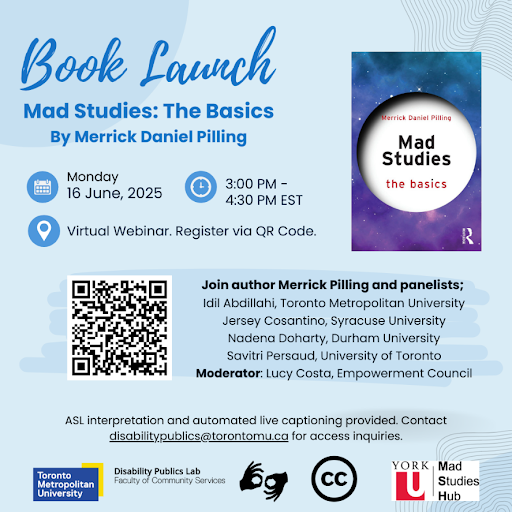
Book Launch – Mad Studies: The Basics by Merrick Daniel Pilling
- Date
- June 16, 2025
- Time
- 3:00 p.m. - 4:30 p.m. ET
- Location
- Zoom
- Open To
- Public
- Contact
- disabilitypublics@torontomu.ca
ASL Translation of event invitation by Deafinitely Digital (external link, opens in new window) with Hayley Hudson (external link, opens in new window) .
Join us for the launch of Mad Studies: The Basics by Merrick Daniel Pilling.
This event is online, free, and open to the public. Registration is required.
Mon June 16 3:00-4:30 PM EST
Speakers:
Merrick Pilling, Toronto Metropolitan University
Idil Abdillahi, Toronto Metropolitan University
Jersey Cosantino, Syracuse University
Nadena Doharty, Durham University
Savitri Persaud, University of Toronto
Moderator: Lucy Costa, Empowerment Council
ASL interpretation and automated captioning provided. Contact disabilitypublics@torontomu.ca for access inquiries.
Sponsored by: Disability Publics Lab (Toronto Metropolitan University) & Mad Studies Hub (York University)
Registration link: https://torontomu.zoom.us/webinar/register/WN_yQYF7wJqQNi8Psi_J-9r9Q#/registration (external link)
Mad Studies: The Basics can be preordered here! (external link, opens in new window)

Merrick Pilling, Toronto Metropolitan University
Merrick Pilling is an Assistant Professor in the School of Disability Studies at Toronto Metropolitan University. He is an interdisciplinary scholar with expertise in Mad Studies and 2SLGBTQ+ experiences of social services and health care. He is the author of Mad Studies: The Basics (2025), Queer and Trans Madness: Struggles for Social Justice (2022) and co-editor of Interrogating Psychiatric Narratives of Madness: Documented Lives (2021).
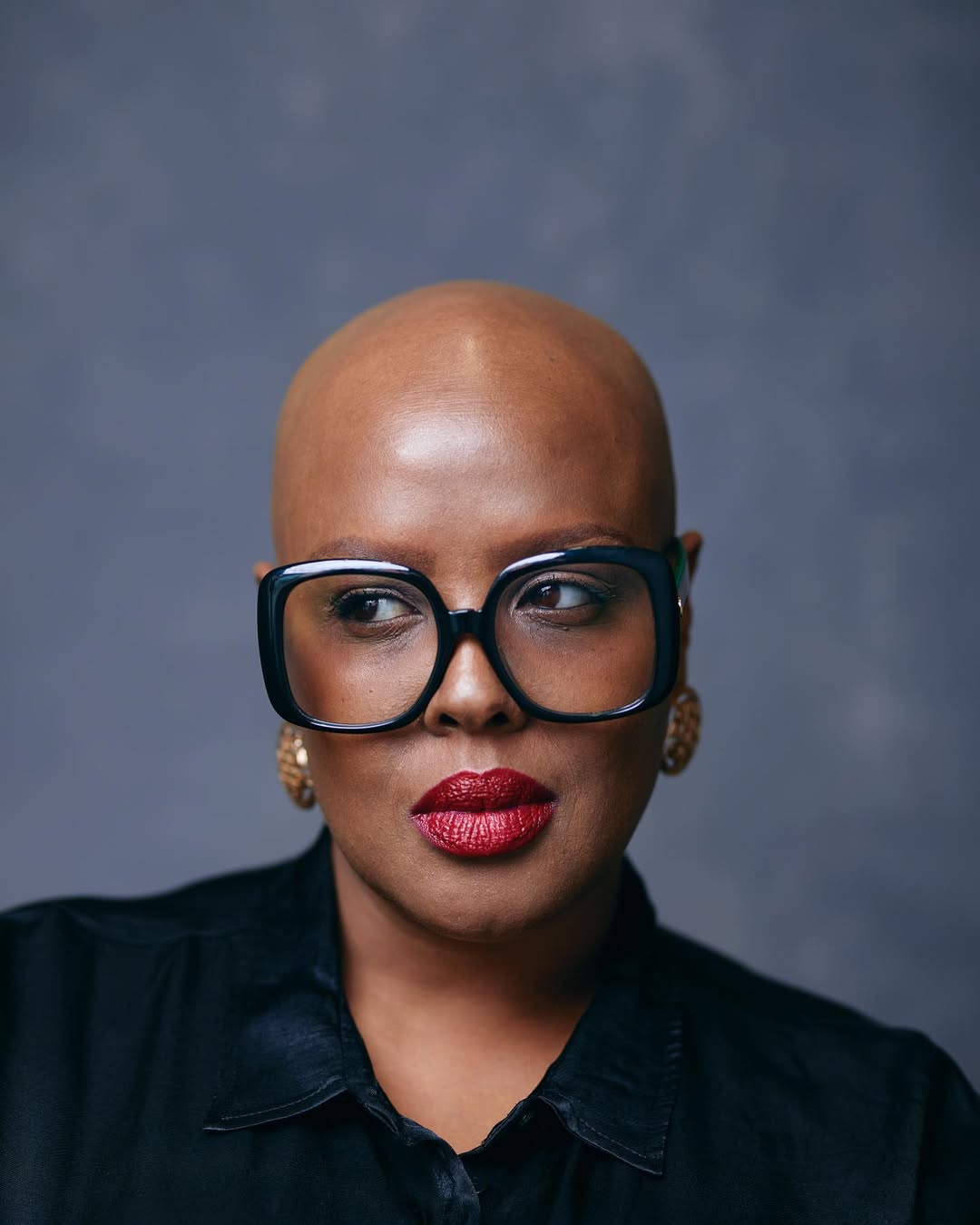
Idil Abdillahi, Toronto Metropolitan University
Dr. Idil Abdillahi is an assistant professor in the School of Disability Studies, cross-appointed to the School of Social Work, and the advisor to the dean on Anti-Black racism at the Faculty of Community Services (2020-2021). Dr. Abdillahi is a critical Black Interdisciplinary scholar, researcher, policy analyst, grassroots organizer, and experienced practitioner across healthcare, institutional, policy, and social service settings. She is the author of Black Women Under State: Surveillance, Poverty & the Violence of Social Assistance (2022), author of Blackened Madness: Medicalization, and Black Everyday Life in Canada (forthcoming), co-author of BlackLife: Post-BLM and The Struggle For Freedom, (2019), and a co-editor of the forthcoming edition of Mad matters: A critical reader in Canadian mad studies.
Dr. Abdillahi is published widely on an array of topics, including mental health, poverty, HiV/AIDS, organizational development, and several other key policy areas at the intersection of BlackLife and state interruption. Most notably, Dr. Abdillahi's cutting-edge research and scholarship on anti-Black Sanism has informed the current debates on fatal police shootings of Black mad-identified peoples. Dr. Abdillahi is attentive to the tensions between data, research, communities, institutions, and monetization. Therefore, Dr. Abdillahi works to challenge the ways that research data about communities experiencing structural oppression—particularly Black communities—are increasingly used to further the oppression of those communities. In effect, these data are used by capital-oriented institutions while simultaneously serving socio-political ‘care’ spaces that range from community-based health care to hospitals and prisons. Dr. Abdillahi’s work integrates an understanding of how these institutions and ‘care’ spaces continue to disproportionately negatively impact Black women/people, leading to their disenfranchisement from ‘public’ services and supports in Tkaronto and beyond.

Jersey Cosantino, Syracuse University
Jersey Cosantino (they/them), a former K-12 educator, is a doctoral candidate in Cultural Foundations of Education at Syracuse University, holding certificates of advanced study in women’s and gender studies and disability studies. A Mad studies and trans studies scholar, Jersey employs Mad trans oral history methodologies that center the experiences and subjectivities of Mad, neurodivergent, trans, and gender non-conforming narrators. Challenging sanism, ableism, and transmisia, their research confronts medical model discourses and the pathologizing gaze of the psychiatric industrial complex. A former co-facilitator for SU’s Intergroup Dialogue Program, they are the co-editor of the International Mad Studies Journal and consulting editor for the Journal of Queer and Trans Studies in Education. Jersey is co-editing the forthcoming International Mad Studies Journal special issues “Maddening the Academy” and "Transing Mad Studies: A MadTrans Studies Special Issue." A former Trans Lifeline call operator, Jersey holds a master’s degree in high school English education (‘14) and a graduate certificate in mindfulness studies (‘19) from Lesley University.
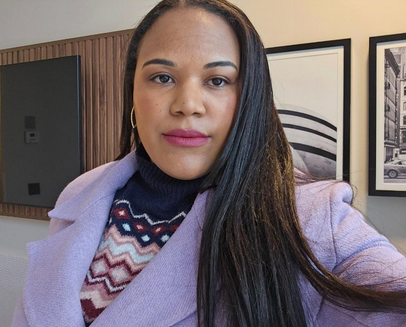
Nadena Doharty, Durham University
Nadena Doharty (she/her) is Associate Professor in Sociology at the University of Durham, UK, with research interests in Black Critical Theory, Mad Studies, and Critical Race Feminism. Her research principally focuses on anti-Black racism in British high school and post-secondary education, and the experiences and outcomes of intersectional Black communities; however, her emerging interests considers the utility of a conceptual pivot towards anti-blackness in exploring Black mental (ill)health.

Savitri Persaud, University of Toronto
Dr. Savitri Persaud is a Postdoctoral Fellow in the Department of Health and Society, and previously at the Dalla Lana School of Public Health, at the University of Toronto. Savitri’s program of research centers i) BIPOC health equity, specifically within Caribbean and Indigenous societies; and ii) postsecondary student mental health. She has worked extensively with communities in Guyana and in the Northern Ontario cities of Thunder Bay, Sudbury, and Sault Ste. Marie. One pillar of her research explores how mental distress is understood and experienced in Guyana and among Caribbean diasporas, specifically analyzing the competing and complementary discourses, aetiologies, and diverse practices employed by Guyanese and Caribbean communities to address and ease distress. Savitri also works closely with an Indigenous-led team on a CIHR-funded project called Walking for Harm Reduction through Street Engagement, which aims to describe and understand Indigenous-specific harm reduction needs in Northern Ontario. Additionally, she is a member of a team-based project analyzing graduate student mental health experiences in Ontario through mad and critical disability studies frameworks. Savitri’s research is rooted in community and scholastic exchanges and coalition building.
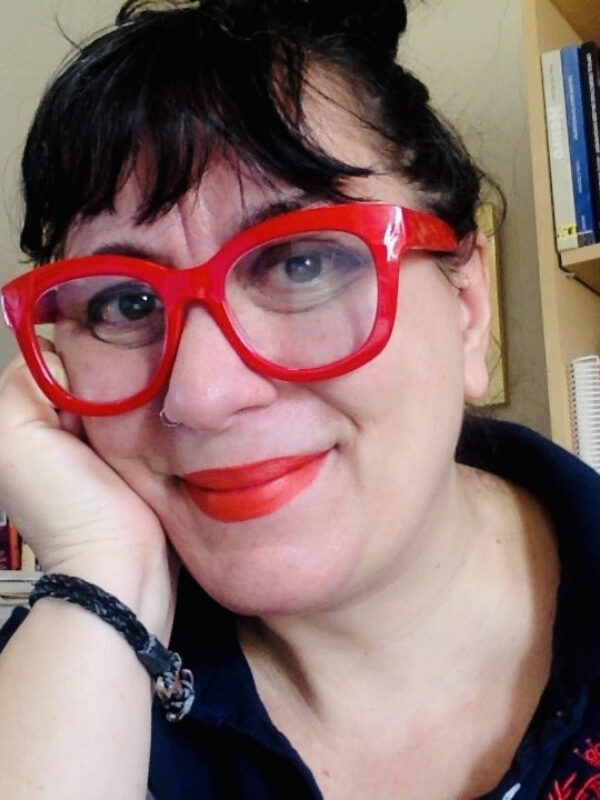
Moderator: Lucy Costa, Empowerment Council
Lucy Costa recently completed her LL.M. at Osgoode Hall Law School. She is the Deputy Executive Director at the Empowerment Council, a rights-based organization in Toronto, Canada, advocating on behalf of mental health service users and survivors. Her work in human rights, Mad Studies, and research includes grassroots projects and mainstream initiatives at both local and provincial levels. She is the co-editor of Madness, Violence, and Power: A Critical Collection (University of Toronto Press) and a special edition of the Journal of Ethics and Mental Health (2019), contributing to critical conversations on inclusion, power, and advocacy.