Canada Research Chair finds new approaches to complex lung conditions
Physics professor Miranda Kirby supports students to take the lead in research
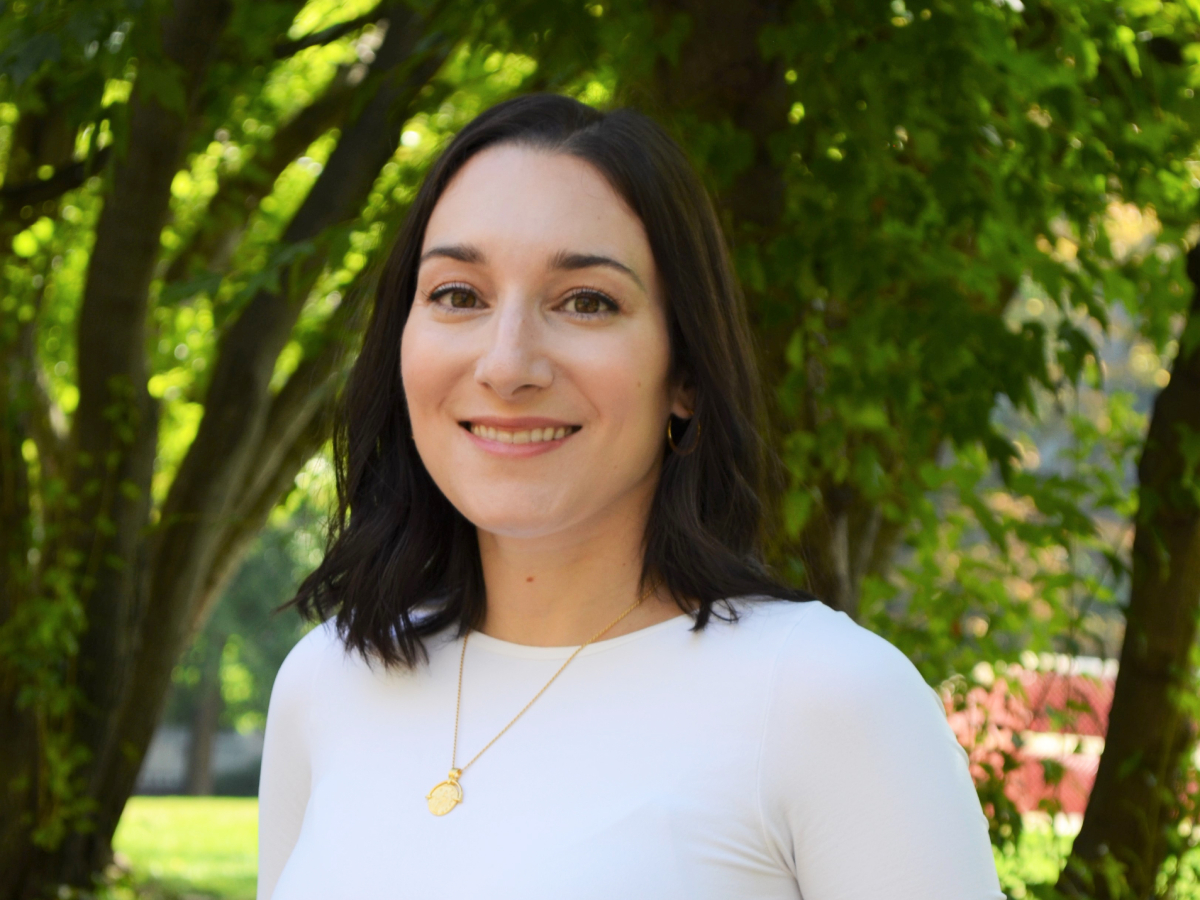
Miranda Kirby, Associate Professor, Physics
Physics professor Miranda Kirby, a Tier II Canada Research Chair in Quantitative Imaging, knows that discoveries often come from refining existing research approaches or looking at problems in new ways. As a researcher in medical imaging with a focus on the lungs, that tactic has brought her not only new insights but recognition such as the Fleischner Memorial Award, a prize honouring young investigators in imaging related to the respiratory system.
The award-winning research offered a twist on past work investigating predictors for Chronic Obstructive Pulmonary Disease (COPD) by separating the data by sex. While many studies had investigated COPD images using machine learning models, Kirby noticed that they lumped all patients together, which left her wondering about whether the results glossed over known differences, such as the fact that women tend to have smaller lungs and airways and even different smoking behaviours. Along with her PhD student, Kalysta Makimoto, who led the project, Kirby re-examined available imaging to discover that taking sex into account did offer more specific findings.
Another ongoing project on COPD aims to interrogate the condition from a different perspective: musculature. Given that scientists believe better muscle mass helps patients cope with disease, Kirby and another PhD student, Danniel Genkin, used deep learning to compile existing 2D images into 3D models that allowed them to investigate the muscles in more detail. “You're not getting a lot of information about the muscle when you're just looking at one slice, so 3D will allow us to answer completely different questions that can't be addressed with the current methods,” says Kirby, who is collaborating with physiologists from McGill University.
A third project’s results were recently published in the leading medical imaging journal Radiology, and featured in the journal’s podcast. Along with Sukhraj Virdee, a former student who received their PhD in 2024, Kirby aimed to better understand how emphysema develops and progresses in clusters in the lungs of smokers. Again, this focus took a different approach. “All the existing ways of measuring emphysema didn't take into account the shape or how compact emphysema was, so we developed a method to quantify the clustered nature of emphysema. We showed that it performed better than existing methods, agreed well with what radiologists see, and predicted the longitudinal progression of emphysema,” says Kirby.
If a common theme here is crediting graduate student co-research, collaboration is a pattern more generally for Kirby. “The lab culture that I try to create is one where the students can be the experts and leaders,” she says, noting that students present their findings and interact with outside collaborators. “I like to sit back and let them become the recognized experts.” Empowerment has led to success, with students landing residencies and postdoctoral positions at leading institutions.
Kirby takes the same approach in her courses. Currently, she teaches PCS 623 Biostatistics and PCS 227 Biophysics, which she enjoys for the same interdisciplinary focus that drew her to imaging work. She regularly brings in research to demonstrate the practical applications of physics concepts. She also includes an oral presentation where students find research papers to analyze and present. “It's a really fun part of the course, where students are learning about some fundamental physics and biophysics, but they're also learning how to explain everyday things. They teach all of us, and I learn a lot. My favourite part of the term is learning from them and what they come up with,” she says.
This research is supported by a Natural Sciences and Engineering Research Council of Canada (NSERC) Discovery Grant, a Canadian Institutes of Health Research (CIHR) Project Grant, the Government of Ontario Early Researcher Awards, and through collaborative funding from the CIHR and National Institutes of Health (NIH).
Kirby started out manually tracing disease in medical images in her supervisor’s lab before there were quantitative approaches available for her research.