Can AI be fair? How a TMU researcher is tackling bias
More people are using AI to search for information, make decisions and connect online. AI can shape what we see and how we react, often without us noticing.
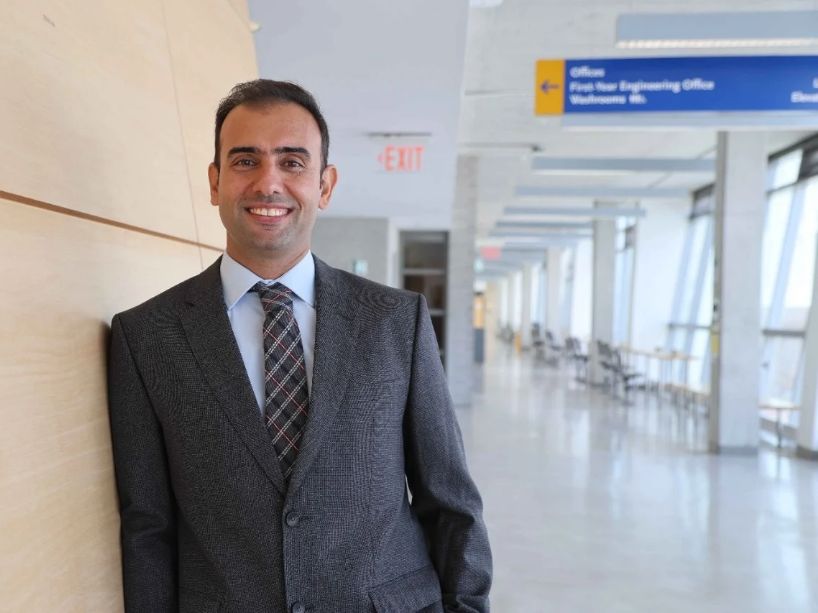
Morteza Zihayat wants people to think more carefully about that. He is a professor in the Department of Electrical Computer and Biomedical Engineering at TMU. His research looks at how bias gets into AI systems, who has control over them and how they can be built to work more fairly for the people using them.
“Accessibility is one angle, equity is another,” Zihayat says. “We’re specifically focusing on the fairness of these systems as they become more and more practical in people’s daily lives.”
In 2025, Zihayat was named Canada Research Chair (Tier II) in Human-Centred Artificial Intelligence. The federal program supports emerging researchers who show promise as future leaders in their fields. It gives them funding and resources to advance their work.
How AI bias shapes what we see
Search results can feel neutral. But the systems behind them still make choices about what shows up first and what gets left out.
Zihayat studies how those choices are made and how to make them fairer. He offers a simple example. Historically, an online search for "nurse" might return mostly images of women. A search for "police officer" might show mostly men.
Bias like this can come from several places: the data used to train a system, the algorithms that process it and even the way researchers measure fairness.
“If the majority of the data we pass to the model is women nurses, the model learns based on what we feed it,” he says.
That means old patterns in the data can show up again in search results, even when they don’t match today’s realities.
In 2025, Zihayat and his co-authors published Understanding and Mitigating Gender Bias in Information Retrieval Systems (external link) . The paper looks at how gender bias enters search systems and how researchers can reduce it.
The takeaway for everyday users is that AI answers and search results aren’t automatically neutral just because a computer produced them.
Why it matters who controls AI
Fairness isn’t only about what an AI system produces. Zihayat also asks who gets to build, train and control these systems in the first place.
His work on decentralized AI draws on blockchain technology, data management and machine learning. Blockchain is built on the idea that no single authority needs to be in charge. Zihayat applies that idea to AI. He looks at how much control a small number of organizations have over tools that people now rely on.
Decentralized AI explores ways to share that control. That could mean pooling computing resources or giving people more say in how AI is built and used.
“It’s about decentralizing the power of building the models, serving the models and maintaining these models,” says Zihayat.
For him, the issue isn’t just how well AI works. It’s also who gets to shape it.
What the Canada Research Chair appointment makes possible
Answering these questions takes more than just new algorithms. It also takes researchers, equipment and teamwork. Zihayat says his Canada Research Chair appointment has already helped with all three.
“I’m very lucky to have this opportunity,” says Zihayat. “I could get better infrastructure based on the funding, I could hire more students, and I could talk to more people, attend more events and get more involved with the right people.”
At TMU’s Human-Centred Machine Intelligence Lab, Zihayat and his students are advancing research on fairness, search and decentralized AI.
For Zihayat, making AI more human-centred also means helping people become better users of it.
“Don’t take the answers for granted,” says Zihayat. “Do your own due diligence when you are using AI systems.”
He compares this moment to the early days of the internet, where people had to learn how to search what sources to trust. AI, he says, calls for a similar kind of literacy.
“The more you learn how such systems help you, the better you can use them.”