From Kabul to convocation: how an Afghan-Canadian writer found her voice through storytelling
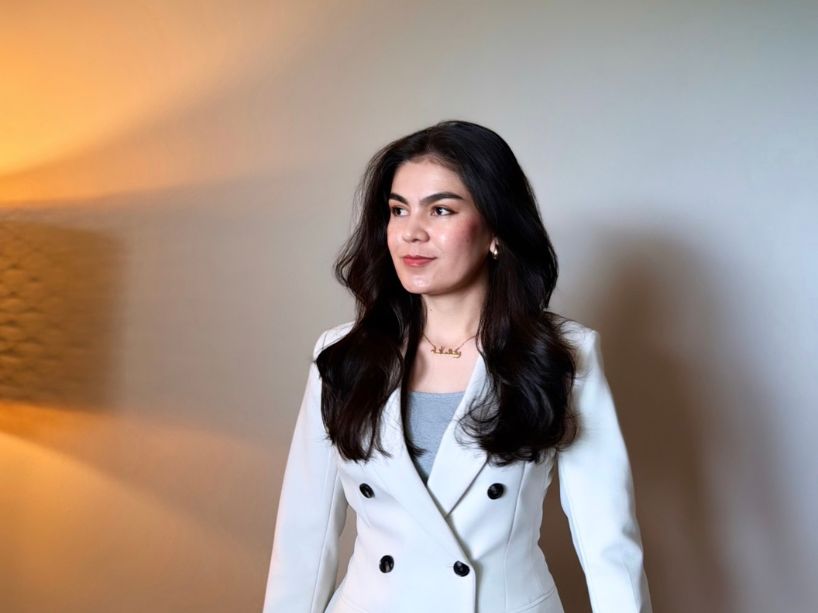
When Rukhshana Ahmadi walks across the convocation stage this June, she’ll carry more than a degree.
She’ll carry the hopes of a mother who never got to go to school. She’ll carry the memory of the life she left behind in Afghanistan, where education was never guaranteed. And she’ll carry the stories of women and girls around the world who are still fighting for the right to learn.
For Ahmadi, who is graduating from TMU’s journalism program, the moment is deeply meaningful.
“Education is everything to me,” she says. “It’s not just my journey. It’s my mom’s journey too, and the journey of so many other people who didn’t have the chance.”
A girl who refused to stop learning
Growing up in Afghanistan, Ahmadi says pursuing an education as a girl was difficult, even before the Taliban returned to power in 2021.
She finished high school in Jaghori, the southern fringe of Hazaristan region in Afghanistan and travelled to Kabul during the winter months to take extra courses in math, physics and science. She was preparing for Afghanistan’s tough university entrance exam, Kankor. She passed, and enrolled in English language and literature at Kabul University.
But she had another dream, too: becoming a pilot.
After writing the entrance exam for Afghanistan’s Civil Aviation Institute, she earned the top score. For a while, she attended aviation classes in the morning and English literature classes in the afternoon.
The day everything changed
In August 2021, Rukhshana was at a conference on women’s education in Kabul when she learned the Taliban had entered the city.
She had been preparing to speak about women’s rights and education. She was dressed in a suit and heels when her mother and aunt called, urging her to come home immediately.
With no transportation available, she walked for hours through Kabul streets to reach her family.
“We worked so hard just to be at that stage of our lives,” she said. “Not just me – every single person.”
She soon fled Afghanistan and came to Canada alone, arriving with only a backpack. In the chaos at the airport, she lost many of her belongings, including important documents.
Starting over in a new country
At first, Ahmadi wasn’t sure she’d ever go back to university. She had already completed three years of study in Afghanistan. In Canada, she would have to start from scratch.
With encouragement from people she met after arriving, Rukhshana applied to TMU’s journalism program. She was accepted.
She still laughs about her first day on campus. Living in Mississauga, she traveled downtown and started asking strangers where TMU was — not yet realizing the university was spread across the city core.
“I remember the first day I came downtown from Mississauga for my orientation. I was walking around asking everyone, ‘Where is TMU?’ only to find out I was already standing on campus," she said. “Looking back, it still makes me laugh as if it happened yesterday, but it’s also one of the memories that has stayed with me the most. I didn’t grow up in the city, and I never had the chance to tour universities beforehand, so everything was unfamiliar. I was navigating a new world entirely on my own, trying to find my place in a life I knew very little about.”
Finding community at TMU
That confusion didn’t last long. Ahmadi quickly found a sense of belonging at TMU.
She found community through classmates, mentors and professors who she says helped her navigate university life in a new country.
“I felt supported. I felt that I had a community,” she says. “No matter what time of day it was, if I needed support, they answered my email.”
That support helped her see journalism as more than a career path. She began to see storytelling as a way to make meaning of her own experiences and to bring attention to people and communities that are too often overlooked.
“My journey at TMU has been amazing,” she said. “TMU helped me understand myself again.”
Using storytelling to give voice to others
While Ahmadi’s reporting is rooted in her own lived experience, it is driven by a commitment to telling other people’s stories. Her work focuses on women’s rights, education, refugees, marginalized communities and the social issues affecting people who have faced discrimination, displacement and exclusion.
“As a storyteller, I recognize the privilege that comes with having a platform,” she said. “I want to use that privilege to help share the stories of people whose stories need to be shared.”
After graduation, she plans to continue writing, launch a podcast, and work on a book that blends fiction and nonfiction, exploring women’s lives under the Taliban regime through a mix of her own experiences.
For now, convocation is a moment to pause and take stock of how far she’s come. From Kabul to Canada, from starting over to finding community and from surviving uncertainty to building a future rooted in purpose.
“I worked hard for everything I wanted to have,” she said. “I believed in this journey, and I’m still walking this path, no matter what happens next.”