TMU partnering with Kids Help Phone on research supporting youth mental health responders
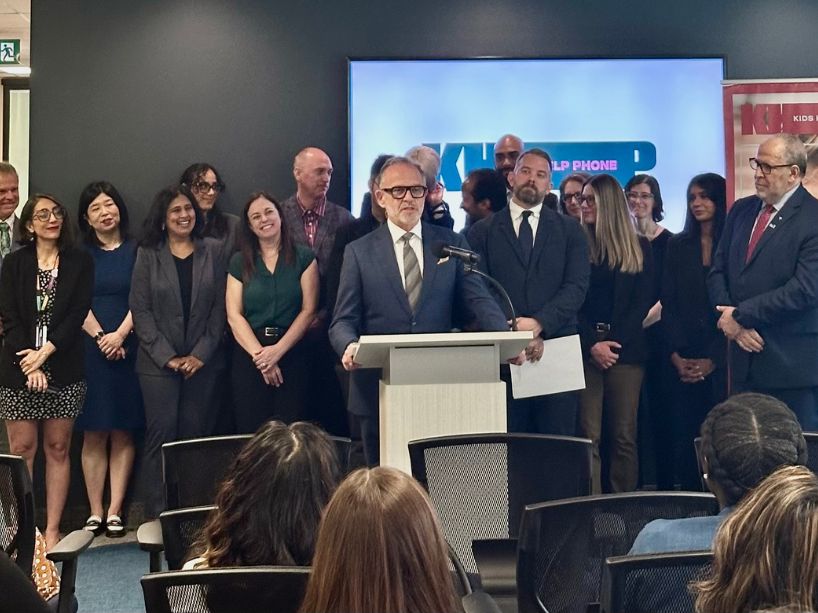
Volunteer crisis responders at Kids Help Phone (KHP) will soon benefit from enhanced training thanks to a groundbreaking AI-powered tool developed through a collaboration between an interdisciplinary team of TMU researchers and KHP team members including researchers and clinical staff. The project is supported by a $3.2 million grant from Wellcome, a U.K.-based charitable foundation.
This is the first major joint project TMU and KHP are undertaking as part of a new, five-year research partnership focused on advancing solutions in child and youth mental health through technology-enabled innovation.
“At TMU, we know that mental health is one of the most pressing challenges facing young people today,” said Mohamed Lachemi, TMU’s president and vice-chancellor.
“We are proud to work with community partners like KHP to find innovative and interdisciplinary solutions, and develop future-focused approaches, to better equip those who are on the frontlines supporting our young people today, and in the future.”
As Canada's only 24/7 e-mental health service, KHP offers free, multilingual and confidential support to young people across the country.
“This five-year partnership formalizes a bridge between our crisis responders and academic research at KHP and TMU to develop responsible AI in mental health, which is more important than ever before given the rapid uptake of these tools by younger generations,” said Rebecca Shields, KHP’s president and chief executive officer.
First major research project between TMU and KHP
The project involves the co-development of a generative AI training simulator tool to better prepare mental health crisis responders for their conversations with youth seeking support.
TMU brings a history of research excellence, innovation and impact in relevant subjects including youth health and well-being, mental health, child and youth care, and novel technology development. TMU researchers also bring strengths in youth-centred technology design, as well as technologically assisted and digital mental health interventions.
“We are excited to announce this impactful project with KHP, funded by Wellcome,” said Steven N. Liss, TMU’s vice-president, research and innovation. “Leading through excellence, this research team is co-developing scalable innovative tools to advance mental health through emerging technology. Ultimately, these tools will enhance training for health providers and contribute to better outcomes for youth seeking mental health support in Canada and around the world.”
Trained on how youth actually talk
The TMU and KHP research team will continue to refine and enhance their AI-enabled training tool. The tool, which was developed using a human- and youth-centric approach, simulates a range of potential scenarios a responder might face in exchanges with youth, such as anxiety or depression. The simulations let trainees practise and refine their skills in a safe, low-risk environment before stepping up to real conversations.
After each practice exchange, the tool gives trainees a graded evaluation of their responses, highlighting where they are performing well and pointing out areas for improvement based on validated KHP quality assurance guidelines.
What sets the training tool apart is the massive dataset it was developed from: more than 750,000 anonymized transcripts of real exchanges between youth in crisis and the KHP responders who connected with them.
That real-world dataset means the tool provides trainees with the kinds of phrases and abbreviations that accurately reflect how young people speak or write in texts, making practice scenarios more relevant and realistic to real-world applications.
The tool’s authenticity has been tested through KHP focus groups with youth and clinical teams, including input from project participant and co-applicant Simran Sodha, a KHP volunteer and Grade 12 student.
“We’re essentially building a flight simulator for crisis responders,” Simran Sodha explained. “When someone my age finally reaches out for help, whether it’s calling from their bedroom at 2:00 a.m. or texting from a school hallway, that moment is everything. At the same time, that means the person on the other end needs to be ready for anything.”
The team behind the research
The TMU research team is led by Naimul Khan, a professor of electrical, computer and biomedical engineering from the Faculty of Engineering and Architectural Science.
“What makes this project distinct is our use of agentic AI systems that can reason and adapt across a conversation rather than simply responding to a single prompt,” Khan said. “In a mental health context, this means the system can follow emotional shifts in real time and respond in ways that reflect how youth crisis conversations actually unfold.”
Khan explained that the training tool’s effectiveness is further amplified by input from the KHP workers who co-developed the current prototype.
“Their counsellors, clinical staff and, most importantly, youth advisors are embedded in the research process, not consulted after the fact,” Khan said. “That frontline knowledge directly shapes how the agentic system learns and behaves.”
Co-applicants from TMU include psychology professor Karen Milligan from the Faculty of Arts, computer science professor Preeti Raman from the Faculty of Science and electrical, computer and biomedical engineering professor Faezeh Ensan. Psychology professors Colleen Carney, Andrew Kim and Ryan Persram are collaborators.
The KHP team is co-led by Lydia Sequeira and Sara Shearkhani. Simran Sodha is a co-applicant. Andréanne Deschamps, KHP’s senior vice-president and head of clinical services and operations, and Alisa Simon, executive vice-president, e-mental health transformation and clinical services, will be actively involved in the research.
“The collaboration between two long-standing and well-known institutions, which bring unique and complementary strengths, creates an opportunity to enhance research and its real-life application to improve youth mental health in Canada,” said Sara Shearkhani, interim executive director, applied research at KHP.
“In their day-to-day work, KHP’s clinical team highlighted the need to strengthen the rigorous training crisis responders already complete. By combining KHP’s expertise with TMU’s research knowledge and experience, we have co-designed a tool that responds to that need.”
Read more about the funding for this project and partnership announcement between TMU and KHP in the press release: $3.2M Funding Secures AI-Powered Future for Youth Mental Health at Kids Help Phone.