Zone ecosystem launches first credit course
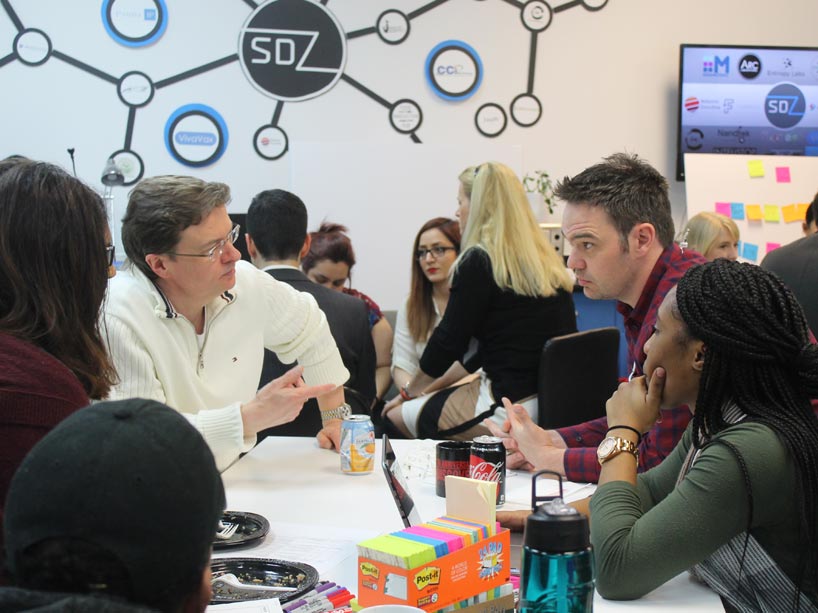
Photo: The Science Discovery Zone’s SCI 888 (Evidence-Based Innovation) will apply the scientific method to business development.
When an aspiring entrepreneur has an idea for a business, the traditional strategy is to pitch it to as many potential investors as possible until one of them says yes. Along the way, as feedback is accumulated, the pitch is adjusted. What if that adjustment period could be addressed in the classroom?
This fall, the Science Discovery Zone will debut the first for-credit undergraduate course from Ryerson’s zone learning ecosystem. Evidence-Based Innovation (SCI 888) combines the rigor of academia with the spirit of Ryerson’s business incubators, with a curriculum that applies the scientific method to business development.
“Every time you pitch an idea, you’re getting feedback on that idea,” says Nathan Battersby, project co-ordinator at the Science Discovery Zone and a 2017 Ryerson biology graduate. “What if every time you took that feedback through a loop and adjusted your idea based on that feedback. The next time you talk to that person, if you’ve incorporated that feedback, you’ve created something that they actually want.
“That’s what we consider evidence-based innovation. It’s essentially applying the scientific method to business development: make a hypothesis, test the hypothesis, and adjust it based on what happens.”
Structured as a series of hackathons, the course puts students together with industry partners and Ryerson mentors. The non-traditional course has no lectures, homework, or exams, with students scheduling their own background research and preparations between sessions. The offbeat approach embodies the zone philosophies of cross-disciplinary networking and experiential learning.
“The course is five hackathons back-to-back,” says Battersby. “Each hackathon takes a period of two weeks, and mixed into that is a lot of professional development and networking with industry partners.
“You’re faced with a problem at the beginning of each segment. You will learn a bit about that problem; you’ll come up with a hypothesis of how you’ll go about solving it; then you’ll talk to people. You’ll talk to a bunch of different people—from the actual industry that are facing the problem, to mentors from the Science Discovery Zone that are very experienced in solving problems. After you receive all that feedback, then you’ll adjust, put it into a final project, and pitch it at the end.”
The new course is part of a big year for the Science Discovery Zone: in October, the zone will move to a larger space at the Centre for Urban Innovation. For Bryan Koivisto, director of the SDZ, both the new space and the course strengthen the zone’s interdisciplinary mandate.
“There will be more connectivity between students and mentors,” says Koivisto. “The Centre for Urban Innovation building is predicated on food, water, and energy as the major research themes, and that’s also where a number of our mentors currently reside. Physically, they’ll be in the same building, and now there will be a lot more engagements and collisions because of it.
“One of the hypotheses we’re always trying to test is: innovation is not about someone having a ‘great idea.’ Great ideas may never be realized. Innovation is about taking an idea and making it great, and to do that you need collisions. You need people interacting and colliding and socializing and saying, ‘Hey—how is your problem going?’ and next thing you realize, ‘Oh, I never ever thought of that…’ “
If you’re interested in taking the course, contact Nathan Battersby directly at nathan.battersby@torontomu.ca.
*
Related stories:
Making science come alive