Residents of Toronto, Montreal and Vancouver support pandemic-time street reallocations
“We’re pleased to see that these street reallocations enjoy broad public uptake and support in Toronto, Montreal and Vancouver. We believe this is a critical juncture, where more people are grasping the need for integrated adoption of active transportation to protect public health."
A new survey from researchers at McGill University, Ryerson University, Simon Fraser University and University of Toronto has found that a high proportion of people in Toronto, Montreal and Vancouver are in favour of the street reallocations made by those cities to help people travel and gather more safely during the COVID-19 pandemic. The survey—the first step in a longer joint research study—concluded that most people would like to see these measures continue beyond the immediate pandemic.
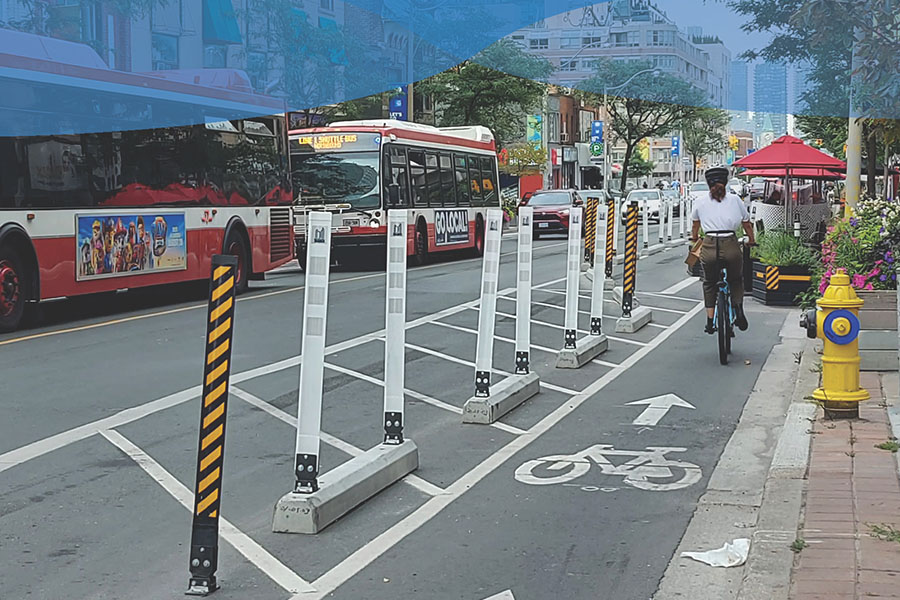
The survey asked 2,078 adults, living in urban and suburban neighbourhoods, about their perception and usage of pandemic-era street reallocations including bicycle lanes/paths, street/lane closures, slow/quiet streets and street cafes/patios in curb lanes and parking spaces. The main goal of the study was to determine the popularity of these measures locally, and their potential for permanent adoption, maintenance and enhancement.
Results suggest that all three cities can count on public support for these measures in the longer term:
- Between 45% and 55% of respondents had used reallocated street projects since March 2020
- 45% to 56% of respondents (depending on type of street reallocation) said the number of projects implemented was “just right,” and 20% to 25% of respondents found the amounts to be “too little”
- 68% of respondents supported or strongly supported future maintenance and enhancements of at least one type of pandemic-time street reallocation, and almost a quarter (23%) were supportive of keeping all types
“We’re pleased to see that these street reallocations enjoy broad public uptake and support in Toronto, Montreal and Vancouver. We believe this is a critical juncture, where more people are grasping the need for integrated adoption of active transportation to protect public health. We hope that going forward, this success will create a new baseline for active transportation planning in Canadian cities” said Dr. Raktim Mitra, Associate Professor at Ryerson University’s School of Urban and Regional Planning.
Next in this study is further research to understand the availability and accessibility of pandemic-time street reallocations across urban neighbourhoods and population groups.